A Bill, an EOB and Three Statements? The Order to Read Them In
A hospital bill, the insurer's explanation of benefits and the itemized statement each answer a different question. Read them in the right order and most disputes resolve themselves.
| Author | Junko Halloran |
|---|---|
| Section | Health |
| Published | |
| Length | 920 words · 4 min |
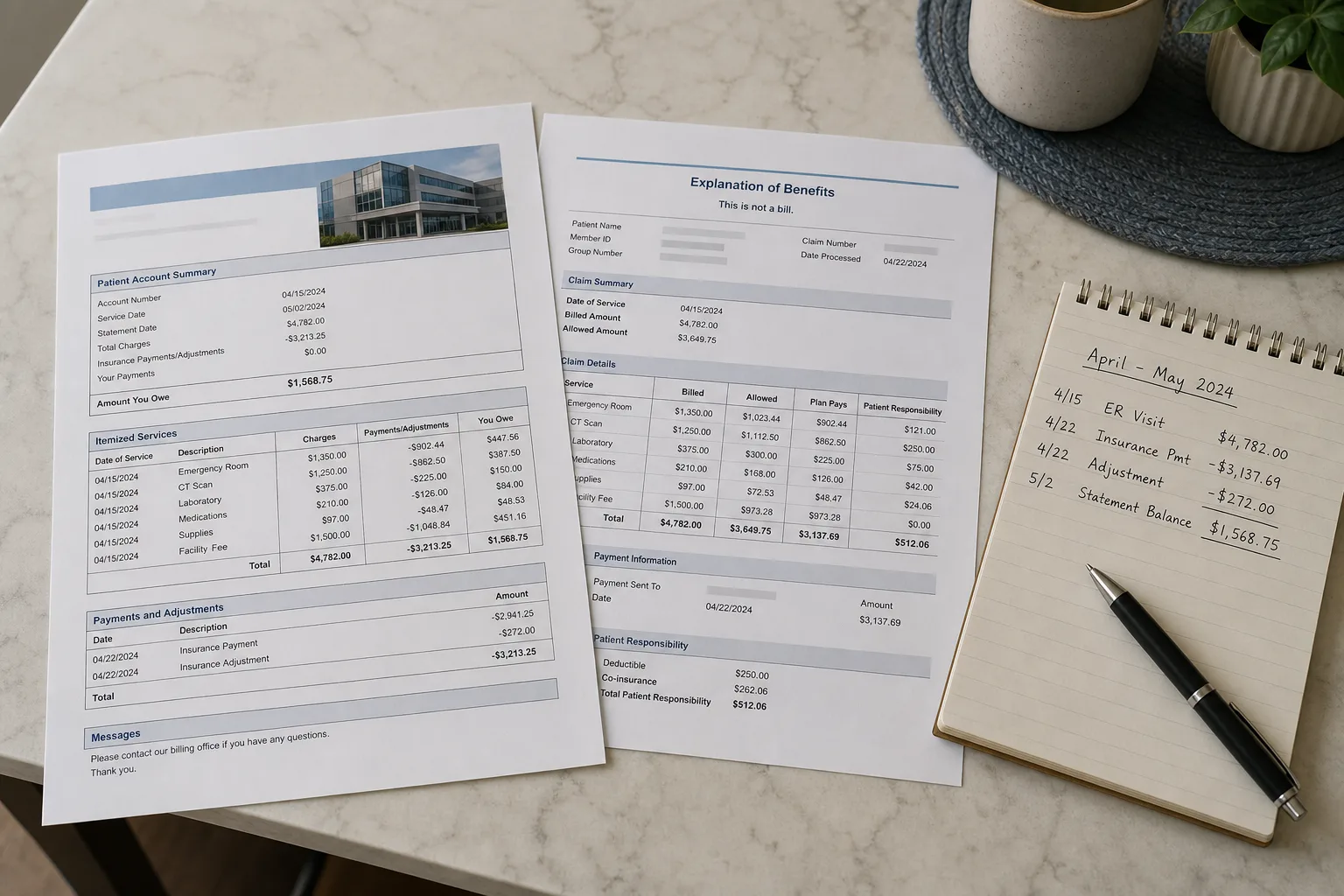
The first piece of paper that arrives after a medical visit is almost never the bill. It is a statement, and a statement is a summary: a date, a provider name, a large number labeled something like "amount due." It exists to tell you a balance, not to explain one. If you pay it on receipt, you are paying a number you have not seen the components of, and in the ordinary week-to-week rhythm of this (an envelope on Tuesday, a portal notification on Friday, a second envelope from a different tax ID two weeks later) that is how most people end up paying more than they owed.
There is a defined order to read these documents in, and it does not start with the one that arrived first.
Start with the explanation of benefits, not the bill
If you have insurance, the explanation of benefits (EOB) from your plan is the controlling document for what you owe. It is not a bill and says so somewhere on it. What it contains is the arithmetic: the amount the provider charged, the amount your plan allowed under its contract, the amount the plan paid, and the amount assigned to you as deductible, copay, or coinsurance.
The gap between charged and allowed is the part people find hardest to accept as real. Take an illustrative emergency visit. Facility charges of $3,400, a CT scan at $2,100, and a separate radiologist reading at $340 come to $5,840 in charges. If the plan's contracted allowed amount for that bundle is $1,850, and the plan pays $1,480 after a $370 coinsurance share, then your number is $370. The $3,990 difference between charges and allowed amount is a contractual write-off. An in-network provider agreed to it and cannot bill you for it.
So the practical test is a subtraction, not a judgment. Find "patient responsibility" on the EOB. Find the balance on the provider's statement. If they match, you are looking at a bill that is doing what it should. If the statement is higher, you have a specific question to ask rather than a vague sense that something is wrong.
Request the itemized statement, and know what its codes are
The summary statement will not show you what was done. The itemized statement will, and you are entitled to ask for it. Facilities generally produce it within a couple of weeks of a request, sometimes same-day through the billing office.
Three code systems appear on it:
- CPT and HCPCS codes (five characters) describe procedures, visits, and services. An office visit, an injection, a suture repair.
- Revenue codes (four digits, hospital bills only) describe the department that generated the charge: pharmacy, laboratory, radiology, operating room.
- ICD-10 diagnosis codes describe why the service was provided. These drive whether a service is covered.
You are not auditing clinical judgment. You are checking three things a layperson can genuinely check: whether the dates match the days you were actually there, whether the quantities are plausible, and whether anything appears twice. Duplicated lines and quantity errors are the ordinary failures. A single unit of a drug billed as ten units is arithmetic, not medicine, and it is visible on the page.
The protections that sit behind the numbers
The No Surprises Act changed what can land on a bill in the situations where patients have the least ability to shop: emergency care, and out-of-network clinicians working at in-network facilities, such as the anesthesiologist or the radiologist you never chose. In those situations your cost sharing is generally calculated as though the provider were in network, and the balance beyond that is settled between the provider and the plan rather than sent to you. The Centers for Medicare and Medicaid Services oversees the federal side of these rules, including the notice and consent forms a provider must use if it wants to bill outside them.
If you are uninsured or paying cash, you can ask for a good faith estimate before scheduled care. Providers are expected to give you one, in writing, covering the expected charges for the item or service and the ones reasonably bundled with it. Keep it. It is the document you hold the final bill against.
One number cannot be known in advance: what the actual final total will be when the care itself changes mid-course. An estimate for a procedure does not survive an unexpected second day of observation, and no one can tell you the figure before the care happens. What you can pin down beforehand is the price of the planned work and whether every clinician involved is in network.
The week-to-week sequence that resolves most disputes
Dispute in writing, through the portal message thread if there is one, so the record is timestamped. Then hold the sequence: identify the specific line and the specific dollar amount, quote the EOB's patient responsibility figure, and ask the billing office to reconcile the two. Ask for the account to be flagged as under review, which generally pauses collections activity while it is open. Note the date of every call and the name of the person you spoke to. That log is worth more later than any argument you make.
Then ask about financial assistance and interest-free payment plans in the same conversation, because nonprofit hospitals maintain written assistance policies and eligibility often extends further up the income scale than people assume.
A bill that survives all of this is almost certainly correct, and you will know why. That is a different position from paying and hoping.
About the author
Junko covers what work costs and why two quotes for the same job differ.