Can't Read the Bill From the Hospital? The Four Documents That Make It Line by Line
The summary statement a hospital mails you is not the bill. Here is the paperwork that turns a lump sum into checkable lines, and where a household should stop.
| Author | Corinne Adeyemi |
|---|---|
| Section | Health |
| Published | |
| Length | 1,315 words · 6 min |
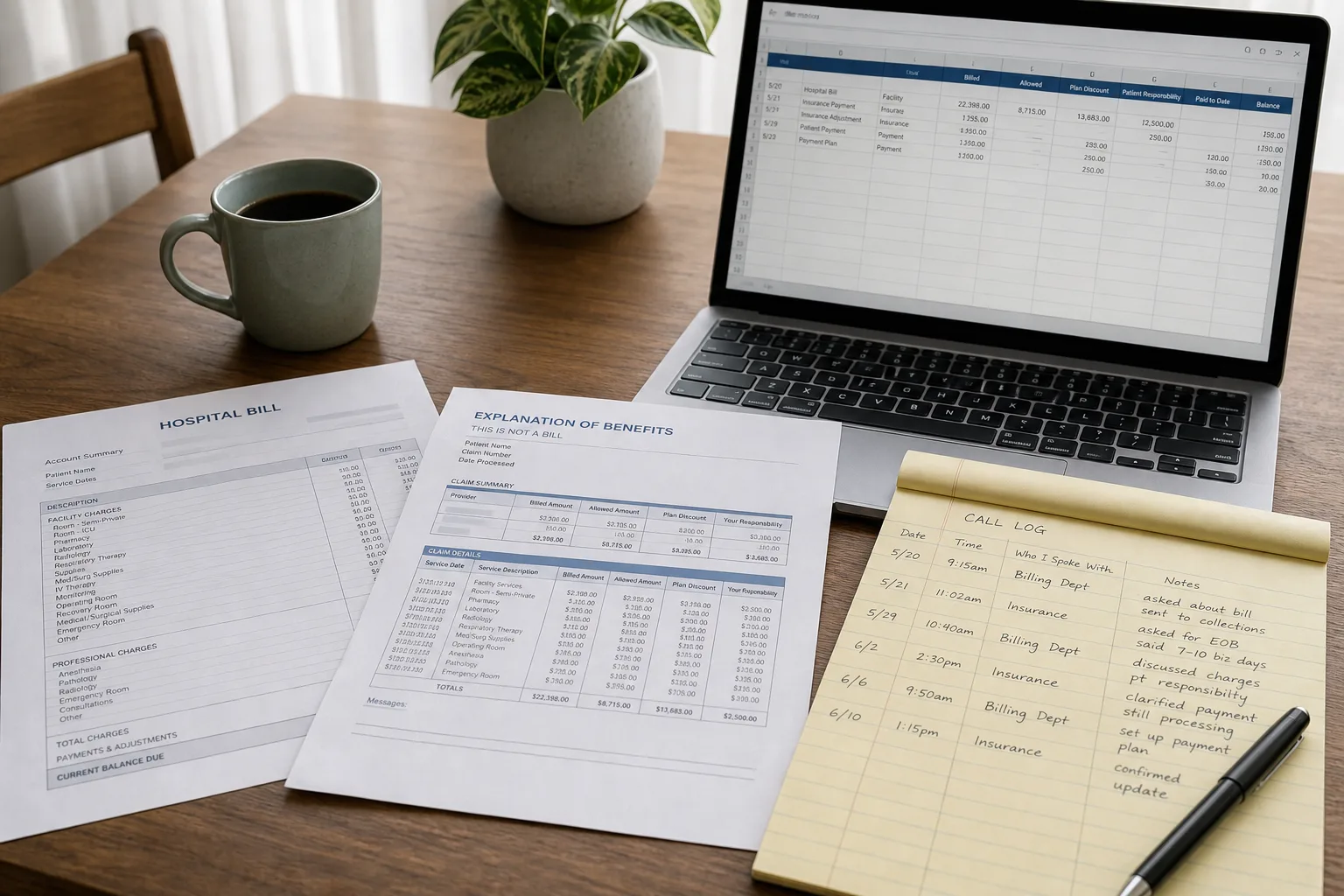
The piece of paper that arrives in the mail after a clinic visit or a hospital stay is usually not a bill in any useful sense. It is a statement of account: a date, a department, a balance, and a payment stub. There is nothing on it you can check, because there is nothing on it that describes what happened. Most people pay it or panic at it. The third option is to spend an hour assembling four documents that turn that single number into forty or fifty lines you can read one at a time, and then to work through them in order. The hour is worth it whether the balance is two hundred dollars or twenty thousand, because the errors that show up most often are not subtle ones. They are duplicated lines, wrong quantities, and charges for a date you were not there.
The itemized bill is a separate document, and you have to ask for it
Call the number on the statement and ask for an itemized bill, sometimes called a detailed bill or an itemized statement, for the specific dates of service. Say those words. If you ask for "a breakdown" you will often get a second copy of the same summary with the departments listed. What you want is the document that shows each charge as its own line with a code, a description, a quantity, a unit price, and a date. For a hospital, that detail sits behind a claim form called the UB-04. For a physician's office or an outpatient clinic, it sits behind the CMS-1500. You do not need to see the claim form itself, though you can request a copy, and it is worth doing if the itemized bill still looks compressed.
Ask for it in writing as well as by phone, using the billing office's patient portal message function or email if one exists, because that creates a dated record of the request. Note the date you asked, the name of the person you spoke to, and the reference number if they give you one. Ask, in the same call, whether requesting the itemized bill pauses collection activity on the account, and what the current due date is. Some systems will hold the account while a review is open. You want that in writing too.
The explanation of benefits belongs next to the bill, not in a drawer
If you have insurance, the second document is the explanation of benefits, the EOB, which your plan sends after it processes the claim. It is not a bill and it says so, which is why people file it without reading it. Its value is that it holds four numbers the provider's statement does not: the amount billed, the amount your plan allowed under its contract with that provider, the amount the plan paid, and the amount it says is your responsibility. The gap between billed and allowed is a contractual adjustment. It is not a discount you negotiated and not a charity. It is the price the provider agreed to accept for in-network work, and it should already be subtracted before you are asked for anything.
Lay the EOB beside the itemized bill and compare the patient responsibility figure on the EOB with the balance on the statement. If the statement asks for more, that is your first question, and it is a specific one: which lines account for the difference. Check the date of service on both, because claims for a single visit are often split across several EOBs when different departments bill separately. Anesthesia, radiology reads, and pathology frequently arrive as their own claims from their own entities, weeks apart.
The codes are searchable, and three families cover almost everything
Each line on an itemized bill carries a code. There are three families you will see in a household context. CPT codes are five digits and describe procedures and services, from an office visit to a joint injection. HCPCS codes cover supplies, drugs, and equipment that CPT does not. Revenue codes are four digits, hospital-specific, and describe the department or cost center the charge came from: the operating room, the pharmacy, the recovery area. A CPT code may also carry a two-character modifier, which changes its meaning, and every line has a units column.
You can look these up. Type the code into a search engine with the word "CPT" or "HCPCS" and you will get a plain description from a professional or payer source. You are not trying to judge whether the code was clinically correct. You are checking four mechanical things, and you can do all four at a kitchen table:
- Date. Was the charge dated to a day you were actually there or admitted?
- Duplication. Does the same code appear twice on the same date with no explanation?
- Units. Does the quantity match reality? Two doses billed as twenty is a keystroke, and it happens.
- Recognition. Does the description correspond to something that plausibly occurred? A charge for a room on the day you were discharged before noon, or for a device you never received, is a question.
The Centers for Medicare and Medicaid Services oversees the coding and price transparency framework that hospitals and clinics bill within, which is why these codes are standardized across the country rather than invented by each facility. That standardization is what makes a household lookup possible at all.
Your own file is the fourth document, and you build it
Start a single folder, paper or digital, per episode of care rather than per bill. Into it go: the itemized bill, every EOB, the good faith estimate if you were uninsured or self-paying and received one before a scheduled service, your discharge paperwork, and a running call log. The call log matters more than people expect. One page, four columns: date, who you spoke to, what they said, what they promised and by when. Reference numbers go here.
Then build a short spreadsheet with one row per billed line and columns for code, description, date, units, charge, allowed amount, and a status column with three values: verified, question, unresolved. Most lines resolve to verified in a few minutes. What is left is your actual worklist, and it is usually short enough to fit in one phone call. Request your medical records for the dates in question if a line stays unresolved, because the record is the evidence that supports or contradicts the charge.
Where a household should stop and hand it off
Do the arithmetic, the date matching, the duplicate hunt, and the units check yourself. Those are clerical and you are as qualified as anyone. Also do the financial assistance application yourself if the hospital is nonprofit, because it has a written policy and an application form, and eligibility often extends further up the income scale than people assume. Ask for it by name.
Hand off three things. The first is any dispute that turns on whether a service was medically necessary or correctly coded for the clinical facts, which requires the record and a trained reader. The second is a formal appeal to your insurer, which has a filing deadline printed on the EOB and rules about what must be included; a patient advocate, the hospital's own financial counselor, or your state's department of insurance consumer division can tell you the form the appeal has to take. The third is an account already sent to collections, where the questions become legal as well as clerical. Getting the itemized bill and the file in order first is what makes any of those handoffs quick, because the person you hand it to starts with the work already done.
Set a calendar reminder for ten days after any call in which someone promised to review something. That single reminder, more than any other habit, is what keeps an open question from quietly becoming a due balance.
About the author
Corinne writes for readers doing some of the work themselves.