Flat Marker, Upright Stone or a Niche Plaque? What the Cemetery Decides Before You Do
A first-time comparison of memorial types, the cemetery rules and federal protections that govern them, and which choices close permanently once work begins.
| Author | Wesley Tarbox |
|---|---|
| Section | Family |
| Published | |
| Length | 892 words · 4 min |
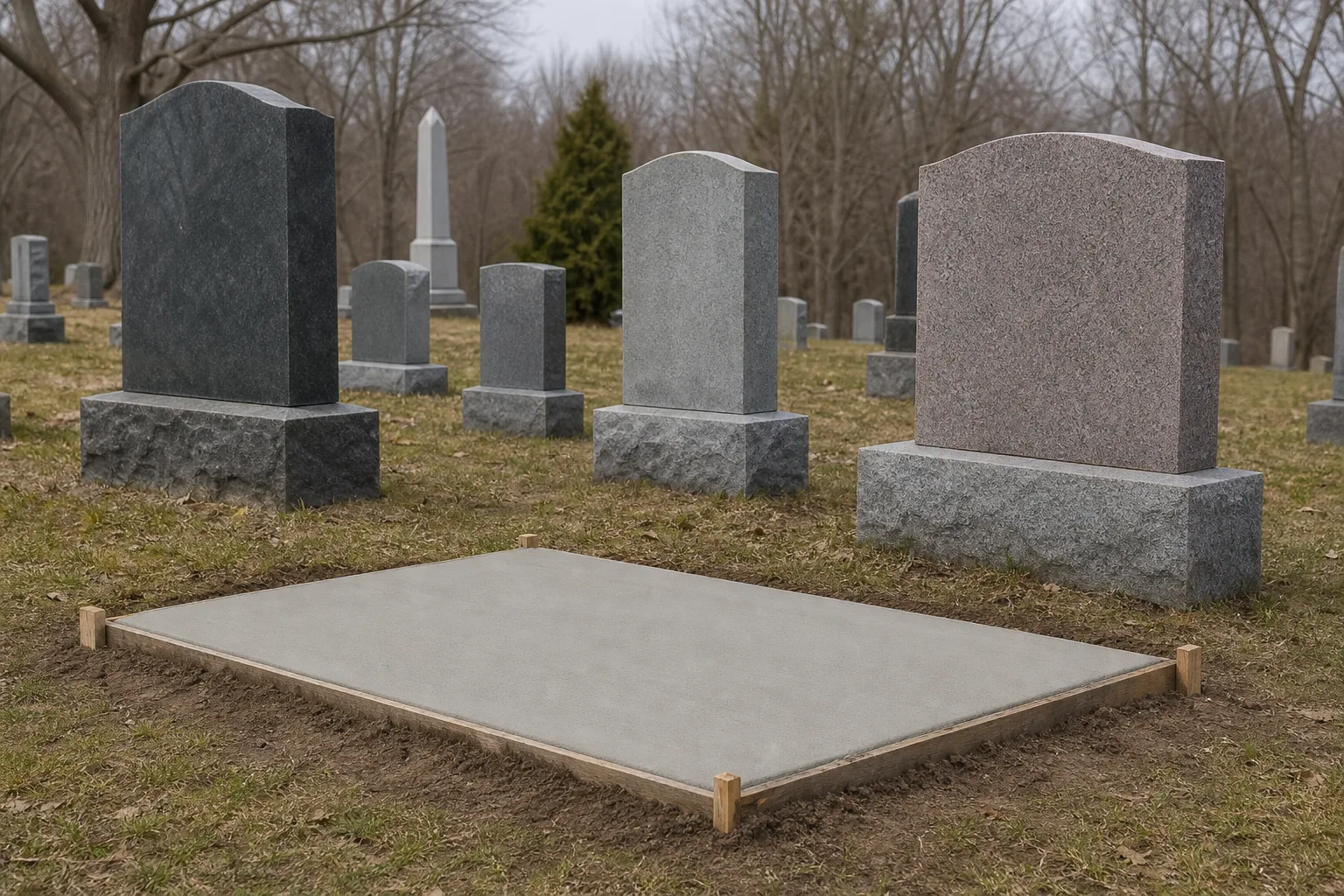
The first thing most families discover, usually a week or two after the service, is that the choice of memorial is not really theirs alone. It is shared with the cemetery. Before anyone looks at granite colors or thinks about wording, the section of ground or the wall of niches where the burial or interment took place has already narrowed the field, sometimes to a single permitted format. Understanding that order of operations is what separates a straightforward purchase from four months of revisions, and it matters more in some months than others.
The cemetery's rules come first, and they are written down
Every established cemetery operates under a set of rules and regulations, and every section within it may be governed differently. A memorial park section typically permits only flat bronze or granite markers set level with the turf, because the maintenance model depends on mowers passing over uninterrupted ground. A monument section permits upright stones, but usually within a maximum height and width, and often with a required base thickness. Columbarium niches accept a face plaque with a fixed character count, because the plate is a standardized size cut to the niche opening. Lawn crypts, cremation gardens and older family plots each carry their own terms.
Ask for the written regulations before you shop. Not a verbal summary at the counter, the document. It will tell you permitted dimensions, whether a concrete foundation is required and who is allowed to pour it, whether vases must be flush or may protrude, whether the cemetery charges a setting fee or an inspection fee, and whether it restricts installation to its own crews. A first-time buyer who reads that document has effectively finished the hardest part of the decision, because the remaining options are all things that can be compared on price and appearance.
Comparing the four common formats on cost, upkeep and flexibility
Prices vary enormously by region and by stone, so treat the following as relative rather than absolute. The pattern holds even when the dollar figures do not.
| Format | Typical constraint | Upkeep | Room to change later |
|---|---|---|---|
| Flat granite or bronze marker | Section rules; usually a fixed size grid | Needs edging and clearing as turf grows over | Limited surface; a second name is often the last addition possible |
| Upright monument | Height, width and base minimums; foundation required | Cleaning; occasional resetting if the base settles | Best case. Reverse face and second panel often available |
| Niche plaque | Fixed plate size and character count | Minimal, indoors or sheltered | Very little. The plate is usually replaced, not amended |
| Bench or garden feature | Approval by cemetery on a case-by-case basis | Highest. Seating weathers and hardware loosens | Moderate, depending on the design |
The column that first-time buyers underweight is the last one. A flat marker sized for one name leaves nowhere to put a spouse's name in twenty years without lifting and replacing the whole stone. An upright monument with a blank reverse face is the format that keeps the most doors open, which is why families who expect a second interment in the same plot tend to end up there even when the first quote looked higher.
The federal protection that applies, and the one that does not
The Federal Trade Commission is responsible for the Funeral Rule, which governs how funeral providers must present and price what they sell. Its core effects are worth knowing precisely. A funeral home must give you an itemized price list, must let you buy only the goods and services you want, and cannot refuse to handle a casket or urn you bought elsewhere or charge you a fee for doing so. That is a real protection, and it is the reason you can price a monument independently.
What the rule does not do is bind cemeteries as such, and it does not override a cemetery's authority over what stands on its grounds. So a cemetery may legitimately require that a foundation meet its specification, or that installation be performed by its staff, and it may charge for that work. What it should be willing to do is state those charges in writing before you commission anything. Get the setting fee and the foundation cost quoted alongside the monument price, so you are comparing two complete numbers rather than one stone against another.
What the calendar does to the timeline
Granite is quarried, cut and shipped, and lettering is done on a shop schedule. Orders placed in late winter arrive into the busiest installation window of the year, because in most of the country foundations cannot be poured while the ground is frozen and everything waits for thaw. Families hoping to see a stone in place by Memorial Day generally need to have signed off on the proof by late winter, not in April. Fall is the quieter season for shops and often the easier one for scheduling a setting, with the caveat that a late order can be pushed past the first hard freeze into spring.
Three things close permanently once work begins: the inscription as approved on the proof, the stone and finish once cutting starts, and the foundation footprint once it is poured. Everything else, vases, an eventual second panel, cleaning, can be revisited. Knowing which three they are lets a first-time buyer spend their attention where it changes the outcome and sign the rest without worry.
About the author
Wesley writes about timing, and why the same job costs differently in March.