He Left in February and the Calendar Set His First-Year Costs More Than His Rates Did
A service tech went out on his own at the end of winter. What his first year actually cost, what drove each line, and which costs have moved recently.
| Author | Wesley Tarbox |
|---|---|
| Section | Work |
| Published | |
| Length | 1,026 words · 4 min |
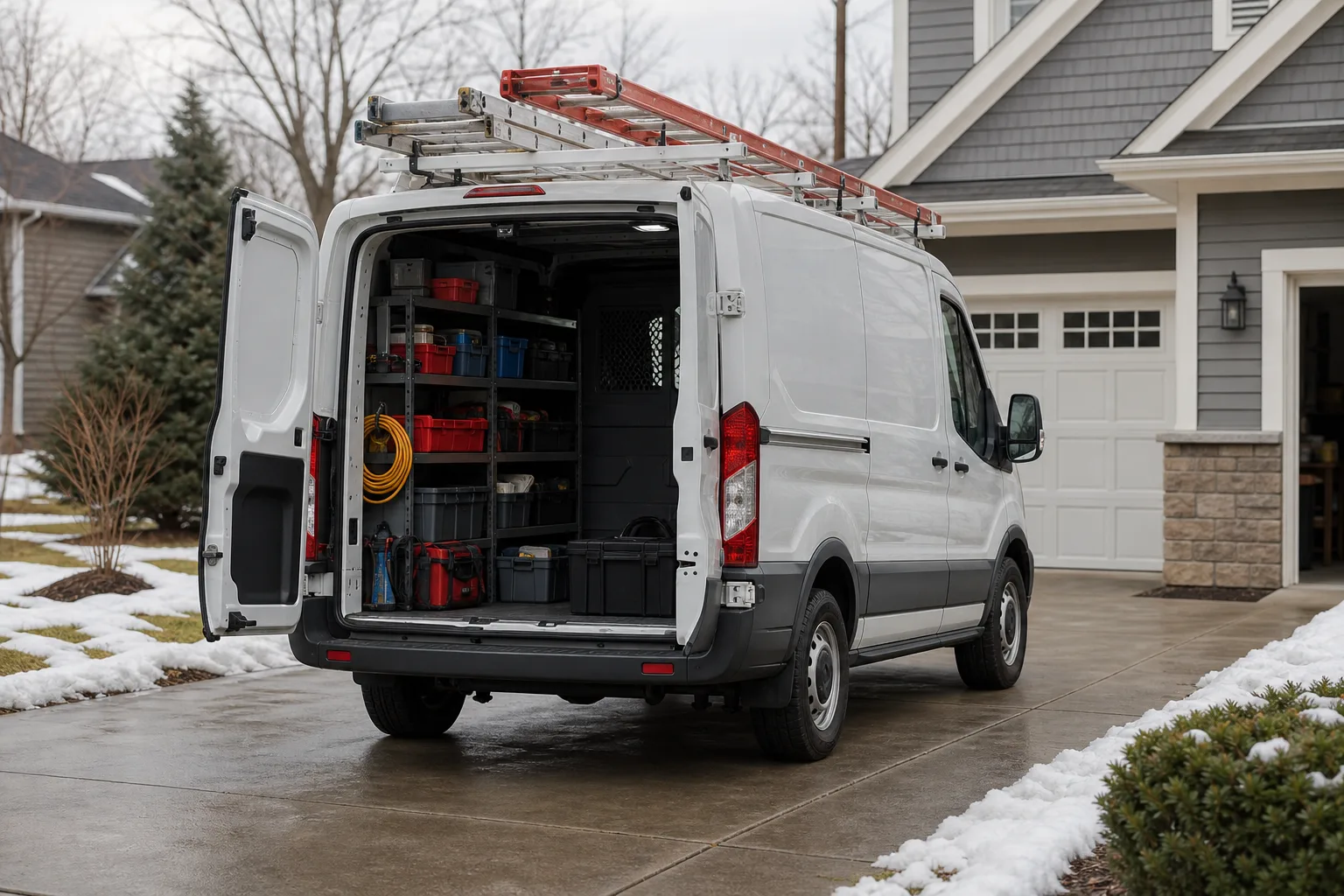
A residential HVAC service tech in the upper Midwest handed in his notice in the second week of February. He had eleven years on other people's trucks, a clean license, a list of about forty customers who asked for him by name, and a savings cushion he had built over two years specifically for this. He thought the hard part would be finding work. The hard part turned out to be that nearly every cost of going out on his own arrived in the first ninety days, while the work that pays for those costs arrives on a schedule set by the weather. That gap, not his hourly rate, is what defined his first year.
His situation is worth walking through in order, because the shape of it repeats across trades. A roofer, a landscaper, a pool tech and an HVAC tech all face the same structural problem: the trade has a season, the costs do not.
The costs that hit before the first invoice
Set-up costs for a one-person trade business fall into three buckets, and only one of them is negotiable in the short run.
The first bucket is the vehicle and what goes in it. He already owned a truck, which saved him the single largest line item most people face, but he still paid for a ladder rack, bins, a recovery machine and gauges he had always borrowed from the shop, plus lettering. Tools you have used for a decade on someone else's account are easy to underestimate. He found he was missing perhaps a fifth of what a full service van carries, and that fifth was disproportionately the expensive fifth.
The second bucket is paper. State and local licensing or registration, a contractor registration where his county required one, general liability coverage, commercial auto coverage (his personal policy did not cover business use, and he confirmed this in writing before he drove a single paid mile), and a workers' compensation arrangement. With no employees he did not need a full policy in his state, but several of the general contractors who wanted to subcontract to him would not put him on a job without evidence of coverage, which meant buying a minimal policy anyway in order to be hireable. That surprised him. It is a common surprise.
The third bucket is the cushion itself: the money that covers his household while receivables age. He had budgeted for two months. He needed closer to four.
Why February was the expensive month to leave
Late winter is the trough for residential HVAC. Furnace emergencies have mostly passed, and nobody is thinking about cooling yet. He left during the one stretch of the year when the phone is quiet in his trade, and he did it because that is when his notice period happened to land.
The effect was that he paid for insurance, registration, tools and fuel for roughly ten weeks before demand arrived in May. Those are carrying costs, meaning they accrue whether or not a job is booked, and they are the ones that drain a cushion. His first genuinely profitable month was June. By then he had spent most of what he had set aside and had started putting consumables on a card, which is how a well-capitalized start quietly becomes a thinly capitalized one.
The lesson he drew, and it transfers: pick your exit date against your trade's demand curve, not against your frustration with your employer. For heating work, going out on your own in late August means the first real bills arrive just as the first cold snap does. For a roofer, spring. For an irrigation contractor, the weeks before the system turn-on calls start. One quarter of timing can be worth more than a full point on your rate.
What has moved in the past two renewal cycles
Several of his recurring costs did not behave the way his former employer's old numbers suggested they would.
Commercial auto has been the most visible mover. Premiums are driven by repair costs and claim severity, and vehicle repair has gotten markedly more expensive as trucks have gotten more complex. A single-vehicle policy for a sole operator is priced off a thin base, so there is not much averaging to soften a market shift. His renewal quote came in noticeably above his first-year number with no claims and no change in use.
Health coverage was the second. Coming off an employer plan, he bought through the individual marketplace during a special enrollment period triggered by the loss of job-based coverage. Subsidy eligibility there is tied to projected household income, which for a first-year self-employed person is a guess. He underestimated, which was pleasant in April and less pleasant at filing time.
Third, payment processing. He moved from checks to card and tap-to-pay on his phone because customers expected it, and the percentage that comes off each ticket is now a real operating cost rather than a rounding error. On a trade where a single service call is a few hundred dollars, processing fees are worth pricing into the rate rather than absorbing.
The quarterly rhythm nobody prepares you for
The IRS is responsible for the estimated tax system that self-employed people fall under, and the mechanics of it are the part most newly independent tradespeople learn the expensive way. Withholding disappears the day the W-2 stops. In its place are payments due four times a year, covering both income tax and self-employment tax, the latter being the portion an employer used to split with you.
He now moves a fixed percentage of every deposit into a separate account the same day it lands, and he does not touch it. That single habit changed his second year more than any pricing decision. It also made his seasonal cash flow legible: he can see, in one account balance, whether the quiet months are funded.
Two winters in, he books his own slow season deliberately. Insurance renewals, tool replacement, a week of continuing education and the first estimated payment of the year all land in the same quarter, and he prices his summer work knowing exactly what that quarter will ask for.
About the author
Wesley writes about timing, and why the same job costs differently in March.