Shipping From a Rented Unit or a 3PL? The Party Who Sets Most of Your Bill Isn't at the Table
Storage and pick-pack fees are the quoted numbers, but the carrier's rate card usually decides the invoice. Here is how that changed over a decade, and how to cost it out.
| Author | Junko Halloran |
|---|---|
| Section | Enterprise |
| Published | |
| Length | 1,206 words · 5 min |
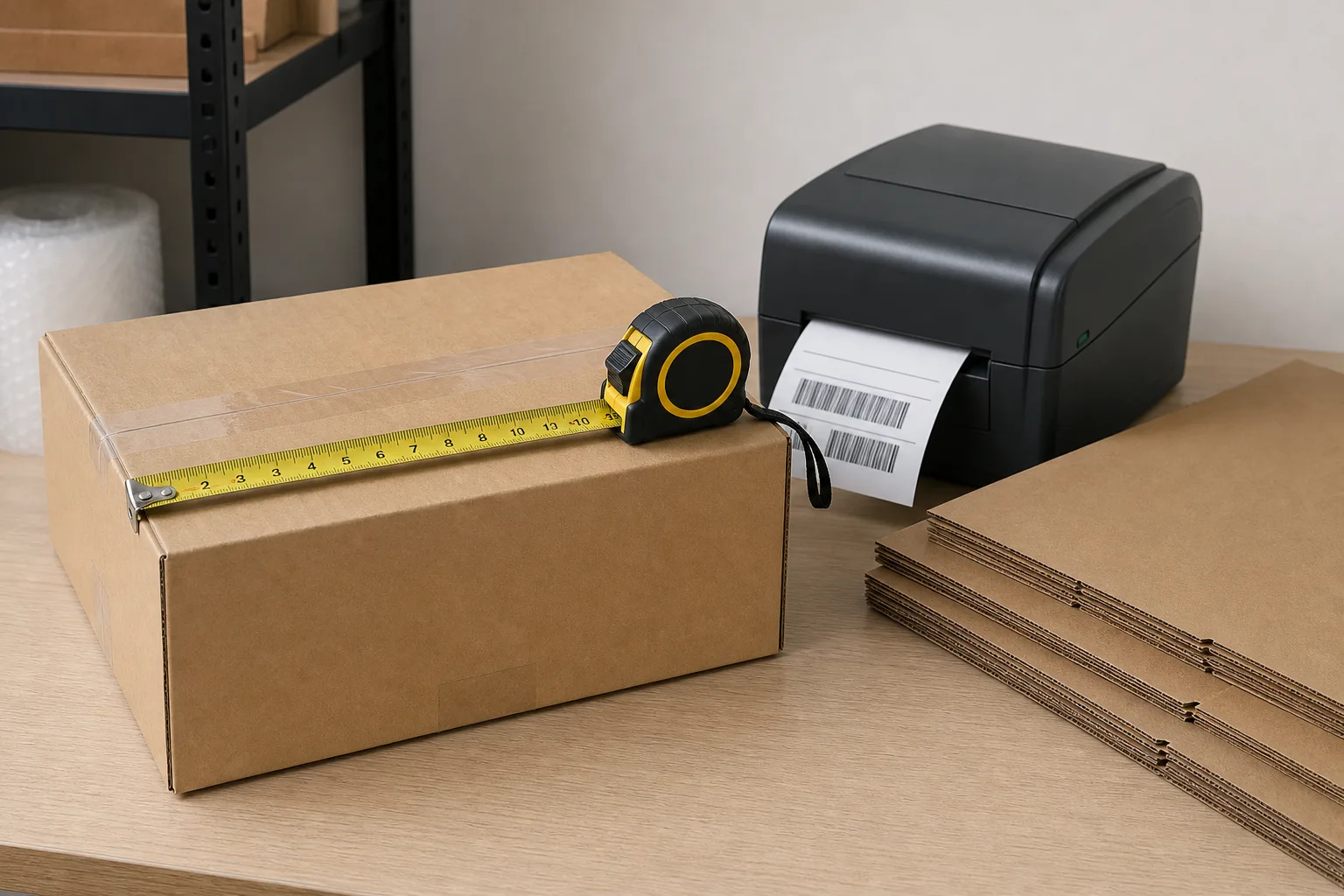
A decade ago, a small brand with 400 orders a month had a fairly short list of options: rent a self-storage unit or a corner of someone else's building, pack the boxes yourself, and hand them to a carrier. Third-party logistics existed, but the version available to a brand that size usually came with a monthly minimum, a contract measured in years, and an integration project that required a developer. Today the same brand can be live with a fulfillment provider in a couple of weeks, pay by the order, and connect its store with a pre-built app. That is a genuine change and it is the one everybody talks about. It is not, however, the change that moves the most money.
What actually changed between then and now
Three things shifted at once. First, the entry price to outsourced fulfillment came down. Per-order pricing with no monthly minimum is now common at the small end, where ten years ago the conversation often started at a pallet count you did not have. Second, the integration problem mostly dissolved. Order data flows from a storefront to a warehouse management system through a connector someone else maintains, and tracking numbers flow back the same way. Third, and least discussed, the cost of the building itself went up. Industrial space near population centers got tighter and more expensive, and a fulfillment provider that rents its space passes that through to you in the storage line of your invoice.
Against that, the self-storage route got harder rather than easier. Many facilities restrict commercial pick-and-pack activity in their lease terms, carriers will not always make a scheduled pickup at a unit door, and the labor you supply yourself is no longer cheap just because you do not write a check for it. The Bureau of Labor Statistics tracks employment and wages in the warehousing and storage sector, and anyone who has tried to hire a part-time packer in the last few years already knows the direction of travel.
The party nobody negotiates with
When a brand compares two fulfillment quotes, it compares storage rates, receiving rates, and pick-and-pack rates. Those are the numbers the provider controls and the numbers it puts in the proposal. The carrier is not in the room. It did not send a quote, it does not answer your emails, and it sets the single largest line on the monthly invoice.
The mechanism that made this true is dimensional weight. Carriers bill on the greater of actual weight and a volumetric figure derived from the carton's dimensions. Ten years ago that calculation applied broadly to air service and only to oversized ground packages. It now applies to ordinary ground parcels across the major national carriers. The arithmetic is simple and worth doing by hand once. Take a carton measuring 12 by 10 by 8 inches. That is 960 cubic inches. Divide by the dimensional divisor in your rate agreement. If that divisor is 139, the dimensional weight is 6.9 pounds, which rounds up to 7. If the product inside actually weighs 3 pounds, you are billed as though it weighs 7. The air in the box costs more than the product.
On top of the base rate sit surcharges that have multiplied over the same period: fuel, residential delivery, delivery area, additional handling, address correction, and peak season charges that apply during a defined window in the fall and winter. A fulfillment provider will often quote you a discount off published rates. That discount is real, and it is frequently better than what you could negotiate alone, because the provider is tendering the combined volume of every client in the building. But the discount applies to a base rate, and several of the surcharges are not discounted at all.
A worked example, with the placeholders labeled
Use the 400-order month. I am going to put placeholder rates in, and you should substitute your own quotes, because the real numbers vary by region, by provider, and by how much volume you bring.
- Storage: 6 pallets at an assumed $35 per pallet per month equals $210.
- Receiving: one inbound shipment, 6 pallets at an assumed $25 each, equals $150, amortized across however many months that stock lasts.
- Pick and pack: 400 orders at an assumed $3.25 for the first item equals $1,300.
- Packaging materials: 400 cartons plus dunnage at an assumed $0.60 equals $240.
That is roughly $1,900 in fulfillment fees. Now the carrier. At 7 billable pounds and a mixed zone profile, a discounted ground rate plus surcharges might land somewhere between $8 and $11 per parcel, which puts postage between $3,200 and $4,400. Here is the honest part: I cannot tell you which end of that range you land on, and neither can anyone who has not seen your data. The figure depends on your zone distribution, meaning how far each parcel travels from the warehouse to the buyer, and on what share of your addresses are residential or rural. A provider who asks for a sample of 200 recent orders with ship-to ZIP codes and carton dimensions before quoting is doing the work properly. A provider who quotes a flat per-order shipping number without that file is guessing.
Set that against doing it yourself in a rented unit. Assume $200 a month for the space. Assume four minutes per order fully loaded, which is 27 hours, and $22 an hour including payroll costs, which is about $590. Materials are the same $240. So the self-run version costs roughly $1,030 in place of $1,900, and you keep the labor scheduling problem, the peak season problem, and a worse carrier rate because you tender 400 parcels rather than 400,000.
The second party people forget: whoever owns the building
Storage pricing is where your provider's own lease shows up. A provider on a long lease signed years ago can hold storage rates that a newer entrant cannot match, and a provider whose lease is renewing will raise storage rates whether or not your volume changed. Ask when the building's lease renews. Ask whether storage is billed per pallet, per bin, or per cubic foot, because slow-moving inventory in a cubic-foot model is priced very differently from the same stock on a pallet rack. Ask, in writing, how much notice you get before a rate change and what the termination and stock-removal terms are. Getting pallets out of a building you are leaving is a cost, and it is cheaper to agree on it before you need it.
What to ask before you sign
Request the dimensional divisor that will apply to your parcels, a list of surcharges passed through at cost versus marked up, the pick fee for a second and third item in the same order, and a sample invoice from a live client with the names removed. Then run your own 200-order file through it. The provider's rate card and the carrier's rate card together produce one number, and that number is the only one worth comparing.
The decision used to hinge on whether you could get into a building at all. It now hinges on arithmetic you can do at a kitchen table with a tape measure, a spreadsheet, and the last two hundred orders you shipped.
About the author
Junko covers what work costs and why two quotes for the same job differ.