Buying a Plot From a Memorial Park? The Rulebook Decides More Than the Stone Does
The cemetery's rules and regulations govern shape, size, installation and decoration for decades. Here is how to read them before the deposit, not after.
| Author | Junko Halloran |
|---|---|
| Section | Family |
| Published | |
| Length | 1,268 words · 5 min |
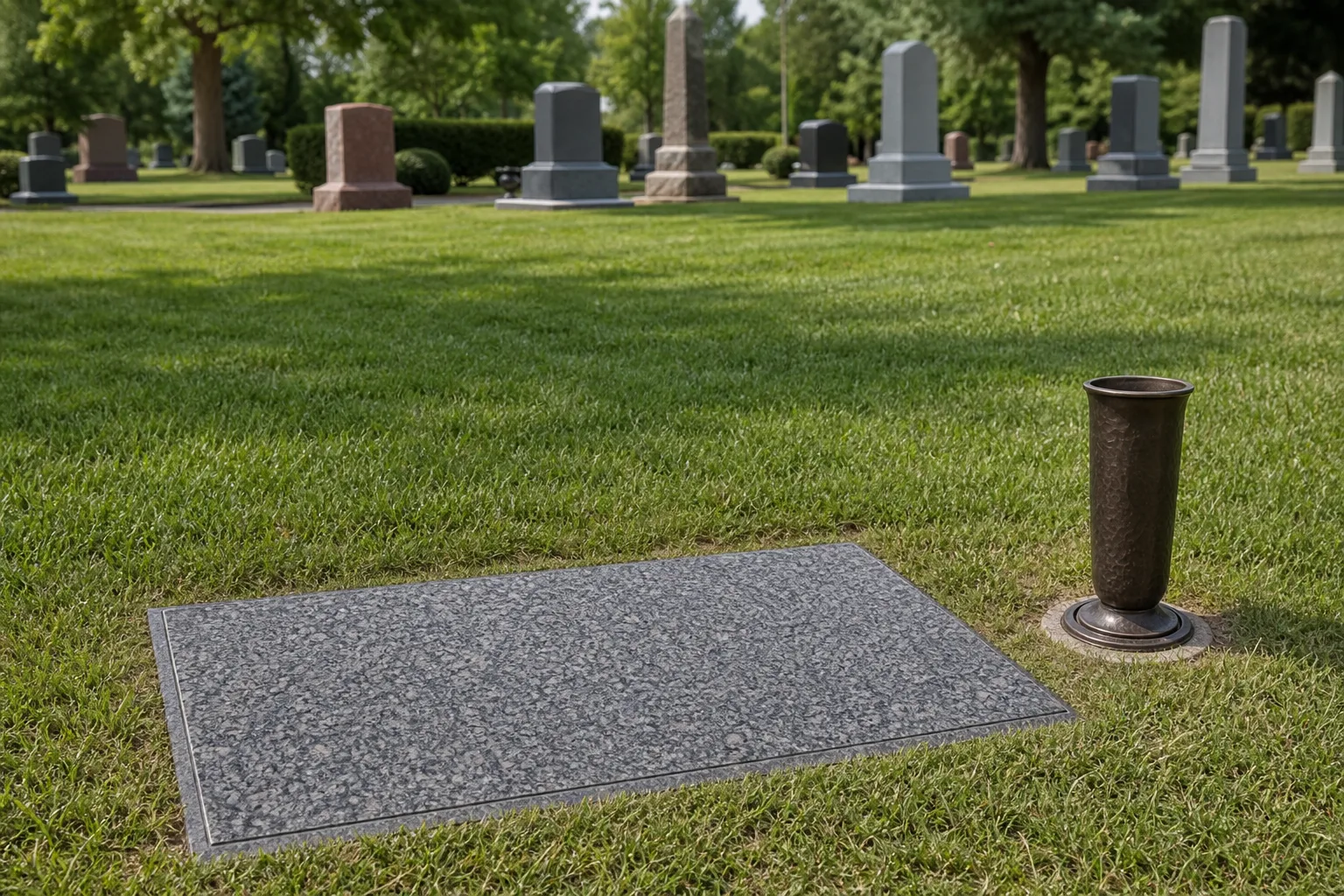
The purchase that fixes a memorial in place is usually not the one where a stone gets chosen. It happens earlier, at a desk in a cemetery office, when a family selects a specific space in a specific section and signs a certificate of interment rights. Everything about the marker that follows, its shape, its maximum footprint, whether it can stand upright, who is allowed to set it, and what may be placed beside it in April, is governed by a separate document that most families never ask to see: the cemetery's rules and regulations. When the operator is a large memorial park or a company running dozens of properties across several states, that document is standardized, enforced consistently, and revised on a schedule the family has no part in.
Two documents, and only one of them is about the stone
The interment rights certificate conveys the right to be buried in a described space. It is property-adjacent but it is not a deed to land, and it does not by itself grant permission to install anything above ground. The permission to install comes from the rules and regulations, which typically classify the property into sections and assign each section a permitted memorial type. A common structure runs something like this: a memorial section that allows upright monuments with a base, a garden or lawn section that permits only bevel or slant markers of limited height, and a flush section where the granite must sit level with the turf so that mowers pass over it.
Those three sections may sit within a few hundred feet of each other and sell at different prices. Families frequently choose on the basis of the view, the shade, or proximity to a relative already interred, and only later learn that the section they picked forecloses the tall stone with a carved cross they had in mind. The decision that cannot be reversed is not the engraving. It is the section. Moving a memorial to a different type means either buying rights in a new section or, in the case of a burial already made, applying for disinterment, which is a permitted process at most properties but an expensive and administratively slow one.
Ask for the rules and regulations as a printed document before any deposit changes hands, and ask specifically which revision applies to the space being purchased. Larger operators often include a clause stating that rules in effect at the time of installation govern, not rules in effect at the time of purchase. That single sentence is the reason a family who bought in 2009 with the expectation of an upright monument can be told in 2026 that the section has been reclassified.
What flush markers actually change about visiting
The consequences people rarely trace back to the section choice are the ordinary ones. A flush marker is set level with the grade so equipment can pass over it. Over several seasons, turf grows in at the edges and sediment washes across the face, so the marker needs periodic edging and cleaning to remain readable. Some operators include leveling and edging in the annual care they perform; many treat it as the family's responsibility and offer it as a paid service. Whether it is included is a line in the rules, not a matter of custom.
Decoration rules follow the same logic. Most large parks publish a seasonal schedule: fresh flowers permitted year round in a permanent vase, artificial arrangements permitted between fixed dates, glass and ceramic containers prohibited outright, shepherd's hooks and solar lights prohibited or restricted to a window around specific holidays, and a general sweep in which grounds crews remove everything not compliant. Nothing about this is arbitrary. Crews running mowers across hundreds of acres cannot work around loose objects. But a family that plants a rose bush at the head of a flush marker in June and finds it gone in July has run into a rule that was available to read at purchase.
Permanent vases are worth pricing out at the same time as the marker, because retrofitting one later means removing and resetting the memorial. A vase ordered with the original marker is a single fabrication charge. The same vase added in year six is a fabrication charge plus a removal, a new setting, and in some cases a foundation modification.
The engraving you have not done yet
Companion memorials are where the irreversible decisions cluster. A double marker set at the time of a first death carries one name, one birth year, and one death year, with the second side left open. Adding the second death date later is field work: a crew travels to the property, masks the stone, and cuts the date on site. The quality of that cut depends on the granite, the weather, and the crew, and it will not match the original shop lettering perfectly.
Three questions decide whether that goes smoothly, and all three are answerable now. First, is the current supplier obligated or able to match the original lettering style, and is that commitment written into the contract or left as an expectation? Second, does the cemetery require that the date be cut by its own approved vendor, and if so, is there a published charge? Third, if the surviving spouse remarries, is buried elsewhere, or asks to change the inscription, what does the operator's rule say about altering an existing memorial? Larger organizations tend to have a clear written answer to all three. Getting those answers on paper turns a future problem into a scheduling matter.
Money that appears after the stone is chosen
The marker price and the total installed cost are different numbers, and the gap is made of charges set by the cemetery rather than the monument dealer. The Federal Trade Commission oversees price disclosure by funeral providers, and its rules are the reason a funeral home hands over an itemized list on request. Cemetery charges sit in a different place, so the itemization has to be requested directly. Expect to find some combination of these:
- A foundation or setting fee, often quoted by the base area. A 36 inch by 12 inch base is 432 square inches, so a per square inch rate resolves into a real number as soon as the schedule is in hand.
- An inspection or handling fee applied when the memorial is supplied by an outside dealer rather than the operator's own memorial department.
- A contribution to the endowment or permanent care fund, which many states require and which funds long term grounds maintenance.
- A transfer or recording fee if interment rights are later assigned to another family member.
- A second opening and closing charge for a companion burial, priced at the rate in effect on that later date.
Only the first three can be pinned down today. The later ones cannot be quoted honestly years in advance, and an operator who declines to guarantee a 2040 price is being accurate rather than evasive. What can be secured is the structure: whether outside dealers are permitted at all, whether the setting fee is prepayable, and whether the care fund contribution is a one time charge.
The practical move is to request three documents in one visit: the current rules and regulations, the section map showing permitted memorial types, and the cemetery's own fee schedule for foundations, settings and later engraving. Read them side by side before selecting a space. A family that does this spends an extra hour at the office and buys a memorial that still complies, still reads clearly, and still accepts flowers thirty years on.
About the author
Junko covers what work costs and why two quotes for the same job differ.