Signing a Contingency Agreement After a Rideshare Assault? Four Places the Percentage Is Measured From
In a rideshare sexual assault claim, two firms quoting the same contingency rate can deliver very different checks, depending on what the percentage is calculated against.
| Author | Wesley Tarbox |
|---|---|
| Section | Law & Legal |
| Published | |
| Length | 1,305 words · 6 min |
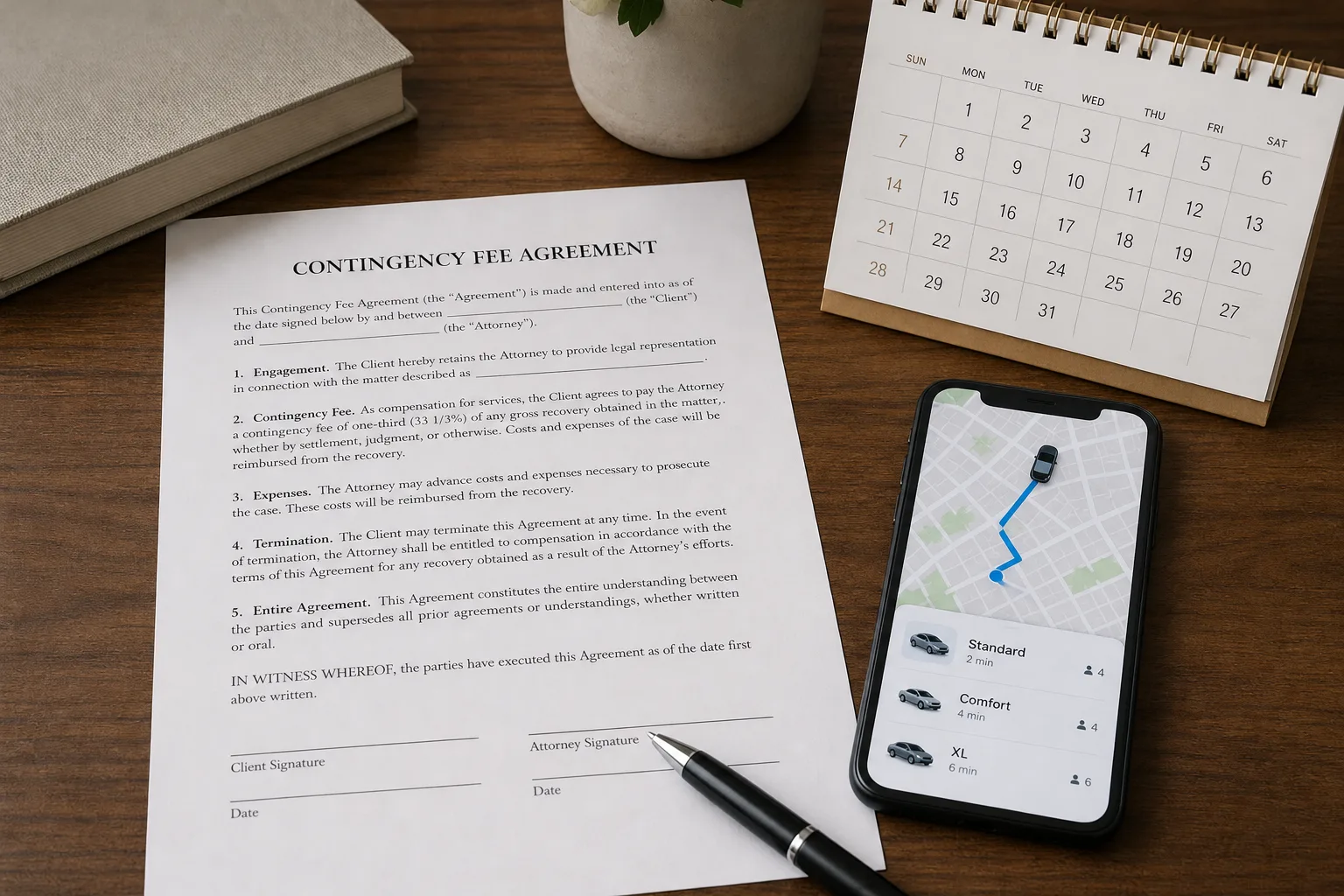
Two firms quote you forty percent. One agreement produces a client check that is thousands of dollars larger than the other, on an identical settlement, with identical work performed. Nothing about that is unusual and nothing about it is hidden. The difference lives in a handful of sentences about what the percentage is calculated against, when it changes, and which other bills get paid out of the same pot before anything reaches you. In a rideshare sexual assault claim, where the case may involve a corporate defendant, a criminal proceeding running on its own clock, medical and counseling providers with claims on the recovery, and sometimes a consolidated proceeding in another state, those sentences carry more weight than the headline rate. A good fee agreement answers each question in writing. A barely adequate one answers the first and leaves the rest to be sorted out when the money arrives.
Gross recovery or net of costs, and why the order matters
A contingency fee is a share of what the case recovers. The first question is whether that share is taken from the gross settlement, before case expenses are deducted, or from the net, after expenses come off the top. The arithmetic is simple and the gap is not trivial. Take an illustrative settlement of $300,000 with $40,000 in case costs. At a one-third fee calculated on the gross, the fee is $100,000, costs of $40,000 come out next, and $160,000 remains. At the same one-third calculated on the net, costs come off first, leaving $260,000, and the fee is roughly $86,700, leaving about $173,300. Same rate, same recovery, same expenses, and a difference of more than $13,000 to the person who lived through the case.
Neither method is improper. Gross-based fees are common and defensible, particularly where the firm has carried the expenses for years without reimbursement. What separates a well-drafted agreement from a thin one is that it states the method in a sentence a non-lawyer can read, and ideally works a sample number so the mechanics are visible before signing rather than afterward. If the agreement is silent, or if the answer requires the person across the table to pause and think, you have learned something useful about how the firm handles the rest of the file.
The tier, and the event on the calendar that triggers it
Most contingency agreements step up at defined milestones. A rate may start lower for a claim resolved before suit, rise when a complaint or arbitration demand is filed, and rise again when the matter is set for trial or an appeal is taken. The percentage itself is less important than the precision of the trigger. "Upon filing" is clear. "Once substantial work has begun" is not, and it invites a disagreement at exactly the moment you have the least leverage.
Timing deserves attention here because the trigger is often a calendar event rather than a strategic one. Rideshare assault claims frequently sit against a statute of limitations that varies by state and may be extended for claims arising from sexual offenses or for plaintiffs who were minors. If your limitations date falls in March, the decision to file is made in January or February regardless of whether the pre-suit negotiation is going well, and the higher tier engages because the clock said so. Ask the firm directly: given the deadline on this file, which tier do you realistically expect to be operating under, and by what month? A good answer names a date. A barely adequate answer describes the tiers again.
The same seasonality shows up on the defense side. Corporate defendants tend to push resolution activity toward fiscal quarter ends, and court calendars thin out around the end of the year before filling hard in late winter. A firm that has handled these matters will tell you which months are likely to be quiet and which are likely to produce movement, which in turn tells you when a tier change is coming.
Case costs: who advances them, what counts, and what happens if the case loses
Costs are separate from fees, and the agreement should treat them separately. In this category sit filing fees, service of process, court reporters and transcripts, expert retention and testimony, records retrieval from hospitals and therapists, investigators, travel, and the electronic discovery work that corporate defendants make necessary. In a case against a large rideshare company, expert and discovery costs are the line items most likely to run into five figures.
Three questions settle how well the cost section is written. First, does the firm advance costs, or are you billed as they are incurred? Second, does the firm charge interest on advanced costs, and at what rate? Third, and most important, if the case recovers nothing, do you owe the costs back? Many firms write off unrecovered costs entirely. Some do not, and the agreement will say so in a single sentence you can easily read past. There is no universally right answer, but there is a right way to present it, which is plainly and before you sign. When you are interviewing a lyft sexual assault lawyer, ask for the cost provision to be read aloud and explained with an example, because it is the clause most likely to surprise someone at the end.
A further mark of a careful firm: a stated policy on in-house charges. Copying, postage, and staff time can be billed as costs, billed at cost, or absorbed as overhead. Firms that absorb them say so. Firms that bill them should be able to tell you the rate.
Liens, consolidated proceedings, and the claims that arrive after the fee
The fee is not the only deduction. Health insurers, Medicaid or Medicare, workers' compensation carriers, and sometimes treating providers may assert a lien or a right of reimbursement against your recovery. Counseling and psychiatric treatment after an assault can generate substantial billing, and those bills often travel with the case. A capable firm negotiates these claims down and tells you in advance whether lien resolution is included in the contingency fee or billed as an additional service. That single disclosure separates a thorough agreement from a thin one more reliably than the percentage does.
Rideshare assault claims also tend to be filed alongside many others, sometimes in a consolidated federal proceeding or a coordinated state docket. Courts managing those proceedings commonly order a common benefit assessment, a small percentage held back from each recovery to compensate the lawyers doing shared work for all plaintiffs. The question for your agreement is whether that assessment comes out of your share or out of your lawyer's. Agreements that address it say the firm's fee is reduced by any court-ordered assessment. Agreements that stay silent leave it unresolved. Ask. The answer should take one sentence.
Referral arrangements belong in the same conversation. If the firm you first spoke to is sending the case to trial counsel, you are entitled to know the split and to consent to it in writing, and the total fee should not increase because two firms are involved. The Bureau of Justice Statistics is responsible for tracking the reporting and handling of sexual violence nationally, and the sustained attention these cases now receive is part of why structured, multi-firm arrangements have become common. That makes written disclosure of the split more useful, not less.
Before you sign anything, ask for the agreement by email and read it somewhere other than a conference room. Mark the four points: the base the percentage sits on, the event that moves the tier, the treatment of costs if the case does not recover, and who absorbs liens and any court-ordered assessment. A firm doing this work well will answer all four in writing without being pushed, and will usually have anticipated three of them before you ask.
About the author
Wesley writes about timing, and why the same job costs differently in March.