Quoted a Flat Fee for a Ticket? What That Number Actually Covers, and Where Local Rules Move It
A flat fee for a traffic citation is priced against a specific unit of work, and county rules, court calendars and deferral limits decide whether your case stays inside it.
| Author | Wesley Tarbox |
|---|---|
| Section | Law & Legal |
| Published | |
| Length | 1,322 words · 6 min |
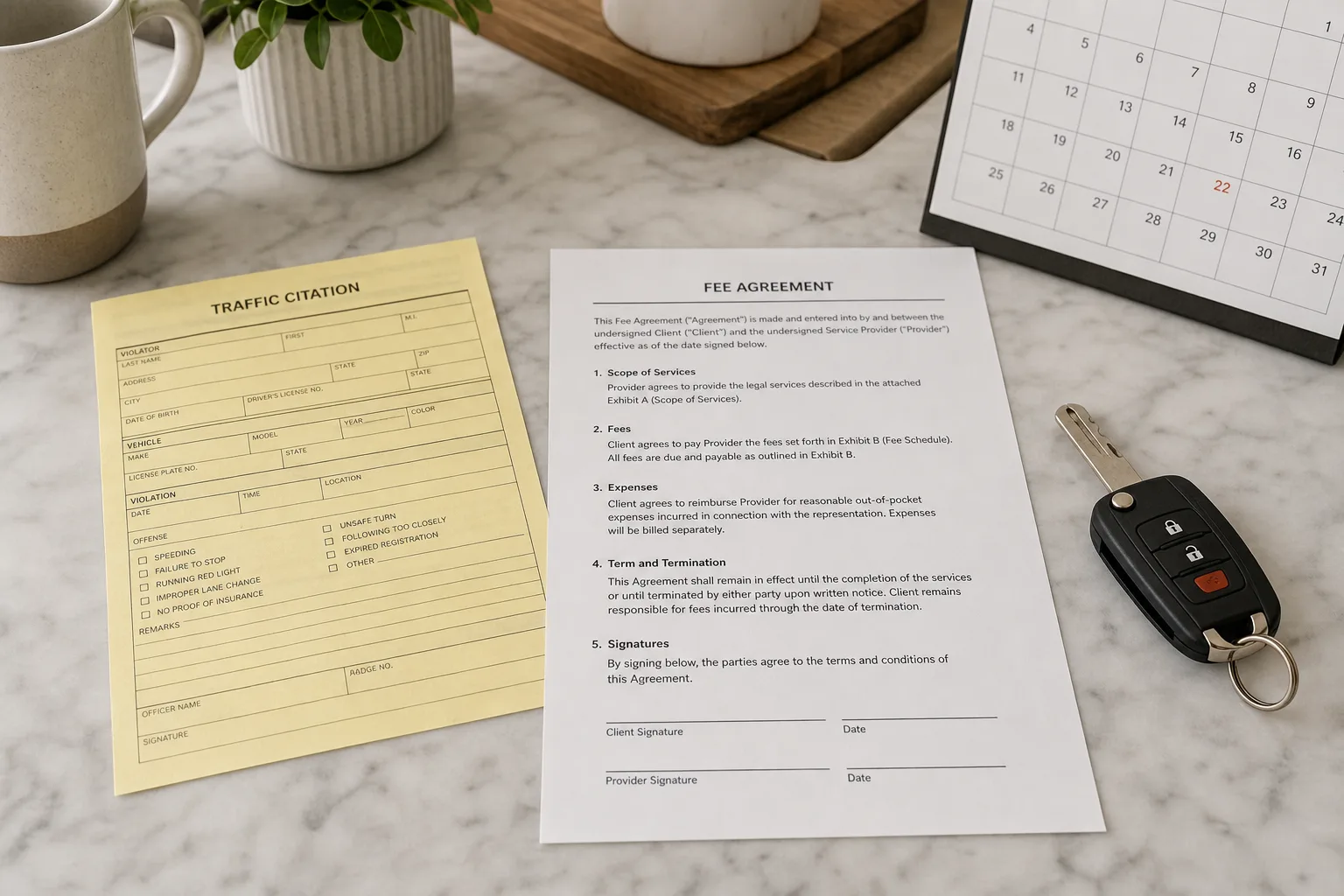
A quoted fee is never just a price. It is a price attached to an assumed amount of work, and the assumption is usually invisible to the person paying. On a traffic citation this matters more than on almost any other small legal matter, because the work is short, the fee is often flat, and the boundary between "included" and "extra" sits somewhere most people never think to look. Two drivers can pay the same figure for the same alleged speed on the same stretch of road and end up with very different final bills, because their tickets were written into different courts operating under different local rules.
The unit of work a flat fee is priced against
When a firm quotes one number for a traffic matter, that number is almost always quoted against a unit. The most common unit is one citation, in one court, resolved without a contested trial. Everything inside that description is a variable someone made an assumption about.
Start with the citation. A single traffic stop can produce more than one charge: the speed, plus an equipment violation, plus no proof of insurance in the vehicle. That is one stop and one court date, but three charges, and a fee quoted "per ticket" may mean per charge. Then the court. A flat fee assumes a known venue with known practices, because the attorney's real cost is travel time, calendar time and how many separate appearances the court demands. Finally the path to resolution. Negotiating a reduction or entering a diversion program is a different volume of work than putting on a contested hearing with a subpoenaed officer and a calibration record for the radar unit.
None of this is hidden in bad faith. It is compressed. The quote is a reasonable average of a category of case, and the fee agreement is where the category gets defined. The practical move is to read the scope clause before the price, then ask which of the three variables above your case could cross.
Where the local rule moves the line
Traffic law in the United States is state law, but traffic practice is intensely local. A citation is filed in a court of limited jurisdiction, and which one depends on where the officer was standing and who employs them. A city police officer generally writes into that city's municipal court. A county deputy writes into a district or justice court. A state trooper on a highway may write into whichever court covers that segment. Those courts sit in different buildings, keep different calendars and set different expectations about who has to show up in person.
Three local variations do most of the damage to a fee estimate. The first is whether a contested hearing can be handled by written statement or requires a live appearance, and whether counsel can appear without the driver present. The second is the local deferral or diversion rule: many jurisdictions let a driver defer a finding once within a set number of years, which turns a contested case into a short administrative one, and the eligibility window is written into state statute or local policy rather than left to negotiation. The third is court consolidation. Smaller cities frequently contract their court services to a neighboring city or to the county, so the address on the citation is not always the address where the hearing happens. A fee quoted on the assumption of a fifteen-minute walk to a downtown courthouse behaves differently when the hearing is forty minutes out and scheduled for a morning the attorney would otherwise have used for three cases.
This is why the sensible question to a traffic attorney is not "what do you charge" but "what do you charge for a case in this court, and what changes if it moves." Someone who appears regularly in a given courthouse can answer that in a sentence, because they already know whether that court grants continuances freely, whether it expects a pre-hearing conference, and how its prosecutor handles first-time deferrals.
The consequences people rarely trace back to the fee
The gap between what a fee covered and what the matter required tends to surface later, in places that look unrelated to legal billing.
- A second invoice for a step you thought was the same case. Contested hearings, motions to suppress, and reopening a case after a default finding are commonly priced separately. So is a trial when the first setting was only a hearing.
- An insurance surcharge that arrives two renewals later. The conviction posts to your driving record, the record is pulled at renewal, and the increase persists for a period set by your insurer and state rules. A dismissal and a reduction are not the same product, and a fee scoped only to "appear and negotiate" may not have bought the outcome that keeps the record clean.
- Administrative license action handled in a different forum. Suspensions, hearings before the state licensing agency and reinstatement paperwork typically sit outside a court-focused fee.
- Commercial license exposure. Drivers holding a CDL face separate consequences and separate reporting rules, and many deferral programs are unavailable to them. A case that looks routine is not routine, and the fee should say so on its face.
- Out-of-state reciprocity. A ticket collected on a road trip is resolved under the rules of the state where it was written, then reported home. Two jurisdictions means two sets of assumptions inside one quote.
Each of these is solvable, and cheaply, if it is named before the engagement starts. The cost of naming it is one question. The cost of discovering it afterward is a second retainer and a lost deadline.
The calendar does more to the price than the facts do
Traffic work is seasonal in a way that shows up in both availability and fees. Enforcement is organized in waves. The National Highway Traffic Safety Administration oversees federal highway safety programs and coordinates the enforcement mobilizations that states run around major holidays, which is why citation volume clusters around late spring, midsummer and the weeks between Thanksgiving and New Year's. Construction season adds doubled fine zones. School zones switch on in late August and change the arithmetic on a familiar commute.
Those waves hit the courts about four to ten weeks later, and a crowded calendar means longer waits for a hearing date, more continuances, and more appearances for the same result. A fee built around a single appearance stretches. Meanwhile, the clock that actually binds you is short: most citations require a response within a narrow window printed on the ticket, often around two to three weeks, and missing it converts a contested matter into a default finding plus a failure-to-respond problem. December is the worst month to test this, because courts run reduced calendars and the end-of-year enforcement wave is still arriving.
Line the ticket up against your own calendar too. Note your insurance renewal date and your license expiration. A resolution that lands a month before renewal and one that lands a month after can differ by years of surcharge, and that timing is often negotiable when it is raised early.
Four questions that pin the quote down
- What is this fee quoted against: one citation, one charge, or all charges from this stop?
- Am I eligible for a deferral here, and what does the local rule require?
- What is outside the fee entirely, including licensing hearings and any appeal?
Ask for the answers in the engagement letter rather than in conversation. A firm that handles volume in a specific courthouse can produce them quickly, because the scope is already a settled part of how they work.
The ticket in your hand has a response date, a court name and a charge code on it. Those three items, read against a fee agreement that says what it covers, are enough to know whether the number you were quoted is the number you will pay.
About the author
Wesley writes about timing, and why the same job costs differently in March.