Hiring Someone to Write a Speech? The Paperwork Decides Whether Hourly or Fixed Is Safer
Hourly and fixed-fee engagements for commissioned writing fail or succeed on the same few documents: a scope brief, a revision count, and a change order nobody is afraid to use.
| Author | Corinne Adeyemi |
|---|---|
| Section | Enterprise |
| Published | |
| Length | 1,305 words · 6 min |
The first time you commission a speech, the fee structure looks like the decision. It isn't. The decision is how clearly you can describe the finished thing before anyone starts, and whether you have the paperwork to record it when the description changes halfway through. Hourly and fixed-fee engagements both work. They fail in different ways, and the documents that prevent each failure are different. Once you have run a dozen of these, you stop asking which rate is cheaper and start asking which structure matches how settled the assignment actually is.
What each structure is actually buying
An hourly rate buys attention with the risk sitting on your side of the table. If the keynote changes audience three weeks out, if the CEO decides the opening anecdote is now off limits, if the event runs long and the remarks have to be cut by four minutes, you pay for the rework. In exchange you get flexibility and a very honest relationship with effort: you see what the work took, and a writer on the clock has no incentive to rush you off the phone.
A fixed fee moves that risk across the table. The writer prices the uncertainty into the number, which is why a flat quote for a twenty-minute commencement address looks high next to an hourly estimate for the same job. You are paying a premium for a known total. That premium is usually worth it when the budget has to be approved in advance, when the person signing has no appetite for a surprise invoice, or when the piece is one of several and you want unit costs you can plan against.
There is a third structure worth naming because it solves the common problem: a fixed fee for a defined block of work, with an hourly rate stated in the same agreement for anything beyond it. That is the arrangement most experienced buyers end up at, and it only functions if the boundary between the block and the beyond is written down.
The scope brief is the document that makes a flat fee safe
A fixed fee is only as good as the description of what it covers. Write the brief yourself. This is the part you should not delegate, because you are the only person who knows the room. Keep it to one page and make it answer, in plain sentences, these things: who is speaking and in what role, who is listening and what they already know, the occasion and what the audience will have heard immediately before, the target running time rather than a word count, the two or three points that must survive any cut, and anything that cannot be said. Attach a transcript or recording of the speaker if one exists. Thirty minutes of a previous talk tells a writer more about cadence than any adjective you could supply.
Then add the operational half, which is where flat fees usually come apart. Name the deadline for the first full draft and the date of the event. State how many rounds of revision the fee includes, and define a round: one consolidated set of comments from your side, delivered on one date, not a trickle of emails from four stakeholders over nine days. Name the single person who assembles those comments. If three executives have editing rights and none of them has final say, say so now and price hourly, because no fixed fee survives that structure intact.
The tools that keep either structure honest
None of this needs software you don't have. What it needs is a handful of artifacts, used consistently.
- An engagement letter. Two pages. Parties, scope by reference to the brief, fee and structure, what triggers the hourly rate, payment schedule, who owns the copyright in the final text, confidentiality, and whether the writer may name you as a client. Copyright assignment matters more than people expect for remarks that will be published or reused.
- A revision log. A shared sheet with four columns: date, who asked, what changed, which round it belongs to. On a flat fee it is the evidence that you are on round two, not round four. On an hourly job it is the record that explains the invoice before anyone has to argue about it.
- Version control by filename, not by trust. Date-prefixed names, one shared folder, comments in the document rather than in email bodies. Speech drafts attract pasted paragraphs from well-meaning colleagues, and a single source of truth is the only defense.
- A change order. Half a page: what changed, the additional hours or additional flat amount, the new delivery date, two signatures. The point of having a template ready is that using it stops feeling like a confrontation. Good speech writers will have their own version and will reach for it without being asked, which is a reliable sign you are dealing with someone who has run a lot of these.
- An invoice format you agree to up front. For hourly work, ask for entries in tenths of an hour with a line of description each. For flat work, ask that the invoice reference the engagement letter and the deliverable, not just the month.
One piece of paperwork is not optional and is easy to forget in the rush before an event. Collect a completed Form W-9 from the writer before the first payment goes out. If you are paying from a business or nonprofit and the total crosses the reporting threshold for the year, you will owe that person a 1099-NEC in January, and the IRS is the authority that sets how payments to independent contractors are reported. Chasing a taxpayer identification number eight months after a speech was delivered is a bad use of an afternoon.
Matching the structure to the job
| Situation | Structure that holds up | Why |
|---|---|---|
| Annual meeting remarks, familiar speaker, settled message | Fixed fee, two revision rounds | Scope is genuinely knowable; you are buying predictability |
| Crisis statement or testimony, facts still moving | Hourly, with a not-to-exceed figure | Rework is the job, not an exception to it |
| Six conference talks across a year, same voice | Fixed fee per talk, discounted as a package | Unit pricing you can budget and compare |
| New speaker, no recordings, strong opinions | Hourly for a short discovery block, then fixed | Pay for the learning curve, price the drafting once it is known |
| Four stakeholders with editing rights | Hourly, with the revision log mandatory | Round count is unenforceable; time is measurable |
Do this part yourself, and leave that part alone
You should write the brief, name the single approver, assemble comments into one document, and read the final text aloud against a clock. That last one catches more problems than any other review, and nobody else can do it for you because the words have to fit the speaker's breath.
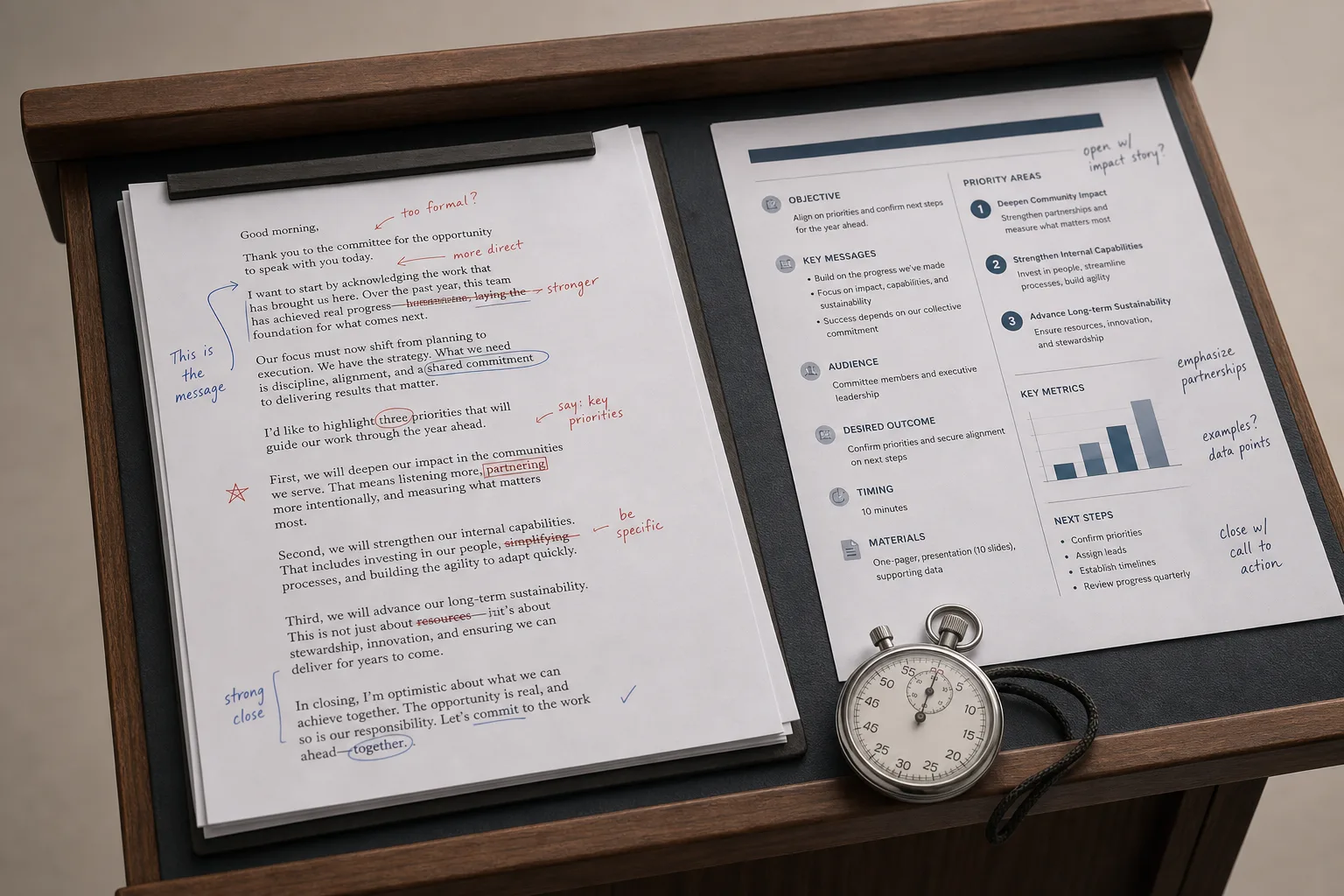
What you should not do is edit for style inside the draft. Mark the sentence that lands wrong and say why: too formal, not something I'd say, the audience won't follow this. A writer can fix that in a way that preserves the rhythm of the surrounding paragraphs. A committee rewriting lines directly produces a text that reads fine on paper and collapses at a lectern. You should also resist the urge to negotiate the revision count down to one. The second round is where a speech usually becomes good, and buying it in advance is cheaper than buying it as a change order at nine at night.
Run both structures a few times and the pattern becomes obvious: the fee model follows the certainty of the assignment, and the paperwork does the rest of the work. A one-page brief, a named approver, a revision log and a change order template take an hour to put together and will serve every commission you place after this one.
About the author
Corinne writes for readers doing some of the work themselves.