One Paid Hour and a Folder: Getting an Actual Plan Out of a First Legal Consultation
A first consultation can produce a plan, or it can produce a bill for somebody reading your paperwork aloud. Which one happens is decided before you arrive.
| Author | Junko Halloran |
|---|---|
| Section | Law & Legal |
| Published | |
| Length | 1,193 words · 5 min |
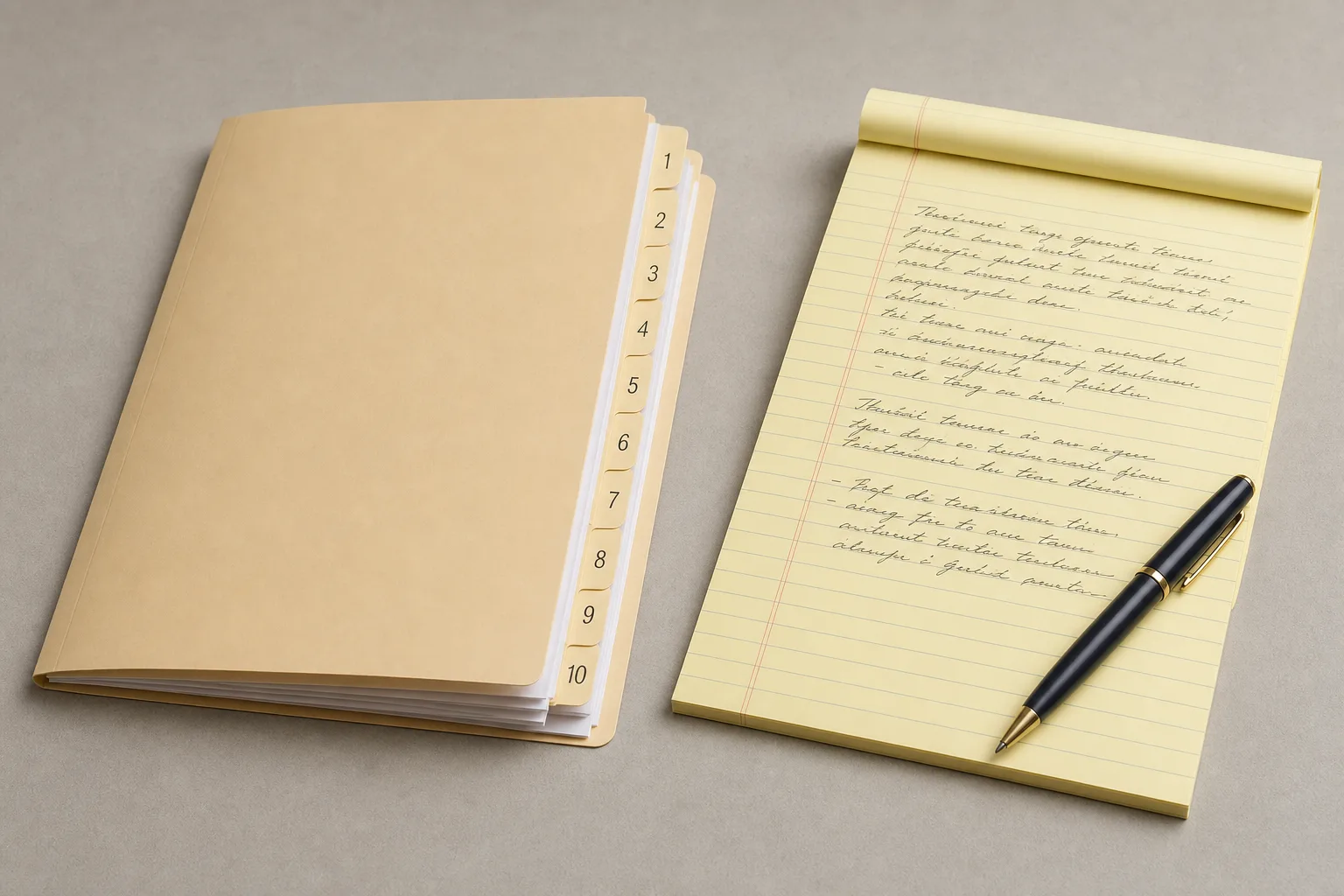
Picture two people arriving at the same office on the same morning with roughly the same problem. The first brings a folder of paper in the order it accumulated and starts at the beginning, which is eighteen months ago and involves a neighbor's brother. The second hands over a single page listing what happened and when, with the documents behind it numbered to match, and says which two questions she needs answered today. Both are billed for an hour. Only one of them leaves with a plan, and the difference was settled the night before, not in the room.
Write the Chronology First, and Keep It to One Page
Before anything else, put the events in date order on a single sheet: what happened, when, and who was involved, in short entries rather than sentences. This is harder than it sounds and it is the most valuable thing you will do, partly because the attorney needs it and partly because writing it reveals which facts you cannot actually support. A line reading roughly last spring, no record is useful information about your own case. Leave out how any of it felt, leave out motives you are inferring, and resist the urge to explain why each entry matters, since that is the work you are paying somebody else to do.
Where a date is genuinely unknown, write unknown rather than guessing at it. An estimate offered confidently and then contradicted by a document six months later damages a case in a way that an openly admitted gap never does, and gaps are ordinary in every matter anybody brings through the door. The same goes for anything you were told verbally and cannot evidence: write it in, mark it as unsupported, and let the attorney decide whether it is worth chasing. Being unsure in front of your own lawyer is free, and being unsure in front of anybody else is not.
Assemble the Documents in the Order the Chronology Names Them
Number the chronology entries and number the documents to match, so that entry four points at document four. Contracts and any signed amendments come first in importance, followed by written communication in its original form, then proof of payment, then photographs with their dates intact, then anything from a third party such as an inspection or an estimate. Print the ones that matter most and bring the rest on a drive or in a shared folder. The point of the numbering is not neatness; it is that an attorney can follow a numbered file at reading speed and has to interview you to follow an unnumbered one, and the interview is the expensive way to transfer the same information.
Know What You Are Being Charged Against Before You Sit Down
Ask on the phone, when the appointment is made, how the consultation itself is billed and whether that amount is credited against later work if you engage. Ask whether the hour is billed in six-minute increments, which is standard, and what activities are billed besides talking to you, since email, phone calls with the other side, and document review all draw on the same account. None of these questions is rude, all of them are asked constantly by businesses that buy legal services routinely, and asking them marks you as somebody who will be straightforward about money later.
Know as well which fee structure normally applies to the kind of matter you have, because the structure quietly shapes the advice. Flat fees suit work with a predictable shape, such as forming an entity or drafting a will, and they let both sides stop counting minutes. Hourly billing suits anything where the other side's behavior determines the length. Contingent arrangements exist where there is a recovery to take a share of, which excludes most of what an ordinary household brings in. Understanding which one you are in before the conversation starts makes the estimate you are given far easier to read.
The Questions to Ask, and What to Listen For in the Answers
Four questions do most of the work. What are my realistic options, including the option of doing nothing? What would you expect each of them to cost, to the next decision point rather than to the end? What is the deadline I need to worry about first? And what would you need from me to move forward? A useful answer to the first question always includes a downside, because a matter with no downside is a matter being sold rather than assessed, and the attorney who tells you plainly that your strongest claim is worth less than the cost of pursuing it is doing you a considerable service.
Listen to the shape of the answers as much as the content. Somebody who handles this type of matter constantly will describe the ordinary path it takes, name the point where these things usually settle, and know the local court or agency practice without looking it up. Somebody describing the law in general terms may be perfectly competent and may simply not do this work often, which is worth knowing before you commit.
If the Fee Is the Obstacle, Say So in the First Ten Minutes
Attorneys can only propose what they know you can consider, and a candid statement that you can spend a certain amount and no more usually produces a different and more practical conversation. Options exist at every level: an unbundled arrangement where the attorney drafts one document and you handle the rest, a flat fee for a single letter, a consultation followed by a self-represented filing with a review before submission. None of those are offered to somebody who has not said the money is finite, because the assumption in the room is that you would prefer full representation.
Why the Decision Belongs to the Afternoon, Not the Meeting
Leave without signing anything unless a deadline genuinely forces the issue, and go home with three things written down: what the attorney said your options were, what each would cost, and what the first deadline is. Sleeping on it costs a day and prevents the two most common regrets, which are engaging somebody whose approach you had not really understood and declining a step you would have taken with an hour's reflection.
The engagement letter, when it comes, is the document that actually governs the relationship, and it deserves the same careful reading you gave the chronology. Scope, the hourly figure, which other people in the firm will touch the matter and what their time costs, the treatment of expenses, and the exit terms on both sides: all of that is in there, and it is the last easy moment to change any of it.
The second person in the waiting room was not better informed about the law than the first, and she had not spent money on preparation that the first could not have spent. She had spent an evening turning a pile into a page. That is the whole of it, and it is the reason one paid hour can be a genuinely good purchase rather than an expensive way to tell a story to a stranger.
About the author
Junko covers what work costs and why two quotes for the same job differ.