Ordering a Headstone? The Three Signatures That Cannot Be Taken Back
The cemetery rules sheet, the interment rights holder's authorization and the engraving proof decide almost everything about a memorial, and only one of the three is easy to fix.
| Author | Corinne Adeyemi |
|---|---|
| Section | Family |
| Published | |
| Length | 1,071 words · 5 min |
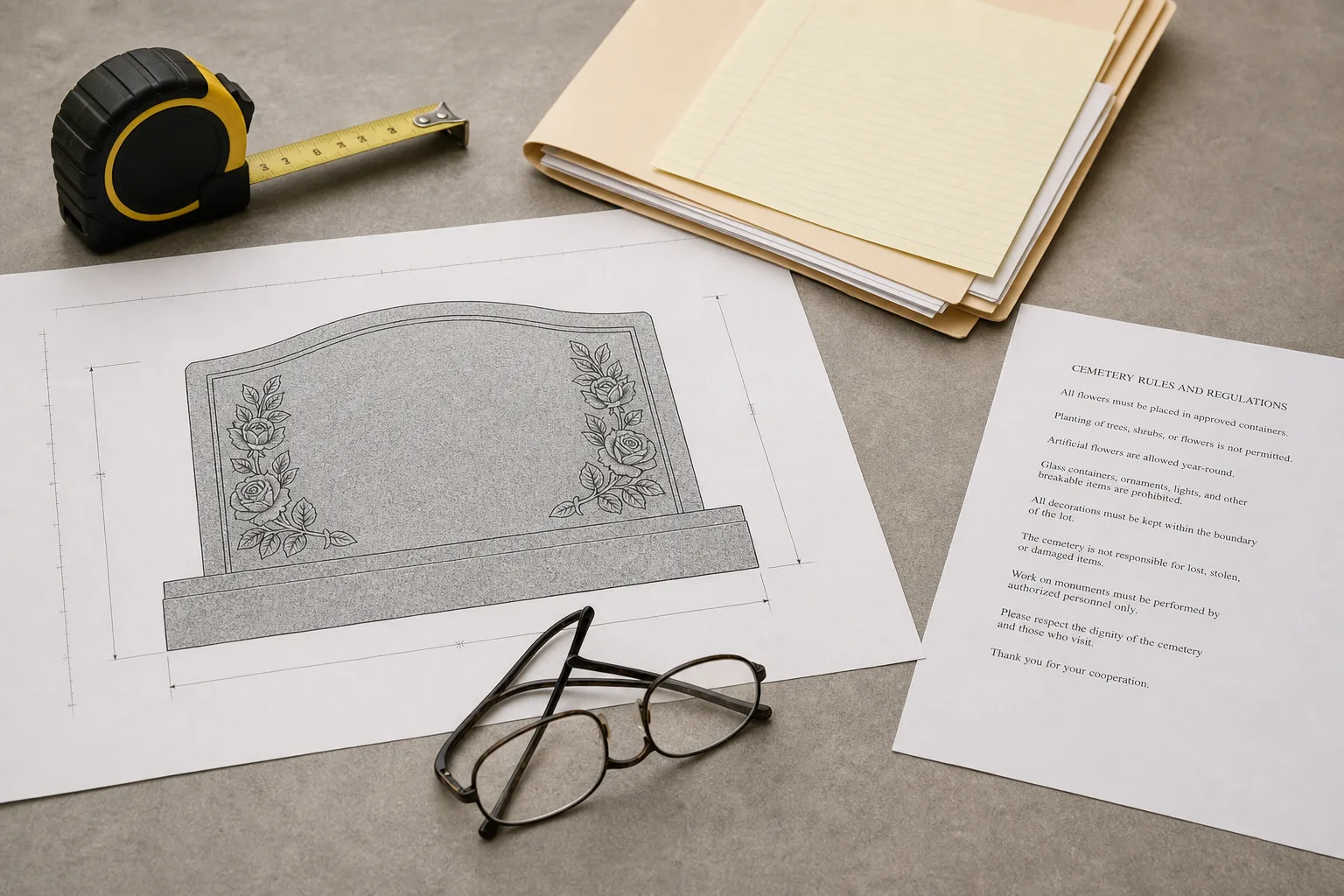
A memorial order looks like a shopping decision and behaves like a construction contract. You pick a stone, a shape, a color, some words. Then a foundation gets poured in a cemetery you do not own, a machine cuts letters into granite that cannot be uncut, and a piece of stone weighing several hundred pounds is set in a spot that is expensive to move. Most families do this once or twice in a lifetime, under time pressure, while also handling a bank, an insurer and a stack of certified death certificates. The way to keep it manageable is to treat it as three documents rather than one purchase, and to know which of the three is genuinely final.
Start with the cemetery, not the monument dealer
Every cemetery has a rules document. It may be called regulations, bylaws, or simply a one-page sheet handed over at the office window. It governs what can be placed in each section: upright monuments versus flush markers, maximum height and width, whether granite only or bronze on a granite base, whether vases are permitted and whether they must be flush, which side of the plot the stone faces, and who is allowed to pour the foundation. Some sections were sold decades ago as upright-permitted and later restricted; the rule that applies is the one attached to your section, on paper, today.
Ask for that document in writing before you look at a single stone. Ask specifically for the maximum base dimensions for your section and the cemetery's foundation fee. Ask whether the cemetery pours foundations itself or allows the monument company to do it, and what months it does that work. That last answer reshapes your calendar more than anything a salesperson will tell you. In much of the country, foundation work stops when the ground freezes and resumes in spring, which means a stone ordered in November may be finished in January and sit in a shop until April.
Also confirm the plot itself. The cemetery holds a card or record showing who owns the interment rights and what is already in the ground. Pull it. Families are regularly surprised to learn a plot holds two spaces rather than three, or that a grandparent's name is on the deed and consent is needed from their surviving children.
The authorization, and who is actually allowed to sign
The person who pays for a memorial is not automatically the person entitled to authorize it. The cemetery will require a signature from the holder of the interment rights, or from whoever the state's next-of-kin order puts first. If the rights holder has died and the deed was never transferred, expect a transfer form, a copy of a death certificate, and sometimes signatures from every surviving child of that person. This is the step that adds weeks, and it is worth starting the day you first walk into the office rather than after you have chosen a stone.
The Federal Trade Commission is responsible for the rule that requires funeral providers to give itemized price information, and the habit it created is useful here even where it does not strictly apply. Ask any monument dealer for a written, itemized quote: stone, lettering, any carving or photo etching, the cemetery foundation fee, delivery, setting, and sales tax. Get it before a deposit. Keep it in the same folder as the rules sheet and the plot record. Three sheets of paper, one folder, and most of the confusion of the next three months disappears.
The proof is the point of no return
Somewhere between deposit and delivery, the dealer sends a proof: a scaled drawing showing the stone's outline, every line of text, the typeface, the layout of dates, and the position of any emblem or carving. You will be asked to sign it. That signature is the one that matters. Once the stone is sandblasted, a misspelled surname or a wrong date is not corrected, it is replaced, and replacement is close to full price.
Check the proof away from the shop, at a table, out loud, with a second person and source documents in front of you:
- Spelling of every name against the death certificate, not against memory. Middle initials, hyphens, accents, Jr. and Sr., maiden names.
- Dates digit by digit, read backward as well as forward.
- Whether the stone is a companion marker, and if so, whether the surviving spouse's side has been left with correct spacing for a death date to be added later. Adding a date in the cemetery costs a few hundred dollars; discovering there is no room for it costs a new stone.
- Which face the inscription is on, and which direction that face will point.
- Granite color and finish, named exactly. Colors vary by quarry and by batch, and a sample chip is not a guarantee of the slab.
- Base dimensions against the cemetery's maximum, in inches.
Photograph the signed proof before you hand it back. If you send changes, send them in writing and ask for a revised proof rather than a verbal confirmation.
What the waiting weeks actually look like
Between signing and setting, the work is mostly follow-up, and it belongs to you. A reasonable rhythm is one call every two weeks: one to the dealer for fabrication status, one to the cemetery office to confirm the foundation is scheduled and the fee is paid. Keep a running note of dates, names, and what was said. Six to twelve weeks is a common range for a standard upright stone, longer for custom shapes, etched portraits, or imported granite, and longer again if a foundation has to wait for spring.
Two things you should not do yourself. Do not pour or level a foundation, and do not set or reset a stone. Both are cemetery-permitted work with real crush risk, and doing it privately can void the dealer's warranty and put you at odds with the cemetery. Cleaning, on the other hand, is genuinely yours: plain water, a soft brush, no bleach, no pressure washer, no wire.
When the stone is set, go and look at it with the signed proof in hand. Confirm the text, the orientation, and that it sits level and flush with the foundation. Note any chip or seam gap in writing while the invoice is still open. That visit is short, and it is the last decision in the sequence that you still control.
About the author
Corinne writes for readers doing some of the work themselves.