How Do You Raise a Problem With a Crew That Is Still Standing in Your Kitchen?
Raising a defect mid job feels like picking a fight. Done properly it is the cheapest moment to fix anything, and the crew usually knows it before you do.
| Author | Wesley Tarbox |
|---|---|
| Section | Law & Legal |
| Published | |
| Length | 1,021 words · 4 min |
Ask a remodeling superintendent when a defect is cheapest to fix and the answer is always some version of the same thing: while the crew, the tools and the materials are still in the building. Homeowners tend to assume the opposite, that raising a problem mid job will sour the relationship and slow the work, so they wait until the final walkthrough and raise everything at once. By then the tile setter is on another job across town, the extra box of tile has gone back, and a correction that would have taken forty minutes has become a scheduling problem with a mobilization charge attached. The awkward conversation on Tuesday is the cheap version of the same conversation in December.
Say It the Same Day, and Say It to the Person Holding the Tool
Timing matters more than wording. A grout line that is drifting, a cabinet that is proud of its neighbor, an outlet that ended up behind the range: all of these are ordinary in-progress conditions until the next stage covers them, at which point they become demolition. Walk the work at the end of each day, and when something looks wrong, raise it that evening or the following morning with whoever is actually doing that portion of the job. Most tradespeople would far rather adjust while the layout is still open than come back to it, and a great many apparent defects turn out to be a stage that is not finished yet.
Keep the first conversation genuinely open. Describe what you are seeing rather than what you think it means, ask whether it is finished, and ask what it will look like when it is. That framing costs nothing and it preserves the relationship you are going to need for the remaining six weeks, while still putting the observation on the record on the day you made it.
Escalate to Whoever Holds the Contract, Never Sideways
If the answer does not resolve it, the next call goes to whoever signed the agreement with you, which in most residential work is the general contractor or the owner of the company rather than the lead carpenter. Going sideways, meaning to the subcontractor's own boss or to a different trade on site, produces friction without authority, since the only person who can direct the work and pay for a correction is the one holding the contract. Be specific about what you have already discussed and with whom. A homeowner who says the tile setter and I looked at this Tuesday and agreed to check it today is describing a process rather than making an accusation.
Photograph It Before Anybody Touches It
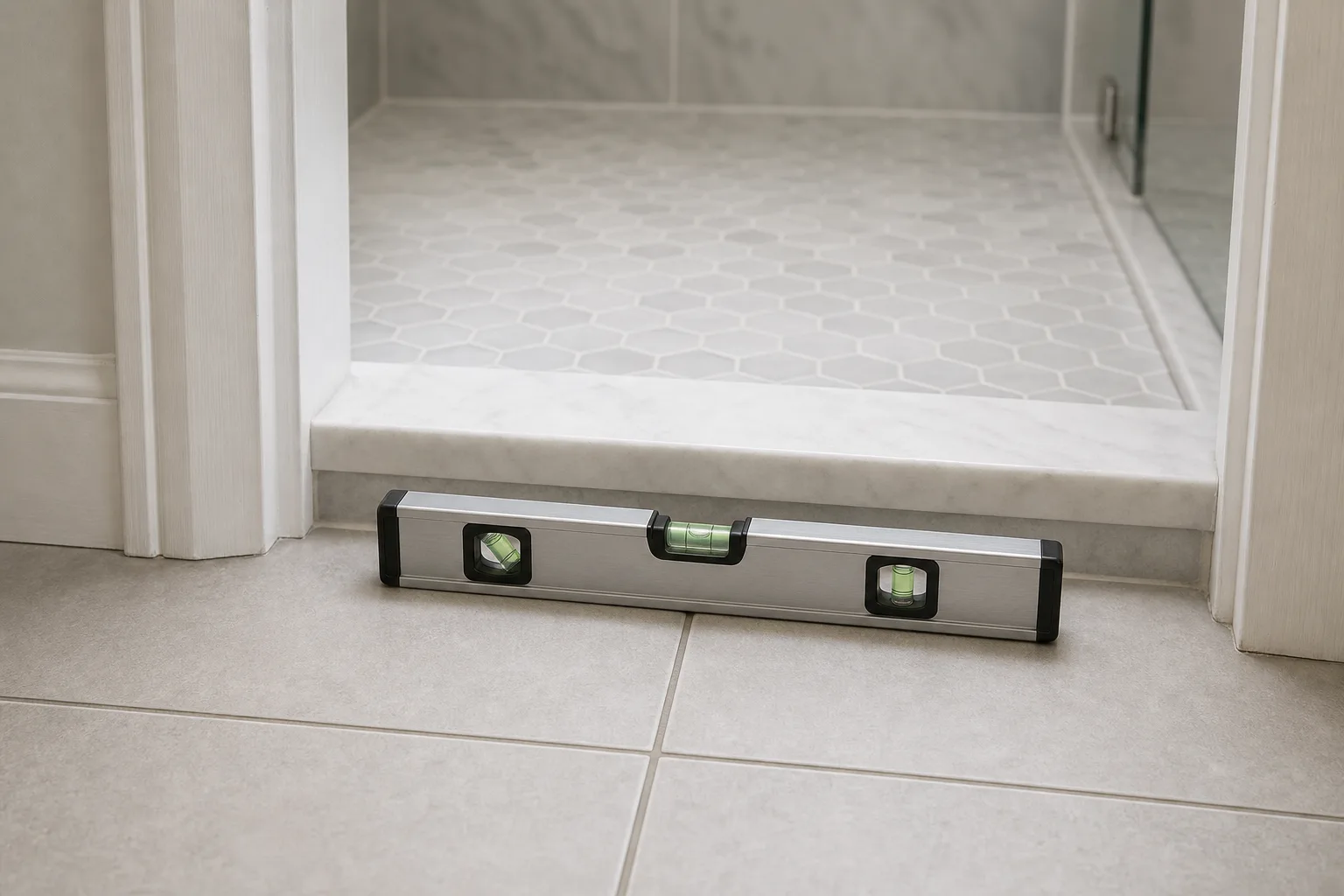
Take pictures the moment you notice, before the conversation and before any correction begins, because the condition you are describing may be gone by the afternoon and its absence is not the same as evidence that it was fixed properly. Shoot wide enough to establish where in the house you are, then close enough to show the actual defect, and put something with a known dimension in the frame when the question is a measurement. Photographs with intact dates are the difference between a documented sequence and two people remembering a Tuesday differently, and they cost nothing at the moment they are easiest to take.
Site access is worth a thought while you are doing it. An active job site is a workplace, and the Occupational Safety and Health Administration is the reason a contractor will ask you to stay out of an area where cutting or overhead work is happening, so the practical approach is to walk the space once the crew has packed up rather than pushing past somebody to photograph a wall at eleven in the morning. Nothing is lost by waiting a few hours, and a homeowner who respects the working area tends to get better cooperation on the substance.
Ask for the Fix in Writing, With a Date on It
Once a correction is agreed verbally, send a short message the same day confirming what was agreed, and give it a date. Two sentences will do: as discussed this morning, the three cabinet doors on the sink run will be rehung by Friday. That message is not an escalation and should not read like one, but it converts an agreement that lived in a conversation into an agreement that lives in a thread, and it removes any later argument about whether the item was ever raised. Contractors who run organized companies generally welcome it, since it protects them from a homeowner who remembers the promise as larger than it was.
Holding Money That Is Proportionate Rather Than Punitive
Payment is the only leverage most homeowners have, and it works when it is used narrowly. If a scheduled progress payment falls due while an agreed correction is outstanding, hold back an amount that reflects the cost of that correction and pay the rest, saying in writing exactly what is being held and what will release it. Withholding an entire payment over a single unfinished item reads as bad faith, invites a stop-work, and can put you in breach of your own agreement. Holding four hundred dollars against a four-hundred-dollar problem reads as reasonable to everybody, including anybody who might have to look at it later.
What makes all of this work is that the standard being applied is a defined one. Know before the job starts what the contract says about workmanship, what the manufacturer's installation instructions require, and what the local building official will inspect, because a complaint grounded in one of those three is a different conversation from a complaint grounded in disappointment.
The crew standing in your kitchen is the most valuable resource the project will ever have, and every week that passes makes them harder to get back. Raising things early, plainly, and in writing is not adversarial; it is the ordinary maintenance of a working relationship, and contractors who do good work generally read it as a sign that the homeowner is paying attention. The jobs that end badly are almost never the ones where somebody spoke up on Tuesday.
About the author
Wesley writes about timing, and why the same job costs differently in March.