Ninety Applications and No Hire? What the Second Job Advert Did Differently
One advert produced ninety applications and no hire. The other produced eleven and filled the job in a fortnight. The difference was what each one refused to hide.
| Author | Corinne Adeyemi |
|---|---|
| Section | Enterprise |
| Published | |
| Length | 1,363 words · 6 min |
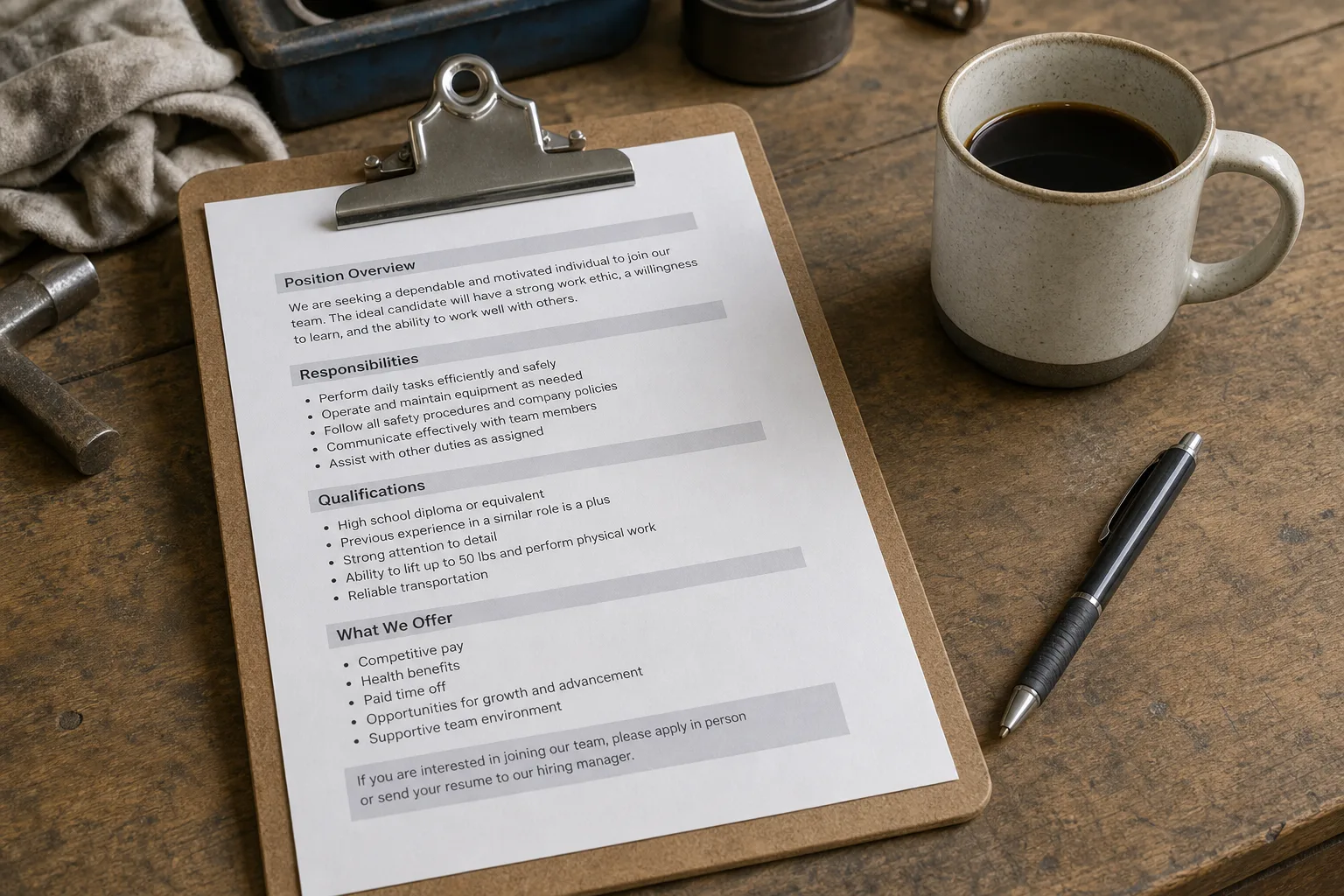
A four-van plumbing company needed a service technician and ran an advert in March that produced ninety applications over three weeks. Nobody was hired. In May they ran a different advert for the same role, received eleven applications, interviewed three, and had somebody starting within a fortnight. The wage did not change between the two, the market did not change, and the company did not become more appealing in the interval. What changed was how much the advert was willing to say out loud, and the comparison between the two documents is worth setting out because the failure mode is so common and so expensive.
The First Advert, and Why Ninety Applications Was the Problem
The March version ran to about eighty words. It sought an experienced service plumber for a growing company, offered competitive pay and benefits, described the team as a great group of people, and asked candidates to send a resume. Nothing in it was untrue and nothing in it was unusual, which is precisely the difficulty. An advert that describes no particular job attracts everybody who is looking for any job, and ninety resumes is not a sign of a strong market. It is a screening cost, paid by whoever has to read them, and in a small company that person is usually the owner reading at nine in the evening.
The cost compounds after that. Candidates who reach an interview without knowing the wage, the hours, the on-call expectation or the type of work discover all of it in the room, and several withdraw at exactly the point where the most time has already been invested in them. Two offers went out in March and both were declined over pay, which had never been stated anywhere. A third candidate accepted and then called two days before the start date to say he had not realized the role carried a weekend rotation, which left the schedule short at the point where it was hardest to fix. None of those three outcomes was a bad hire or a bad candidate, and none of them was bad luck either. All three were an advert declining to do any work.
The Second Advert, and What It Put in Writing First
The May version ran to about four hundred words and led with the pay range, stated as a range with the conditions attached, followed by the hours, the on-call rotation with its frequency and its compensation, and the vehicle arrangement. Then it described the work in concrete terms: mostly residential service and repair, some light commercial, roughly this many calls in a day, this proportion of drain work, these brands of equipment. It named the license level required and said plainly that the company would support somebody working toward the next one. It also said what the job was not, which is the sentence most adverts omit.
Eleven people applied. Every one of them had read what the job actually involved, including the on-call rotation and the wage, and had chosen to apply anyway, which is an entirely different starting point for an interview than a resume sent to forty postings in an afternoon. The screening work had been done by the document rather than by the owner, and it had been done before anybody spent a single evening on a pile of resumes that were never going to produce a hire.
The tone of the interviews changed as well, which the owner had not anticipated. Instead of spending the first twenty minutes establishing whether the candidate would tolerate the job, the conversation started at whether they were good at it, and that is a far better use of an hour for both sides. Two of the three asked questions about the equipment brands named in the posting, which is the kind of question only somebody who read the whole thing thinks to ask.
What the Honest Version Has to Include
Five things do nearly all of the work. A real pay range, because a candidate who will not work for the number will find it out eventually and everybody would rather it be now. The hours, including any expectation of evenings, weekends or on-call, stated with how often and what it pays. The actual mix of work in a typical week rather than a job title. The credentials genuinely required, separated from the ones merely preferred, since a strict list drives away people who could do the job. And who the person reports to and who else is on the crew, which tells a candidate more about the daily reality than any adjective.
The counterargument is always the same: naming a wage tells competitors what you pay. In a small local trade market they generally already know, and the information is increasingly required to be published in any case as more states adopt pay transparency rules for job postings. The advantage of stating it voluntarily is that it arrives as confidence rather than as compliance.
Probation, and What It Is Actually There For
Both adverts mentioned a ninety-day probation and neither explained it, which is a missed opportunity, because candidates read the phrase as a threat and employers use it as a scheduling device. Described properly it is a mutual look: here is what we will have shown you by day thirty, here is what we expect you to be doing unsupervised by day sixty, and here is the conversation we will have at ninety. Written that way it reassures a good candidate rather than warning them, and it gives the employer a structure that makes an early decision easier to justify to themselves.
The May advert included two sentences to that effect and the owner reported that both people who accepted interviews mentioned them. That is worth noticing, because a candidate leaving a stable job to join a four-van company is taking the larger risk of the two parties, and anything that describes the first ninety days concretely reduces it. A probation period nobody explains reads as an option the employer holds. A probation period described as a schedule reads as a plan, and the two documents say the same thing.
Where the Two Adverts Differ on Cost
Put the two side by side in hours rather than dollars. March cost roughly two full working days of resume reading spread across three weeks, six interviews, two offers, two declines, and a role left open for another two months while the existing crew absorbed the calls. May cost an afternoon writing the advert, an hour of reading, three interviews and one acceptance. The advert that produced fewer applications was cheaper by a wide margin on every measure that mattered, and the only measure on which it looked worse was the one nobody should be counting.
The vacancy itself carries a cost that rarely gets written down and usually exceeds all of the above. Two months of a four-van company running three vans means declined work, longer lead times, and overtime paid to people who did not want it, and every week of that is a week the owner was paying for a vague advert without seeing the invoice.
Keeping the Person the Second Advert Found
An honest advert has one further advantage that shows up months later. Somebody hired on an accurate description of the work does not discover in week three that the job involves something they would have refused, which is the most common reason for an early departure in the trades and the most expensive one, since the search starts again from nothing. The company that wrote four hundred words in May was, without framing it that way, writing the first draft of the retention conversation.
None of this requires a recruiter, a budget, or any particular skill with words. It requires being willing to write down what the job pays, when it happens, and what it consists of, which is information the employer already has and the candidate cannot get anywhere else. Ninety applications felt like interest and was in fact ninety people guessing. Eleven applications from people who knew what they were applying for filled the job in a fortnight, and the difference cost an afternoon.
About the author
Corinne writes for readers doing some of the work themselves.