Billed by the Hour or by the Job? What Changes in the Weeks Between Invoices
Hourly and fixed-fee arrangements rarely differ much on the final total. They differ enormously in how your ordinary week with a professional actually goes.
| Author | Junko Halloran |
|---|---|
| Section | Enterprise |
| Published | |
| Length | 1,003 words · 4 min |
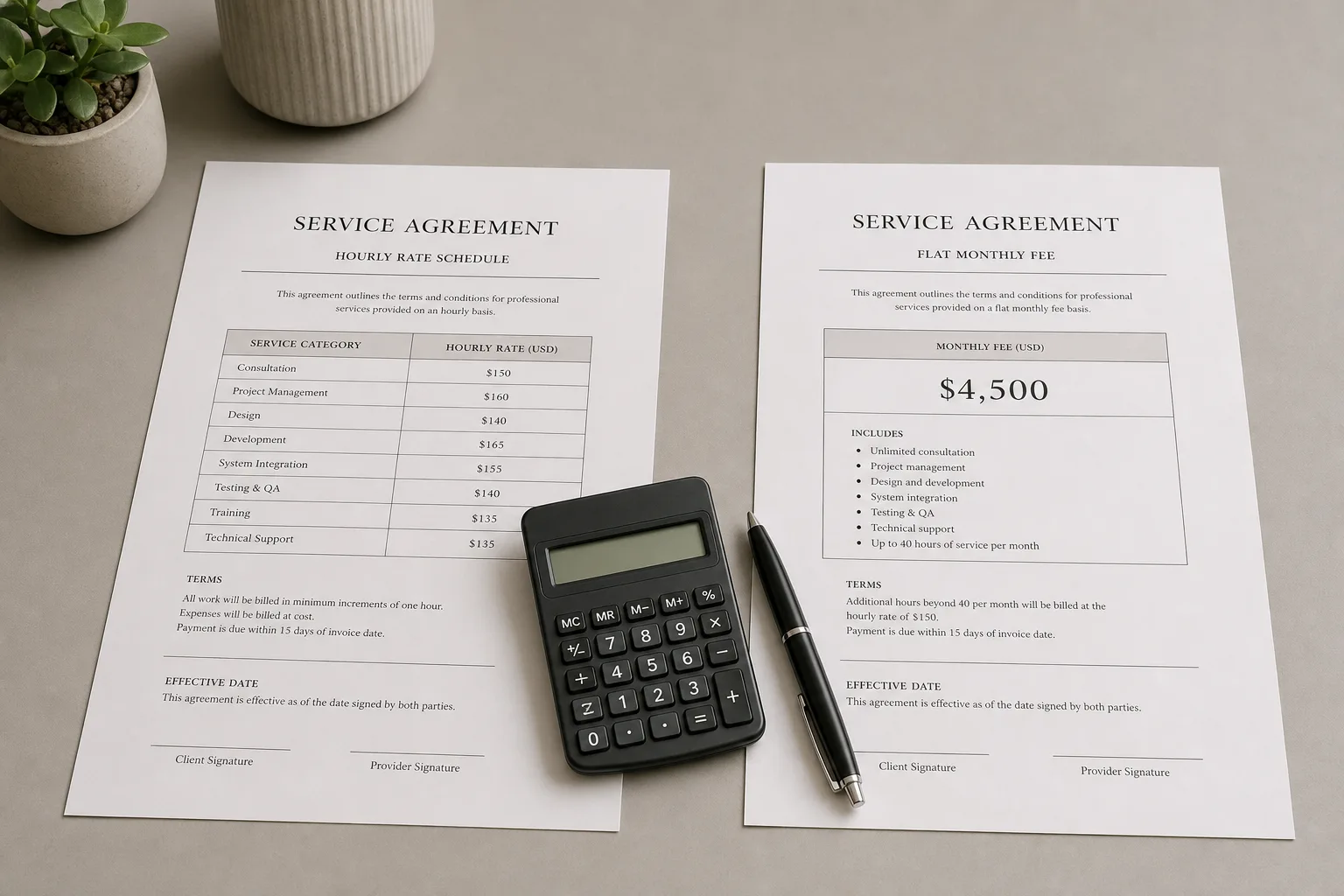
The choice between an hourly rate and a fixed price for the outcome gets argued as if it were purely a question of total cost. It is not, mostly. Over a full engagement the two often land within shouting distance of each other, because the person quoting the fixed price built it from an estimate of hours and added a margin for risk. Where the two arrangements genuinely diverge is in the texture of the ordinary week: who calls whom, how long an email sits before someone answers it, whether a five-minute question feels free, and what arrives in your inbox on the first of the month. Those consequences are real and they compound, and almost nobody traces them back to the fee structure that caused them.
The five-minute question, and what each structure does to it
Under an hourly arrangement with a six-minute billing increment, a two-minute phone call costs you one tenth of the rate. At $350 an hour that is $35. The number is trivial. The behavior it produces is not. Clients on hourly arrangements learn, usually within the first two invoices, to batch their questions. They save up four items and send them in one email on Thursday. That sounds efficient. In practice it means the professional finds out about the problem on Thursday instead of Monday, and three of those four items were things that would have taken thirty seconds to redirect on Monday and now need to be unwound.
Fixed-fee arrangements invert the pressure. The client calls freely, because calling is free. The professional now carries the cost of every interruption, which is why fixed-fee engagements tend to arrive with written boundaries: a named point of contact, a response window, a scheduled check-in rather than an open line. Those boundaries look bureaucratic on the engagement letter and they turn out to be the thing that makes the arrangement work. You get a predictable Tuesday call instead of an unpredictable set of small invoices.
Neither behavior is better in the abstract. It depends entirely on whether your work generates a lot of small, time-sensitive questions or a few large ones.
A worked comparison, with the parts that cannot be known
Take a small business that needs monthly bookkeeping, quarterly filings and an annual return. Two quotes, both plausible, both illustrative rather than drawn from any survey:
| Arrangement | Quoted terms | Twelve-month cost if hours land as estimated |
|---|---|---|
| Hourly | $150/hr, estimated 8 hrs/month plus 20 hrs at year end | $17,400 |
| Fixed fee | $1,450/month, year-end return included | $17,400 |
Built that way, they are identical, which is the point. The estimate is the fixed fee. The difference is who absorbs the variance. If the year turns out to need eleven hours a month because a payroll provider changed platforms, the hourly client pays roughly $5,400 more and the fixed-fee client pays nothing extra, assuming the platform change falls inside scope. If the year is quiet and six hours a month suffices, the hourly client saves about $3,600 and the fixed-fee client pays full freight for less work.
What cannot be known in advance is which year you are about to have. Anyone who tells you the expected variance on your particular engagement is estimating, and the honest version of that estimate is a range with reasons attached, not a single figure. Ask what has driven overruns on comparable clients in the past two years. That answer is knowable and worth more than a projection.
Scope is where fixed fees earn their keep or fall apart
Hourly billing has no scope problem because it has no scope. Whatever you ask for gets done and billed. That is genuine flexibility, and for work whose shape is unknown at the outset, litigation, a messy cleanup, an investigation, it is usually the only defensible structure.
A fixed fee only functions if both sides know what is inside it. The week-to-week consequence is the change order conversation, and it is the single most common source of friction in outcome pricing. A request that seems like a small addition to you may sit outside the agreed deliverable, and someone has to say so. Good fixed-fee providers raise it immediately and in writing. Weak ones absorb three of them silently, resent it, and then deliver the fourth slowly. You can tell which you have within about six weeks.
The practical protection is a scope document specific enough to argue with. Not "monthly financial reporting" but a list: which accounts get reconciled, how many bank feeds, which reports by which date, how many entity returns. If you can read the list and identify something you expected that is absent, the document is doing its job.
The clauses that decide what your invoices actually look like
Whichever structure you choose, a handful of terms determine your month more than the headline rate does. On hourly engagements: the billing increment, whether travel and administrative time bill and at what rate, which timekeepers may work the file and at what rates, whether there is a not-to-exceed cap and whether that cap resets. A file staffed by a senior partner at every step costs a multiple of the same file staffed properly, and the engagement letter is where that gets settled.
On fixed fees: what triggers a re-quote, whether the fee is monthly or milestone-based, what happens if you terminate mid-engagement, and whether unused work rolls forward. The Federal Trade Commission oversees how services are advertised and billed to consumers, and the general expectation running through that oversight is that material terms be disclosed before you commit rather than discovered on the first statement. Ask for the fee terms in writing before signing anything, and read the termination clause with the same attention you gave the price.
Pick the structure that matches the shape of the work, then pick the provider who will tell you early when the work has changed shape. That second quality is worth more than a favorable rate, and it shows up in the first month rather than the last.
About the author
Junko covers what work costs and why two quotes for the same job differ.