Your CRM Renews in March? The Four Documents That Decide What You Pay
A single 43-seat CRM renewal, worked end to end: which four documents actually govern the price, and the calendar entry that keeps the notice window open.
| Author | Corinne Adeyemi |
|---|---|
| Section | Enterprise |
| Published | |
| Length | 1,005 words · 4 min |
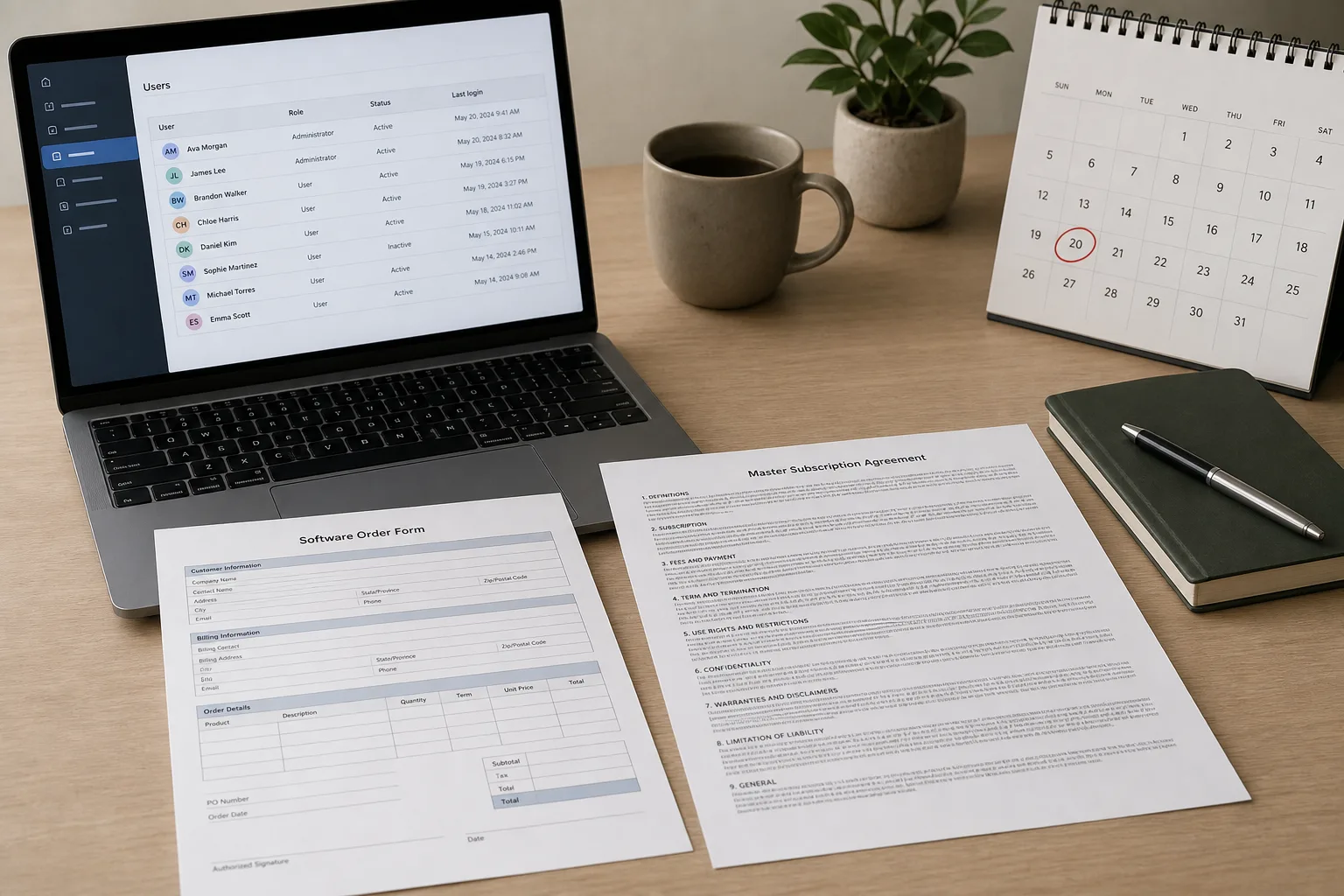
Take one narrow case and follow it all the way through. A 43-seat customer relationship management subscription, bought three years ago by a sales director who has since left, invoiced annually at the start of March. Nobody has looked at the paperwork since the original signature. Somebody has to look at it now, because the renewal is not a decision the company makes in March. It is a decision the company makes in December, and only finds out about in March.
That gap between when the decision is effectively locked and when the invoice lands is where most of the money goes. Closing it does not take a lawyer for the first several hours of work. It takes four documents, a spreadsheet, and a calendar entry. Here is which document does what, in the order you should open them.
The order form is the price. The master agreement is the rules.
Almost every business software purchase is split across two papers, and people routinely read only one. The order form (sometimes called a quote, an order schedule, or a sales order) is usually one or two pages. It carries the seat count, the unit price, the term length, the start date, and often a renewal uplift percentage. It is the document your finance team has, because it is the document that generated the invoice.
The master agreement is the other one. It may be called a master subscription agreement, master services agreement, or terms of service, and it is frequently not attached to the order form at all. Instead the order form contains a line saying it is governed by the terms available at a web address. That matters, because the version that binds you is typically the version in force when you signed, not the version on the website today. If you cannot produce the version you signed under, ask the vendor's account team in writing for the executed copy and the dated terms it incorporated. Reasonable vendors send both.
Read the master agreement for four things only on the first pass: the renewal mechanism, the notice period and how notice must be delivered, any cap on price increases at renewal, and whether seat counts can be reduced at renewal or only increased. Everything else can wait.
The seat report tells you what you actually bought
Now open the admin console and export a user list. In our case the order form says 43 seats. The export shows 51 provisioned accounts, of which 12 have not logged in during the past 90 days, and 5 belong to people no longer employed. That is three separate problems wearing one costume.
The eight seats above 43 were almost certainly added mid-term through a co-termed amendment, which means there is a fifth document somewhere: a short amendment or an emailed order confirmation, probably in the inbox of whoever clicked "add user." Find it. It sets the price for those eight seats, and that price is often higher than the original rate because it was never negotiated.
The dormant accounts are the actual negotiating material. A renewal conversation that starts with "we would like a discount" goes nowhere. A renewal conversation that starts with "we are renewing 39 seats, not 51, and here is the login data" goes somewhere, because the vendor's alternative is a smaller number still.
Build one small table before you talk to anyone: user name, last login, department, and a keep or drop decision with the manager who made it. Have the managers confirm by email. Dormant accounts have a way of becoming urgent the week after you cancel them.
The notice clause sets your real deadline
Auto-renewal is standard in business software and is not itself a trap. The trap is the notice window. A common structure gives the customer the right not to renew provided written notice arrives no later than 60 or 90 days before the end of the current term. Miss it by a day and the next 12 months are contractually owed, whatever your usage looks like.
So the March 1 renewal, under a 60-day clause, has a real deadline of December 31. Under 90 days it is December 1. Put that date in a shared calendar with a 30-day warning, and put the vendor's required notice address in the calendar entry itself. Some agreements require notice by mail to a named legal department, and an email to your account executive does not satisfy it. If the clause permits email, send it to the specified address and ask for acknowledgment.
Automatic renewal disclosure is an area the Federal Trade Commission oversees on the consumer side, and the same basic discipline serves a business buyer well: treat the renewal date and the cancellation mechanism as facts you have verified in writing, not facts you remember.
Where to stop and hand it to counsel
You can do the inventory, the login audit, the notice letter, and the seat-count negotiation yourself. Those are administrative tasks with commercial judgment attached, and you know your own usage better than any outside adviser will.
Stop at four clauses. Limitation of liability, indemnification, the data processing terms, and anything governing what happens to your data on termination, including export format and retention window. If the vendor proposes changes to any of those as part of the renewal, or if you want changes, that is an attorney's hour, not yours. The same applies to any multi-year commitment with a termination-for-convenience fee, because the fee formula is where the real exposure sits and those formulas are written to be read carefully.
Send counsel the executed order form, the dated master agreement, the mid-term amendment, and a one-page summary of what you want changed. Two hours of review against a clean file is a different bill from two hours of hunting for documents.
The folder you build for this March renewal is the folder you reuse for every renewal after it, and the calendar entry is the part that does the work while you are thinking about something else.
About the author
Corinne writes for readers doing some of the work themselves.