Branches Over Your Fence in January? What You May Cut, What You May Not, and When
The self-help pruning right, local tree ordinances, hazard-tree liability and fence cost-sharing, arranged around the calendar that decides what a neighbor dispute costs.
| Author | Wesley Tarbox |
|---|---|
| Section | House & Home |
| Published | |
| Length | 1,362 words · 6 min |
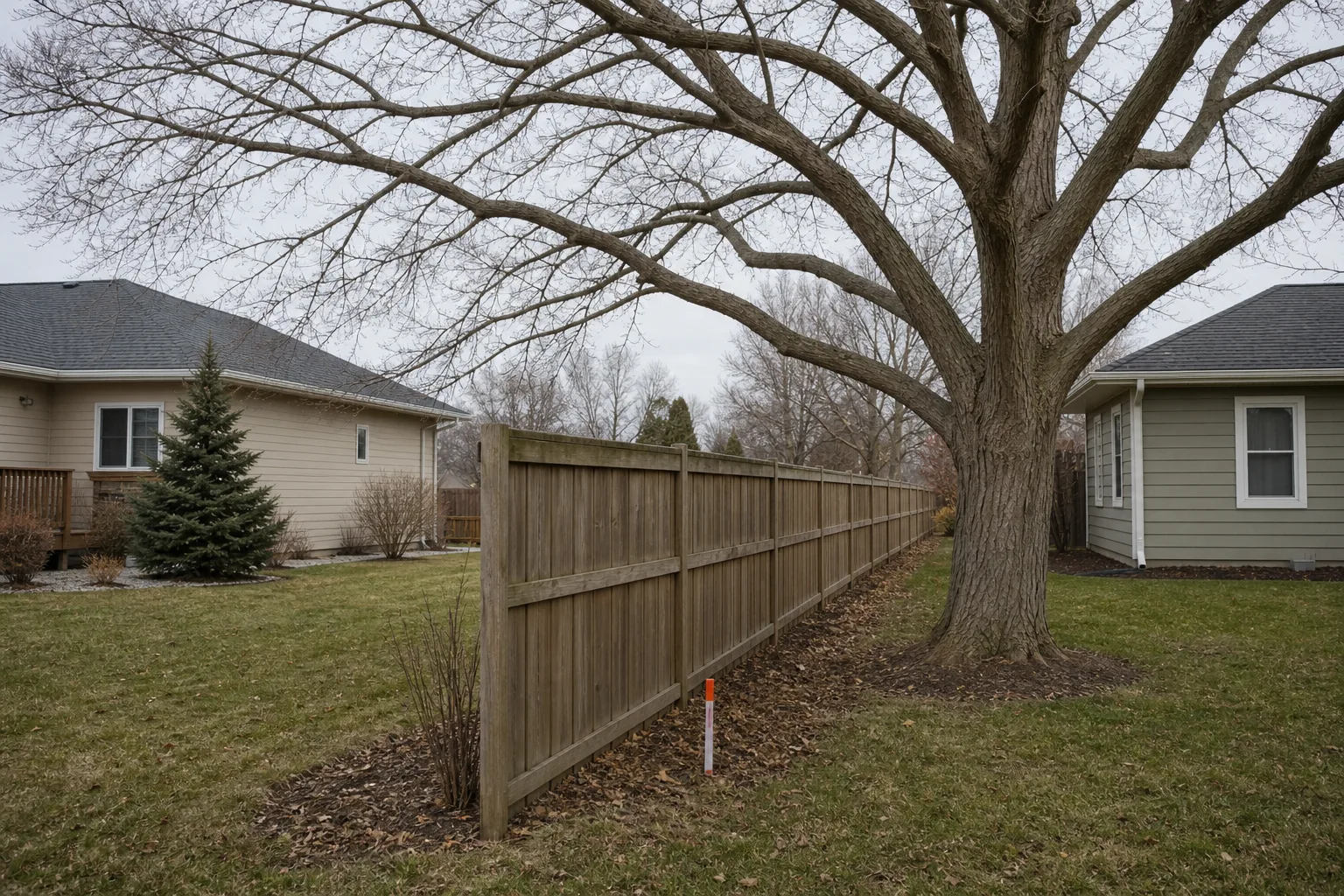
Most tree disagreements between neighbors arrive on a schedule. They start in late summer when a limb sags over the driveway with fruit on it, they get loud after the first wind event of the fall, and they get expensive in February when every climbing crew in the county is booked on storm work. The rules themselves barely change year to year. What changes is how much leverage you have, how long you will wait for a crew, and what the tree will tolerate being cut. Knowing which of the three you are up against in a given month is most of the skill.
There are four separate bodies of rule stacked on top of one another in a typical residential yard: your state's common law about encroachment, your city or county tree ordinance, your zoning code's fence and setback provisions, and, if you have one, a recorded set of covenants. They do not say the same thing, and the one that binds you is usually the narrowest. Work through them in that order before anyone picks up a saw.
The line on the ground is not the line in your head
Ownership of a tree is determined by where the trunk stands at ground level, not by where the canopy spreads or where the roots travel. A trunk entirely on your neighbor's side is their tree, no matter that eighty percent of the shade and all of the leaf litter lands on you. A trunk straddling the line is generally treated as jointly owned, which means neither party can remove it unilaterally. That single distinction decides the rest of the conversation, and it is worth settling with evidence rather than memory.
The evidence is a boundary survey performed by a licensed land surveyor, who sets or recovers the corner monuments and marks the line. Fences, hedges and old landscape timbers are not the line. They are where someone once guessed. Survey work is seasonal in a way people do not expect: surveyors are busiest from late spring through early fall, when closings peak and the ground is workable, and quietest in the dead of winter in cold climates where frozen ground and snow cover make monument recovery slow. In milder regions, winter is genuinely the better time to book, because leaf-off conditions make sight lines along a wooded boundary far easier to shoot. Ask what the turnaround is before you commit to a timeline with your neighbor.
The pruning right, and the three limits on it
Nearly every state recognizes some version of the self-help rule: you may cut branches and roots that cross onto your property, at your own expense, back to the property line. That right is real and it is useful. It also has three limits that people discover after the cut rather than before.
The first limit is trespass. The right to cut does not include a right to stand on the other side of the line to do it. If the only safe way to take a limb is from the neighbor's lawn, or to drop it onto their beds, you need their permission, and you want it in writing even if it is just an email thread. The second limit is the health of the tree. Pruning back to the line is permitted; pruning so aggressively that the tree dies or becomes structurally unsound exposes you to a damages claim, and in many states that claim can be multiplied. Courts have little patience for a homeowner who takes sixty percent of a mature canopy and calls it a boundary trim. The third limit is the local tree ordinance. Many municipalities protect trees above a certain trunk diameter, trees of listed species, or any tree in a designated conservation or historic district. Where an ordinance applies, it applies to the branch over your yard too, and a permit may be required before a crew touches it.
Season matters here more than most people expect. Late winter, while deciduous trees are dormant and before bud break, is the window when a heavy reduction cut does the least harm and the structure is easiest to read. Oaks in much of the country should not be pruned during the warm months at all because of disease transmission risk, and several jurisdictions write that restriction into the ordinance rather than leaving it to good practice. A cut that is routine in February is a liability in June.
Who pays when the tree comes down
The default rule in most states is that a healthy tree falling in a storm is an act of nature. If your neighbor's healthy oak lands on your garage, your own homeowners policy handles the structure and the debris removal on your side of the line, subject to your deductible, and your insurer may or may not pursue the neighbor. That changes entirely when the tree was known to be hazardous. Once the owner has been put on notice of a visibly defective tree and fails to act within a reasonable time, the loss becomes negligence rather than weather, and their liability coverage is in play.
Creating that notice is a procedure, not a conversation over the fence. The sequence that holds up is: get a written assessment from a certified arborist identifying the specific defect, send a copy to the neighbor by certified mail with return receipt, keep the green card, and photograph the tree with a dated image. If nothing happens, send a second letter referencing the first. Do this in the fall, before the wind and ice season, not after. An arborist report dated three weeks before a failure is worth a great deal. The same report dated the day after is worth very little.
Whoever ends up hiring the crew, verify two things: a current certificate of general liability insurance naming you, and workers' compensation coverage for every person who will leave the ground. Tree work is among the more dangerous trades in residential settings, and the Occupational Safety and Health Administration is the federal body responsible for worker safety standards on this kind of job. An uninsured climber who falls in your yard becomes your problem in a way no price advantage can offset.
Fences, shared costs, and the code that sets the height
Fence disputes follow the same stacking pattern. Many states have a division fence or good-neighbor fence statute that allows an owner to require a neighbor to share the reasonable cost of a boundary fence, usually with advance written notice and sometimes with a specified process through a local official. Those statutes are old, they vary sharply, and they often apply differently to agricultural and residential parcels. Read your state's version before assuming anyone owes you half.
Separately, zoning sets height limits, which commonly run lower in a front yard than a rear yard, and which can tighten further at a corner lot for sight-line reasons. Covenants may add material and color requirements on top. A fence built on the line is jointly owned and jointly maintained in most states; a fence built a few inches inside your line is yours alone to repair and yours alone to replace, which is sometimes the cleaner outcome. Fence contractors price lowest and schedule fastest in late winter and early spring, before the season opens up. If you already know a fence is coming, that is the quarter to sign.
Putting the sequence in calendar order
The version that keeps relationships intact looks like this. Survey in the off-season so the line is a fact rather than an argument. Raise the issue in writing in early fall, when there is time to act and no emergency pressure. Get the arborist assessment before the storm season rather than after. Confirm the ordinance and pull any permit while the permit counter is quiet. Schedule structural pruning for the dormant window. Book fence work in the first quarter.
Handled on that schedule, almost every one of these matters resolves between two households and a contractor, with no attorney involved and no surprise about who pays. The rules are not hostile to homeowners. They mostly reward the one who moved first and wrote it down.
About the author
Wesley writes about timing, and why the same job costs differently in March.