Under Contract and Ten Days to Decide? Which Inspections Earn Their Fee
A general home inspection, the specialty add-ons, and the engineer's report do three different jobs. Here is how to tell which you need and what good work looks like.
| Author | Junko Halloran |
|---|---|
| Section | House & Home |
| Published | |
| Length | 1,347 words · 6 min |
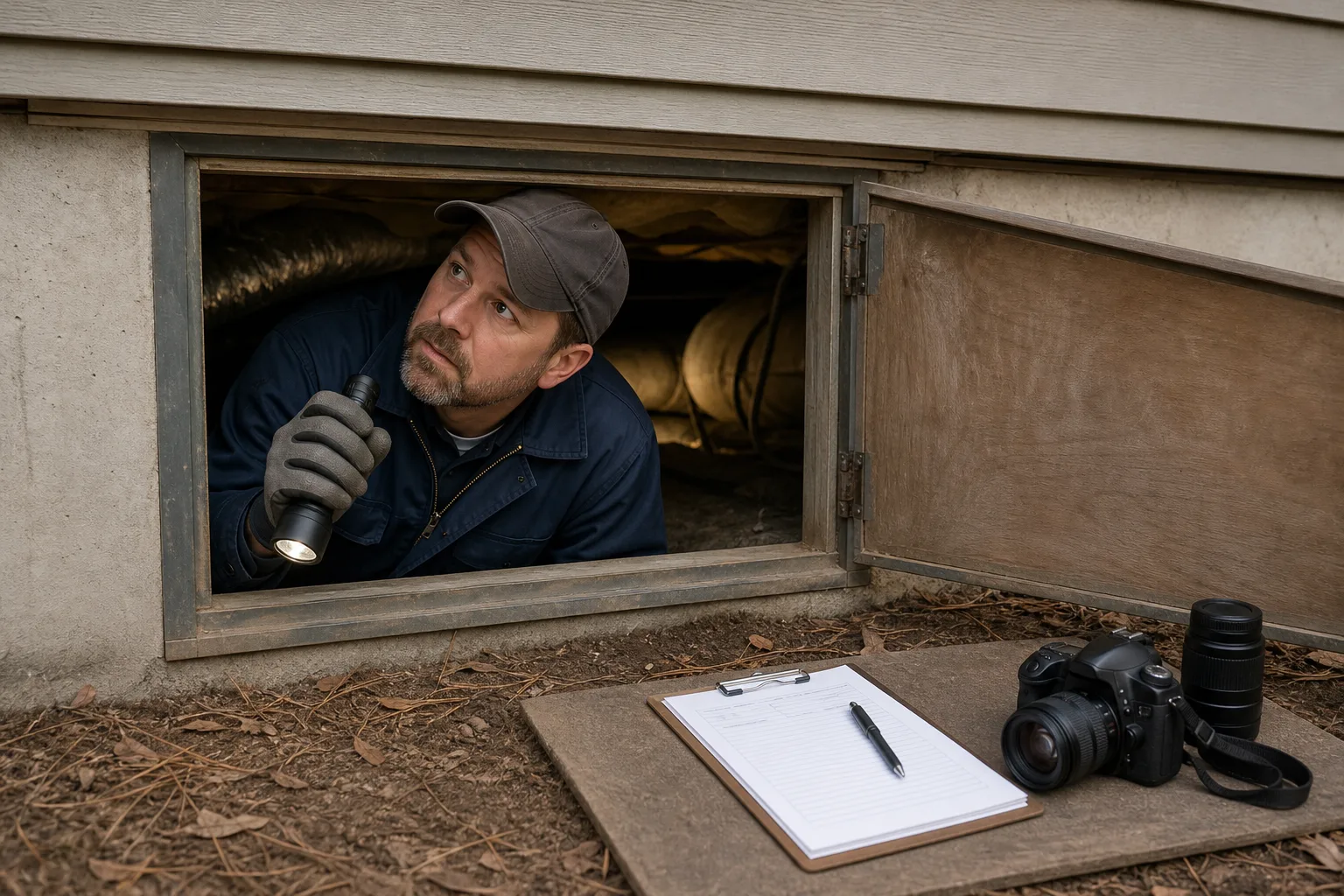
The inspection period on a residential purchase contract is usually measured in days, not weeks, and it starts running the moment both parties sign. That compression is what pushes most buyers into the cheapest available choice: one general inspector, one visit, one report, decision made. Sometimes that is the correct call. Often it leaves the two or three questions that actually carry money on them unanswered, because the person you hired was never engaged to answer them and said so on page one of the agreement you did not read.
What follows is the distinction between the tiers of inspection available on a typical American house, who genuinely needs each, and the practical markers that separate a thorough job from one that technically complied.
The general inspection is a visual survey with a defined boundary
A general home inspection is a non-invasive, visual examination of the readily accessible systems and components of a house: roof covering, exterior cladding, structure as visible, attic, foundation and crawlspace as accessible, plumbing, electrical, heating and cooling, interior finishes, and the installed appliances. The operative words are visual, accessible, and non-invasive. The inspector does not open walls. They do not lift carpet or move a heavy dresser. They do not dismantle a furnace or pull the panel on a sealed system. If a crawlspace hatch is blocked by stored boxes, the inspection report will say the crawlspace was not inspected, and that sentence is doing real work.
Understanding that boundary matters more than any other single thing in this process. A general inspection is a screening tool. It is designed to find the conditions that warrant a closer look, to confirm that major systems operate at the time of the visit, and to document what the inspector could actually see. It is not a warranty, not a prediction of remaining service life, and not a repair estimate. An inspector who writes "recommend evaluation by a licensed electrician" is not dodging. That is the report doing exactly what it is built to do: escalating a question to the trade that can answer it.
The specialty inspections are separate trades, ordered separately
Four add-ons come up often enough that they are worth considering on nearly any resale house, and a fifth or sixth depending on the region and the construction.
| Inspection | What it answers | Who performs it |
|---|---|---|
| Sewer scope | Condition and slope of the lateral line from the house to the main | Plumber or dedicated scope technician with a camera |
| Radon test | Indoor radon concentration over a measured period | Measurement professional, device left in place 48 hours or longer |
| Wood-destroying insect (WDI) | Active or prior termite and beetle activity, conducive conditions | Licensed pest control operator |
| Chimney, Level 2 | Flue interior by camera, including concealed portions | Certified chimney sweep or inspector |
| Pool and spa | Equipment, bonding, barrier compliance, surface condition | Pool service contractor |
The chimney tier system is worth knowing because it mirrors the broader logic. A Level 1 chimney inspection is a visual check of readily accessible portions. A Level 2 adds a camera up the flue and is the standard triggered by a property transfer or a change of appliance. A Level 3 involves removing masonry or other components and is ordered only when a Level 2 found something that cannot be resolved from the outside. The same escalation runs through every category here: screen, then look closer only where the screen gave you a reason.
Radon in particular is worth ordering on its own merits rather than in response to a finding, because elevated radon is invisible, odorless, and entirely unrelated to the apparent condition of the house. The Environmental Protection Agency is the federal body responsible for radon guidance and for the indoor air program under which measurement professionals operate, and a short-term test sitting in a closed basement for two days is among the least disruptive items on this list.
When the answer has to come from a licensed engineer
There is a category of question that a home inspector is not permitted to answer and a contractor has a financial interest in answering a particular way. Structural movement is the clearest case. If the report notes stair-step cracking in a block foundation wall, horizontal cracking with inward bow, a sloped floor that reads consistently across several rooms, or a load path that appears to have been modified during a past renovation, the next call is to a licensed professional engineer, typically one practicing structural engineering in your state.
What you are buying there is different in kind. The engineer issues a signed letter or report that states a professional opinion on cause, on whether the condition is active or stable, and on what remediation, if any, the structure requires. That document carries weight in a repair negotiation, carries weight with an insurer, and carries weight with the next buyer when you eventually sell. A foundation contractor will also look at your cracked wall, at no charge, and will produce a proposal. Those are not the same product.
What a good job looks like in the ordinary week
Strip away the credentials and the distinctions above and most of the difference between an excellent inspection and a barely adequate one shows up in scheduling and logistics, which is to say in the unglamorous week-to-week reality of getting it done.
- Time on site. A thorough inspection of an average single-family resale takes hours, not forty-five minutes. If the appointment is booked back to back with two others, you are buying a walk-through.
- Access arranged in advance. Good inspectors send a pre-visit list to the listing agent: utilities on, attic hatch clear, crawlspace accessible, pilot lights lit, garage emptied enough to reach the panel. Barely adequate inspections produce reports full of "not inspected" lines because nobody asked.
- You attend, at least for the last hour. The verbal walkthrough at the end is where the inspector distinguishes the cosmetic from the consequential. A report alone flattens everything to the same visual weight.
- Turnaround inside the deadline. A report delivered on day eight of a ten-day period leaves no time to get a plumber out for a second opinion. Ask for the turnaround commitment in writing before you book.
- Specialty vendors booked the same day you book the generalist. The sewer scope and the radon device should not wait on the general report. Radon alone needs the device sitting undisturbed for at least two days.
Who needs which
Work the arithmetic rather than the adjectives. I am deliberately not quoting dollar figures, because inspection pricing is local, scales with square footage, and moves; what does not move is the structure of the decision. Collect three quotes for the general inspection and a flat quote for each add-on, total them, and compare that total against the cost of the single cheapest repair each one could plausibly surface. A sewer lateral replacement under a mature front yard is a four-figure to five-figure job in any market. The scope that finds it costs a small fraction of that, and it is the clearest favorable ratio on the list.
By situation: a buyer of a house under ten years old on municipal sewer can reasonably run the general inspection plus radon and WDI. A buyer of anything with a mature tree between the house and the street adds the sewer scope without debating it. A buyer of a pre-1980 house with a fireplace in use adds the Level 2 chimney inspection. Anyone whose general report contains the word "structural" stops, extends the inspection period in writing if the contract allows, and hires the engineer. And a seller preparing to list can run the general inspection and the sewer scope ahead of time, which converts the surprises into scheduled work done at a contractor's normal rate rather than concessions negotiated under a deadline.
The buyers who come out of this well are rarely the ones who spent the most. They are the ones who decided, in the first forty-eight hours after signing, which three questions the house was actually asking them, and then hired the right person for each.
About the author
Junko covers what work costs and why two quotes for the same job differ.