A Roof Survey Landed in Your Inbox and Nobody Is There to Explain It. Three Ways to Read It
A roof report arrives as a PDF of drone photos and a measurement page. Here is how three ways of reading it compare, and which line items decide the final bill.
| Author | Junko Halloran |
|---|---|
| Section | House & Home |
| Published | |
| Length | 1,202 words · 5 min |
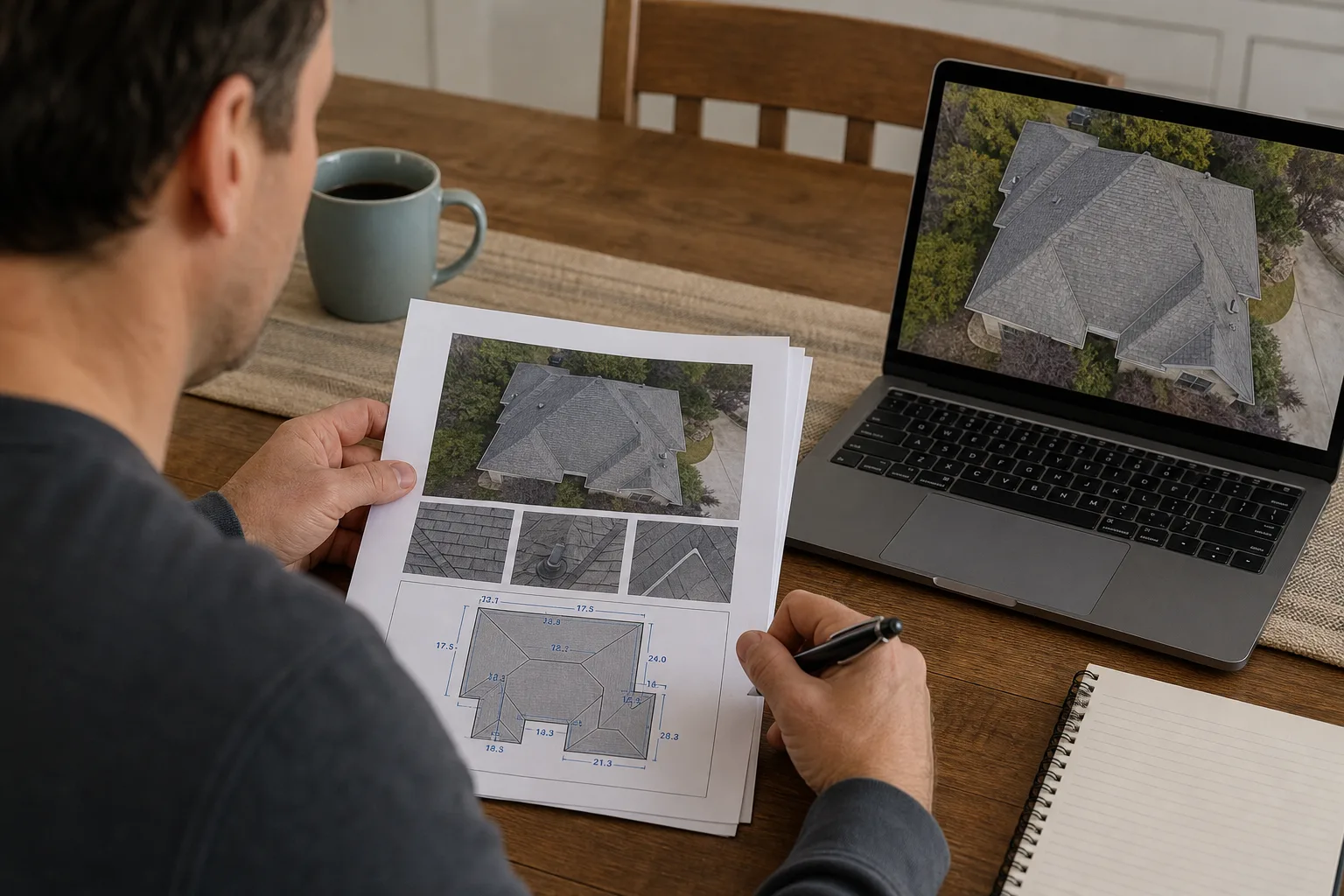
The survey usually arrives as a PDF. Thirty or forty aerial photos, a diagram of the roof planes with numbers along each edge, a page of findings written in a register somewhere between a technician's notebook and a sales document, and then a price. The person who produced it is not sitting across the table from you. You may not want them to be, because the moment they are, the reading of the document and the selling of the work happen at the same time. Reading it alone is the better position. It only works if you know which pages carry weight.
What is actually in the file, and which parts are verifiable
A roof survey is three different documents stapled together, and they have very different reliability.
The first is the photo set. This is the most useful part and the part homeowners skim. Photos are evidence: a lifted shingle tab is either in the frame or it is not. A good survey labels each photo by roof plane or by compass direction, so you can tell the north slope from the garage. A barely adequate one gives you twenty unlabeled images, several of which are the same chimney from slightly different angles. You can test this yourself in ten minutes. Open the diagram, then try to place every photo on it. If you can place fewer than two thirds, the inspector was documenting a conclusion rather than a roof.
The second is the measurement take-off: total area in squares (one square is 100 square feet of roof surface), linear feet of ridge, hip, valley, rake and eave, pitch for each plane, and a count of penetrations. These numbers are usually produced from aerial imagery and they are checkable against public parcel data and your own footprint. The third is the findings-and-scope narrative, which is judgment. Judgment is not worthless, but it is the part that moves with the incentive of whoever wrote it, so it is the part you read last and most slowly.
Three ways to get it read, and what each one costs you
There are really three routes, and they are not mutually exclusive. Most households end up using two.
| Route | Typical outlay | What it reliably catches | What it misses |
|---|---|---|---|
| Read it yourself against a checklist | Your time, roughly two hours | Missing photo coverage, arithmetic on squares and waste, vague scope language, allowance items with no unit price | Whether the condition described actually warrants replacement rather than repair |
| Pay for an independent read (home inspector with a roofing focus, or a licensed engineer for structural questions) | A flat fee, quoted before the visit; engineers charge more and write a stamped opinion | Whether the deck, framing and ventilation support the proposed scope; whether damage is storm-related or age-related | Market pricing. Inspectors do not price labor and generally decline to |
| Get a second contractor's bid and compare line by line | Usually free, costs you a second appointment | Price range, differing opinions on decking, flashing and ventilation, local code items one bidder omitted | Nothing, if both bidders share the same blind spot, which happens more than you would expect |
The self-read is not a consolation prize. It is what makes the other two routes productive, because it turns a vague unease into four specific written questions. The independent read is worth paying for in exactly one situation: when the survey claims a structural problem, when it recommends replacing decking across most of the roof, or when an insurance claim is in play and the carrier's position and the contractor's position differ. Otherwise the second bid is the better buy, because it tests the price and the scope at once.
A worked example on the measurement page
Suppose the diagram gives you 2,850 square feet of roof surface across six planes, pitches of 6/12 and 8/12, 180 linear feet of eave, 96 feet of ridge and 64 feet of valley. That is 28.5 squares. Now look at what the contractor ordered. Material quantities on a real roof always exceed the measured area because of cuts at hips and valleys, and the figure used to cover that is the waste factor. A simple gable roof with no valleys might run a low single-digit percentage. A cut-up roof with 64 feet of valley will run higher. What you are checking is not whether the waste factor is correct in the abstract. It is whether the quantity on the order matches the complexity on the diagram, and whether you are being charged for waste as material or as material plus labor.
Then check the things that are measured in linear feet, because those are the ones quietly dropped. Drip edge should appear at close to 180 feet of eave plus the rake measurement. Ice and water membrane, where local code requires it, should appear as a stated number of courses at the eaves and full coverage in all 64 feet of valley. Ridge vent should be a number, not the word "as needed." I cannot tell you what any of this costs where you live, because roofing labor is priced locally and the same scope in two metro areas can differ substantially. What I can tell you is that if a line has no quantity, it has no price you can hold anyone to.
The language that decides what you pay at the end
Decking is where most roofing jobs find their overrun. Nobody knows what the sheathing looks like until the old roof is off, and an honest survey says so. The difference between a good document and a barely adequate one is not whether the uncertainty is acknowledged but whether it is priced. Good: "Deck replacement, if required, at a stated dollar amount per 4x8 sheet, documented by photograph before installation, approved by owner in writing." Barely adequate: "Replace rotten decking as needed." The second sentence is a blank check with a friendly tone.
Apply the same test to flashing (replaced or reused, and if reused, say so), to pipe boots (counted or not), to the chimney (counter-flashing reglet cut into masonry, or caulk), and to disposal and permit fees. Regional code drives several of these, which is why a roofer in columbus oh will write a different ice-barrier and ventilation note than someone bidding the same house plan in a dry climate, and why a scope copied from a national template is a flag worth asking about. The Federal Trade Commission oversees how home improvement work is advertised and contracted to consumers, and its general framing is the right one to carry into the reading: the specifics you agree to in writing are the specifics you are owed.
Send your questions by email and number them. A contractor who answers four numbered questions in writing, with quantities, has told you a great deal about how the job will be run before anyone sets a ladder against the house.
Keep the PDF, your annotated copy, and the email thread in one folder. If a shingle lifts in year three, the argument you will be having is about what was promised and what was installed, and the person holding a labeled photo set with quantities attached is the person who wins it quickly.
About the author
Junko covers what work costs and why two quotes for the same job differ.