Most Maintenance Schedules Fail Because They Are Too Long and Attached to Nothing
Maintenance schedules fail for the same reason every time: too long, too detailed, and attached to nothing that already happens in the year.
| Author | Junko Halloran |
|---|---|
| Section | House & Home |
| Published | |
| Length | 978 words · 4 min |
The belief behind every abandoned home maintenance list is that the problem was discipline. It rarely is. Most of these lists are downloaded in January, contain sixty items across twelve months, specify tasks for systems the house does not have, and require somebody to consult a document they will not remember to consult. By April it has fallen behind, by June it is generating guilt rather than action, and by October it is gone. A list that survives has different properties, and building one takes an afternoon and produces something considerably shorter than what people expect.
Sort Every Candidate Task Into Three Tiers
Start by dividing everything into safety, prevention and cosmetic, because those three deserve completely different treatment. Safety items are the ones where failure hurts somebody: smoke and carbon monoxide alarms tested and batteries changed, the dryer vent, combustion appliance venting, the ground fault outlets in bathrooms and kitchens pressed and reset. These are short, cheap, and non-negotiable, and they belong at the top of every list. Prevention items are the ones where failure costs money: gutters, water heater, the shutoff valve exercised so it still turns, caulk and flashing, the condensate drain. Cosmetic items are everything else, and the useful decision is to accept that they will happen when they happen.
The tiering matters because a list that treats a filter change and a fence stain as equivalent obligations is a list nobody can prioritize in a busy month, and a list that cannot be prioritized gets abandoned whole rather than trimmed. Two of these tiers are commitments and belong on the page. The third is a wish, and writing it somewhere else entirely is what keeps the page honest. A household that completes every safety and prevention item in a year and stains nothing has had a successful year of home maintenance, and a list that makes that feel like failure is working against itself.
Anchor Each Item to Something Already in Your Year
This is the step that decides whether the calendar survives, and almost no downloaded list does it. Tie each task to an event that already reliably happens rather than to a month. Alarms get tested when the clocks change. Gutters get cleared the weekend after the last leaves come down, which is a condition rather than a date. Filters get changed on the first of the quarter, which is easy to remember because bills arrive then. The outdoor faucets get shut off the weekend the first freeze is forecast. Anchoring works because it borrows a reminder that is already firing rather than asking somebody to remember one more thing independently.
Batch by Location Rather Than by System
Most published schedules organize by system, which is logical and wrong for the way people actually work. A list that sends somebody to the basement in March, in June and again in September produces three trips down the stairs and three opportunities to postpone. A list organized by place produces one trip with five things to do while you are there: water heater, shutoff valve, sump pump tested, dehumidifier cleaned, exposed pipes checked. Do the same for the attic, the roofline and gutters, the exterior perimeter, and the mechanical closet. Four or five batches, each a single session, replaces twenty individually scheduled tasks.
Write the Whole Thing on One Page and Decide What You Are Hiring
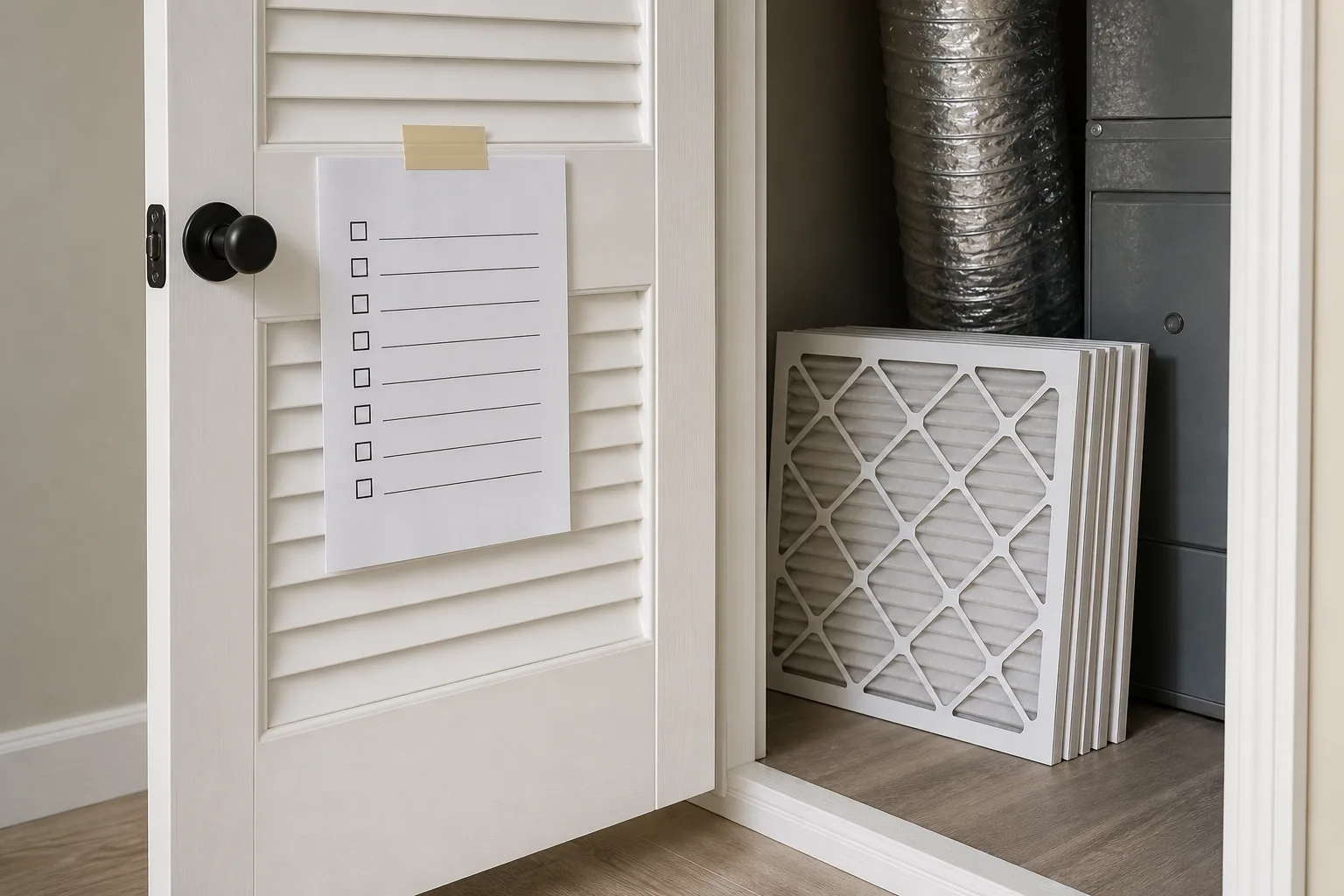
If it does not fit on one page it will not be used, and the discipline of fitting it there forces the cosmetic tier off the list where it belongs. Print it, and put it somewhere the work happens rather than in a drawer: inside the utility closet door, on the side of the panel, in the garage. Then mark which items you are not doing yourself, and mark them honestly. Anything on a steep roof or above single-story height, anything involving gas or the combustion side of an appliance, anything requiring the panel to be opened, and any drain line that needs a camera all belong to somebody else, and writing that on the list means the item gets scheduled rather than deferred indefinitely.
Include the annual service visits on the same page along with the month each should be booked rather than the month it should happen, because heating service arranged in September is a routine appointment at a routine price and the same call made in November is competing with everybody whose furnace has just failed. The same logic applies to cooling in March, chimney work in late summer, and any tradesperson whose calendar fills seasonally. Booking ahead of the rush is the single cheapest form of leverage a homeowner has, and it costs nothing but a note in the right month.
The Items Worth Adding That Almost No List Includes
A few things belong on a household calendar and rarely appear on published ones. Exercise the main water shutoff once a year so it still turns when it matters, since a valve that has not moved in a decade frequently will not. Photograph the contents of each room annually for insurance purposes, which takes ten minutes and is worth a great deal after a loss. Check for recalls on the appliances and equipment in the house, which the Consumer Product Safety Commission publishes as searchable notices covering everything from space heaters to smoke alarms, and which almost nobody thinks to look at once a product is installed and working.
Built this way, a home maintenance calendar stops being an aspiration and becomes a set of four or five short sessions attached to things that already happen. It fits on one page, most of it is safety and prevention, the expensive items are marked as somebody else's job, and nothing on it requires remembering a date in isolation. That is a list still in use in October, which is the only test that matters.
About the author
Junko covers what work costs and why two quotes for the same job differ.