Changing the Filter and Nothing Else? The Cleaning That Decides How Long Equipment Lasts
Filters and lint screens are the visible half. The parts that actually foul sit one panel further in, and they are why equipment gets replaced early.
| Author | Wesley Tarbox |
|---|---|
| Section | House & Home |
| Published | |
| Length | 888 words · 4 min |
Picture the maintenance most households actually perform on the equipment that heats and cools them: a filter changed a few times a year, a lint screen emptied, maybe a vacuum run over a return grille. All of that is worth doing and none of it reaches the parts that determine whether a system lasts twelve years or twenty. The components that foul are one panel further in, they cannot be seen without removing something, and their condition is invisible from the thermostat right up until the point where a repair bill arrives. Knowing what is behind that panel changes what you ask for when somebody comes to service it.
The Blower Wheel, Which Almost Nobody Looks At
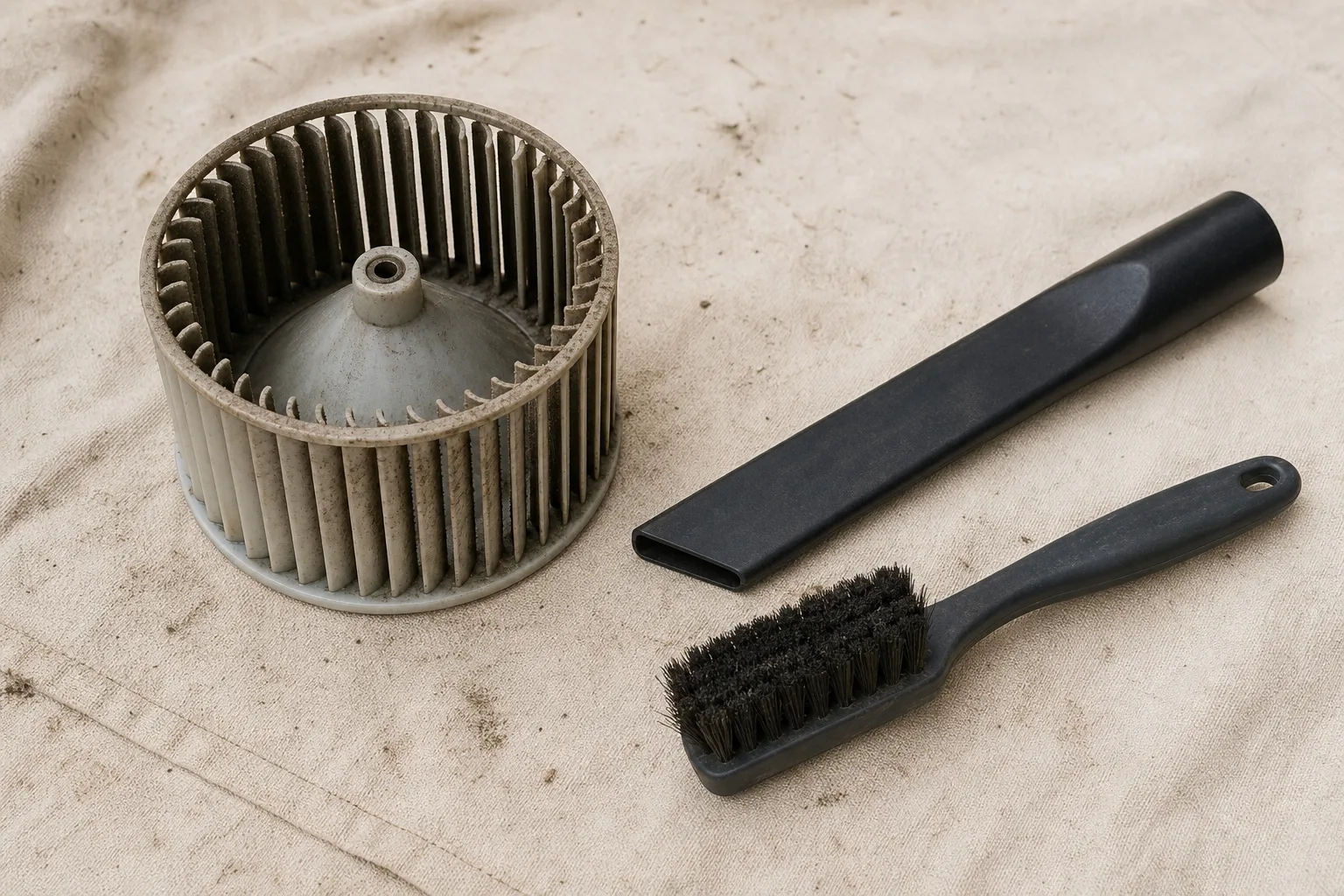
The blower is a squirrel-cage wheel with a few dozen small curved fins, and each fin moves air only if its shape is intact. Fine dust that slips past a filter, and every filter passes some, collects on those fins in a layer that thickens over years until the wheel is effectively a smooth cylinder. Airflow falls steadily, the motor draws more current to move less air, and the whole system starts behaving like a smaller one. The symptoms are vague enough to be blamed on anything: rooms that never quite reach temperature, longer run times, a slightly noisier unit. Cleaning it properly means pulling the wheel, which is why it is skipped.
The Coils, Both of the Ones You Have
A cooling system has two coils and both get neglected for different reasons. The outdoor condenser coil sits in the weather collecting cottonwood, grass clippings and dust, and it is at least visible, so it gets rinsed occasionally. The indoor evaporator coil sits inside the ductwork above or beside the air handler, wet whenever the system runs, and it collects a felt of dust that turns into a mat. That mat insulates the coil, drops capacity, and lowers the coil temperature to the point where ice can form, which restricts airflow further. It is a genuine cleaning job with chemicals and access panels rather than a rinse, and it is the single most commonly deferred item on any maintenance list.
The Condensate Drain, Which Causes the Ceiling Stains
A cooling system removes water from the air continuously during the season, and that water leaves through a small drain line, often three quarters of an inch across, running to a floor drain or outside. Biological growth in a dark wet pipe narrows it gradually until it stops. Where the air handler sits in an attic, the resulting overflow lands on a ceiling, and the repair costs many times what the system service did. The float switch that is supposed to shut the equipment down before that happens is a small inexpensive part that not every installation has and not every technician tests. Ask whether yours is present and whether it was tested, because the answer is occasionally no.
The Exhaust Paths Everywhere Else in the House
Every appliance that moves air out of a building has a path, and every one of those paths is a maintenance item nobody scheduled. Dryer ducts pack with lint. Bathroom fans lose most of their capacity to dust on the impeller and to a duct that was never properly connected in the attic. Range hood filters and the duct behind them collect grease. Combustion venting on a furnace or water heater has to stay clear for reasons that go beyond efficiency, and it is worth confirming that whoever services the heating equipment actually looks at it rather than assuming.
All of these are cheap to address while they are still working and expensive once they are not, which is the pattern the whole list follows. A bathroom fan cleaned and properly ducted costs an hour of somebody's time; the same fan left to recirculate moist air into an attic eventually costs sheathing. Put them on the same schedule as the equipment service rather than treating them as separate jobs nobody owns, because a maintenance item that belongs to nobody in particular is one that will not happen.
What a Maintenance Visit Should Include, and How to Ask for It
A visit worth paying for goes beyond a filter and a temperature reading. It should include an inspection of the blower wheel with a report on its condition, a cleaning of both coils or a plain statement of why they do not need it this year, a flush of the condensate line and a test of the float switch, an electrical check of contactors and capacitors, and refrigerant pressures read and recorded rather than merely glanced at. Ask for the readings in writing, and keep them, because a single year's numbers say very little and four years of the same numbers say a great deal about what is changing.
The reason any of this is worth the trouble is that the equipment failing early is not usually a manufacturing question. It is a question of a motor that spent nine years pushing against a dirty wheel and a compressor that spent nine summers rejecting heat through a coil wearing a blanket. Both of those are reversible with an afternoon of somebody's attention. The filter on the return grille is a genuinely useful habit, and it is the doorway to the work rather than the work itself.
About the author
Wesley writes about timing, and why the same job costs differently in March.