From the Roof Edge to Six Feet Out: The Drainage Path That Keeps a Basement Dry
Interior water problems are traced back to roof drainage far more often than to foundations, and the fix is usually cheap, outdoors, and takes a Saturday.
| Author | Corinne Adeyemi |
|---|---|
| Section | House & Home |
| Published | |
| Length | 879 words · 4 min |
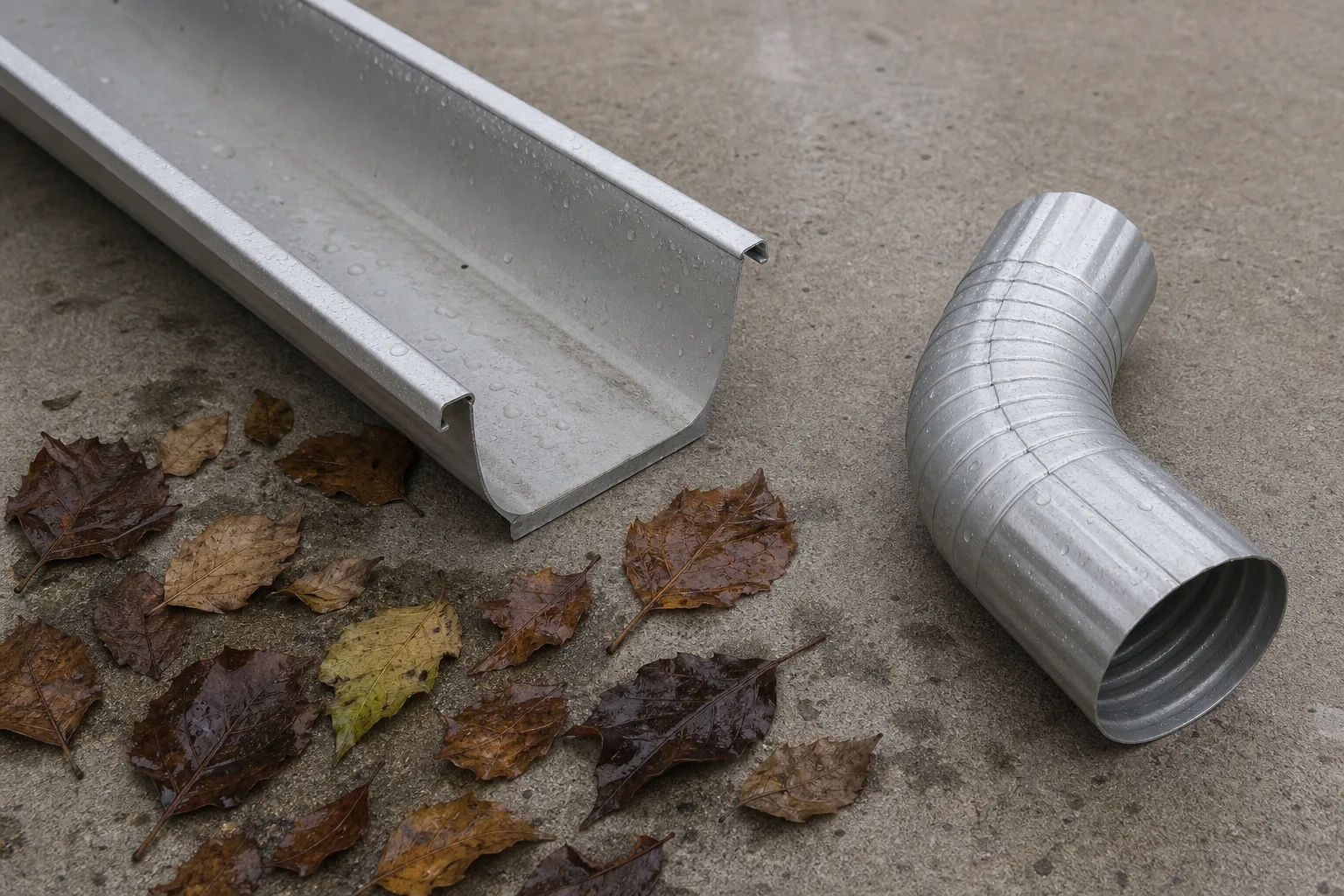
A homeowner finds a damp patch on a basement wall in November and starts pricing foundation work, which is where the money is and where the anxiety naturally goes. Contractors who do this for a living tend to start somewhere much less dramatic, at the roof edge, and follow the water down. A roof of ordinary size sheds an enormous volume during a heavy rain, all of it collected into a handful of downspouts, and if those spouts release it against the wall the ground next to the foundation becomes saturated every time it rains. The fix for that is usually a Saturday, a ladder, and a few lengths of extension.
Clear the Gutters After the Leaves Are Down, Not Before
Timing is what separates one cleaning from three. A gutter cleaned in early October fills again by the middle of November in any yard with mature deciduous trees, so the useful pass is the one done after most of the leaves have actually fallen, which in much of the country means late in the season and sometimes uncomfortably close to the first freeze. If the trees overhang the house directly, two passes is realistic, one mid-season to keep water moving and one at the end to leave the system clear through winter. Ice forming in a gutter already packed with wet debris is what tears fasteners loose and lifts the edge of a roof.
While the ladder is up, look at the things that are cheaper to notice than to repair. Check that hangers are tight and spaced closely enough that the run does not sag between them, that seams are not weeping, and that the gutter still pitches toward the outlet rather than holding a puddle. Standing water in a gutter after the debris is out means the pitch has moved, and correcting it now costs an hour.
Follow the Water Once It Leaves the Downspout
This is the step most people skip, and it is the one that actually decides the basement. Go out during the next real rain and watch where each downspout discharges, because a spout that ends at a splash block eighteen inches from the wall is putting hundreds of gallons into the exact soil you least want saturated. Extensions that carry the discharge six feet or more away from the foundation cost very little and are the highest-value item on this list by a wide margin. Where a buried drain line already exists, confirm it is actually flowing rather than assuming, since a line packed with silt looks identical from the top to one that works.
The Six Feet of Ground Closest to the Wall
Backfill settles for years after a house is built, and a grade that sloped away from the wall at completion very often slopes back toward it a decade later. Walk the perimeter and look for ground that is flat or dishes inward, for mulch beds built up against siding, and for patios or walkways that have tilted toward the house. The general target is a fall of roughly six inches over the first ten feet, achieved with soil rather than mulch, since bark holds water and floats. This is wheelbarrow work rather than skilled work, and it repays the afternoon it takes more reliably than almost anything else a homeowner can do outdoors.
The Parts Worth Handing to Somebody Else
Two things on this list belong to other people. Anything on a steep roof, a second story reached by an extension ladder, or a gutter run over a hard surface is a fall risk that does not become safer because the job is small, and ladders are a consumer product regulated like any other, with duty ratings and standards enforced through the Consumer Product Safety Commission, which is worth remembering mainly because the ladder in most garages is rated lighter than the person plus tools who is about to climb it. The second is a buried drain line that has stopped flowing, where a camera and a jetter in the hands of somebody who owns both will settle in an hour what a homeowner can spend a weekend guessing at.
Why the Cheapest Work in the Yard Compounds the Fastest
Water against a foundation does not announce itself with a flood. It works slowly, saturating soil that then freezes and expands, keeping a wall damp enough that efflorescence appears and finishes fail, and eventually creating the conditions people pay five figures to correct. Every stage of that sequence begins with the same input, which is roof water released too close to the house, and interrupting it costs a ladder, a few extensions, and some soil moved with a shovel.
The damp patch that sent the homeowner shopping for foundation work is worth reading as information rather than as a verdict. Follow the water backward from the wall to the grade, from the grade to the downspout, and from the downspout to the gutter, and in most houses the answer turns up somewhere along that path well before anybody needs to talk about excavation. Doing that walk once each fall is the whole maintenance program, and it is one of the few jobs on a house where an afternoon of ordinary effort genuinely prevents the expensive version.
About the author
Corinne writes for readers doing some of the work themselves.