Why Do the First Two Days After a Leak Decide Whether This Is a Rebuild?
What happens in forty-eight hours determines whether this is a drying job or a rebuilding job. The sequence is not obvious and the expensive mistakes happen early.
| Author | Corinne Adeyemi |
|---|---|
| Section | House & Home |
| Published | |
| Length | 1,168 words · 5 min |
A supply line behind a washing machine lets go on a Saturday morning and by the time anybody notices, water has crossed a laundry room, run under a wall, and found the edge of a hardwood floor. What that eventually costs is decided almost entirely in the next two days, and the decisions that matter are not the obvious ones. Materials that are wet for a day usually dry. Materials that are wet for three days often do not, because the biological clock starts before the drying does, and once it has started the job stops being about water and becomes about replacement.
The First Ten Minutes, Which Are About Water and Electricity
Stop the source before anything else. That means the fixture shutoff if one is reachable and accessible, and the main valve if it is not, and every household should know where that main valve is before the day it matters rather than looking for it in a crawlspace with a flashlight. Then deal with electricity, because water and power in the same room is the only genuinely dangerous part of the whole event. Kill the circuits serving the affected area at the panel, and where the water is deep enough to reach outlets or where the panel itself is wet, stay out and call the utility. Nothing in the room is worth entering standing water for.
What Kind of Water This Is, Which Governs Everything After
Restoration professionals sort water into three categories and the category decides what can be dried and what must be discarded. Clean water from a supply line or a water heater is the best case and most materials can be saved if drying starts quickly. Water that has passed through an appliance, a dishwasher discharge or a washing machine drain, carries contamination and narrows the options. Sewage backup or floodwater from outside is in a different class entirely, and porous materials it has touched, carpet, pad, insulation, drywall below the line, are generally removed rather than dried. The category also worsens with time, so clean water sitting for two days is no longer clean water.
Photograph Everything Before Anybody Moves Anything
The instinct is to start mopping, and ten minutes of documentation first is worth more than those ten minutes of cleanup. Photograph and film the standing water, the source, the extent of the spread, and every affected item before it is moved, including the underside of furniture and the contents of cabinets. Shoot the room wide first so the location is established, then close on damage. This is the material an adjuster will work from and it cannot be recreated later, which is why it is the one step that becomes impossible rather than merely harder if it is skipped.
Call the insurer while the water is still on the floor, and read the policy while waiting for a call back. Two provisions matter immediately: whether sudden discharge is covered, which it usually is, and what the policy requires of you in the way of mitigation, which is generally an obligation to prevent further damage. That obligation is why acting quickly protects the claim as well as the house, and it is also why receipts for anything spent on mitigation should be kept from the first hour.
Extraction and Air Movement, and Why a Dehumidifier Is Not a Fan
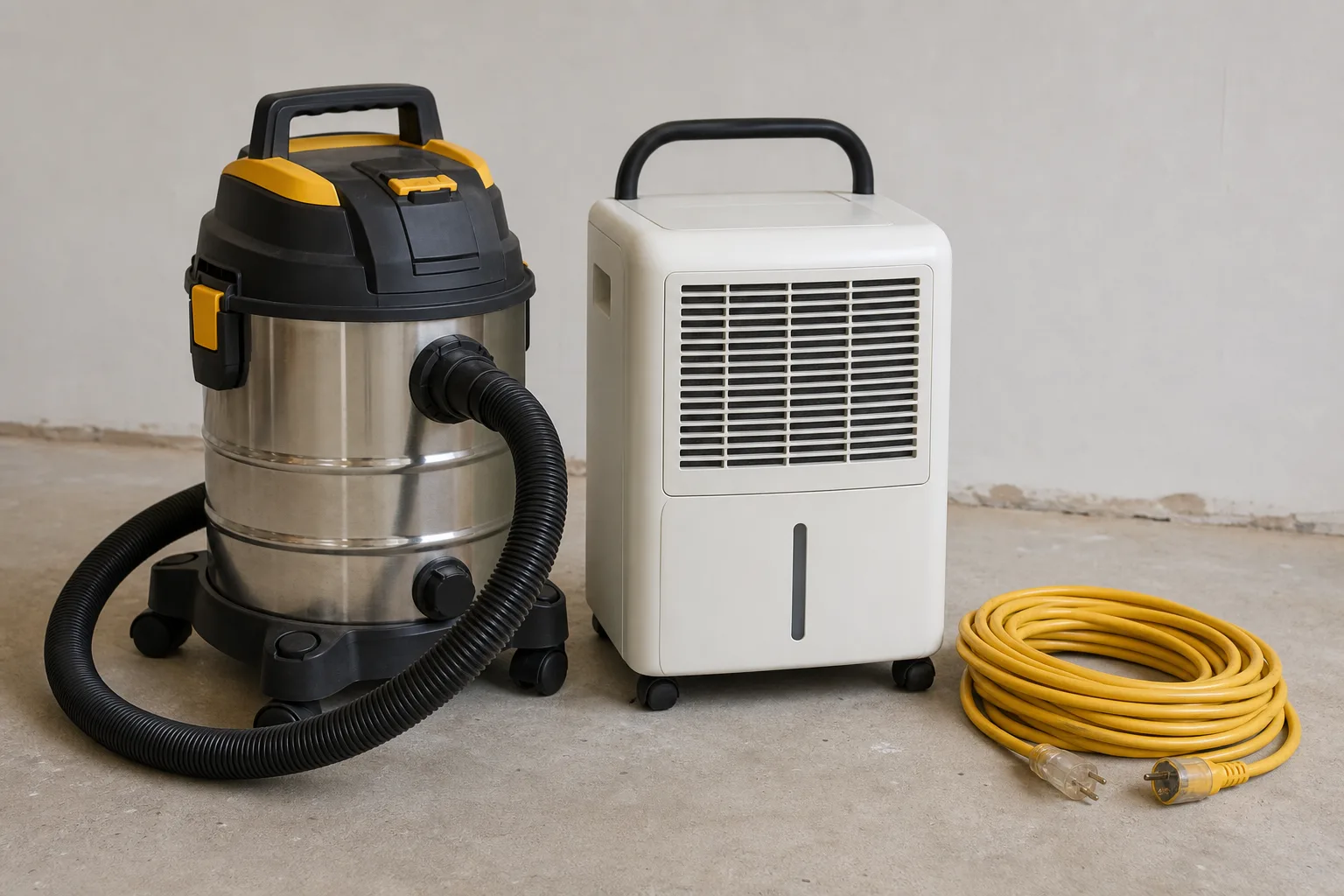
Standing water comes out with a wet vacuum or a pump, and the more that leaves mechanically the less has to leave through the air. Then set air moving across wet surfaces rather than into the room generally, which means fans aimed low and along floors and walls at an angle rather than pointed at the middle of the space. The part most households get wrong is the next one. Moving air alone lifts water into the air and leaves it in the building, so a dehumidifier has to be running at the same time to take that moisture out, and windows should generally stay closed while it works rather than open, since the outdoor air in a humid summer is bringing moisture in rather than removing it.
Rental equipment is available almost everywhere and a single household dehumidifier is rarely enough for a room-sized loss. Where the affected area is larger than a bathroom, or where water has reached more than one room, this is the point at which a restoration company with commercial equipment is not an indulgence but the difference between drying and not drying.
Opening Up and Measuring Rather Than Guessing
Water travels inside assemblies and does not stay where it is visible. Baseboards come off, and small holes drilled low in the drywall let air into the cavity behind it, which is a repair costing very little compared with replacing a wall that stayed wet. Carpet pad is almost always discarded since it holds water like a sponge, and carpet itself can often be saved if it is lifted and dried from both sides. Insulation that has been wet is usually replaced. The critical discipline through all of this is to measure rather than assume: a moisture meter, which can be rented or bought cheaply, tells you what a surface feels like versus what it actually is, and material that feels dry to a hand is frequently far from it.
Take readings daily and write them down, in the same spots, until the numbers stop falling and match an unaffected part of the house. That record has two uses. It tells you when to switch off the equipment, and it demonstrates to an insurer that the drying was done properly, which matters if a question arises months later about whether damage was mitigated.
The Claim File, and Working With the Adjuster
Keep everything in one folder from hour one: photographs with dates, the daily moisture readings, receipts for equipment rental and materials, an inventory of damaged contents with what each item cost and when it was bought, and a log of every conversation with a note of who said what. Adjusters handle a great many claims and the ones that move quickly are the ones that arrive organized. Disaster preparedness guidance published through the Federal Emergency Management Agency makes the same point about household records in general, and the specific version that matters here is that flood damage from rising water outside the house is usually excluded from a standard homeowners policy and covered by a separate one, which is a distinction worth knowing before a claim rather than during it.
Two days is not very long, and the sequence above fits inside it comfortably for anybody who knows it in advance. That is really the point of writing it down. The household that comes through a burst supply line with a dried floor and a paid claim is not luckier or better equipped than the one that ends up replacing a subfloor in September. They knew where the valve was, they photographed before they mopped, and they had a dehumidifier running by the afternoon.
About the author
Corinne writes for readers doing some of the work themselves.