Fog Inside, Fog Between the Panes, Fog Outside. Three Problems, Three Answers
Where the moisture sits on a window tells you whether you have a humidity problem, a failed seal, or a sign your glass is working as designed.
| Author | Wesley Tarbox |
|---|---|
| Section | House & Home |
| Published | |
| Length | 1,553 words · 7 min |
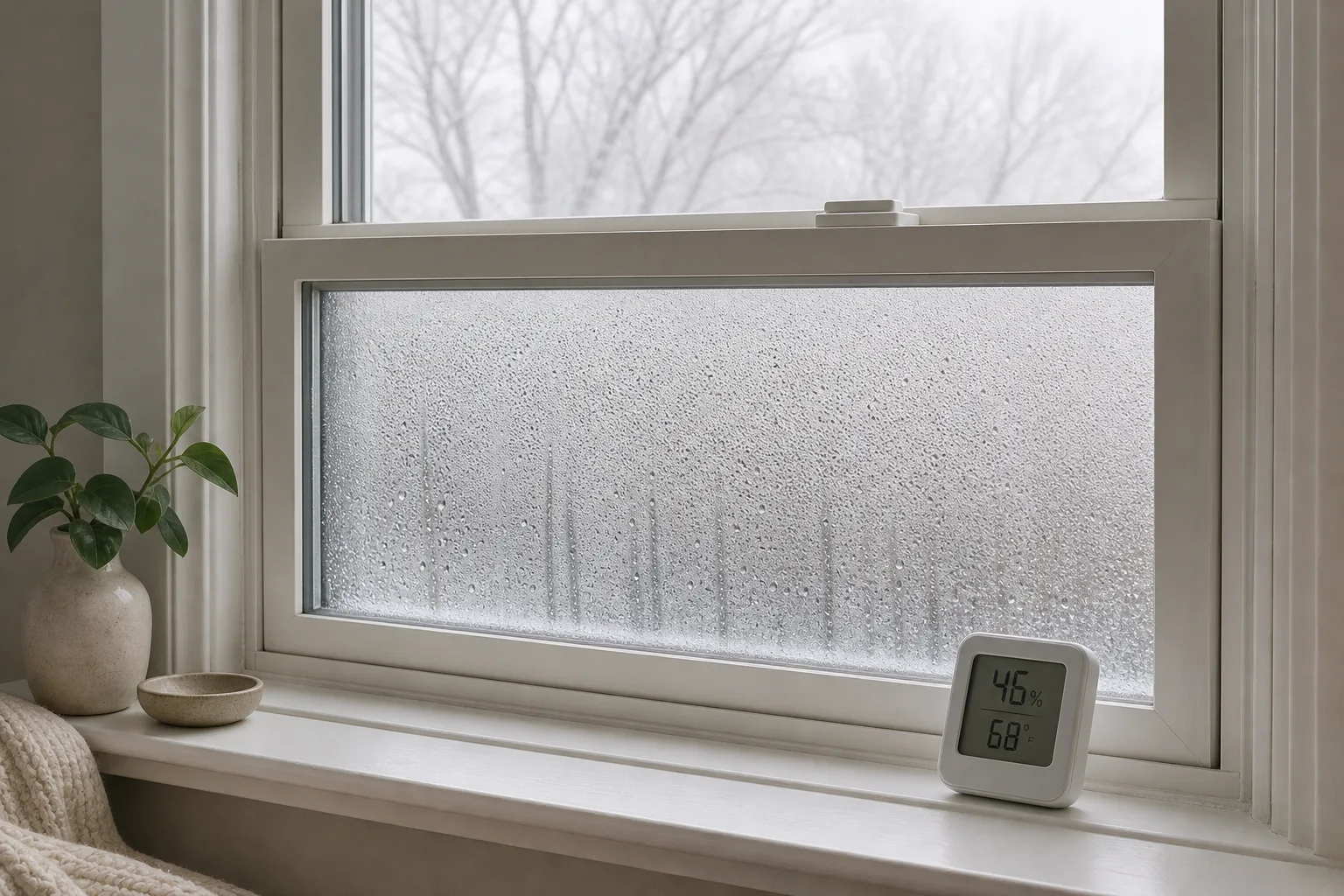
The first cold morning of the season is when most households discover their windows again. Water on the glass at breakfast, a puddle on the sill by mid-morning, and a line of gray along the bottom of the frame that was not there in August. That pattern repeats every year between roughly October and March, and it is the reason window companies load their phone lines in the fall. The useful thing to understand before anyone comes out to measure is that condensation is not one problem. It is three distinct conditions that happen to look similar from six feet away, and they call for three different responses, two of which cost nothing.
Sorting them out takes about a minute per window and a dry fingertip. Do that before you take a quote, because the difference between the three determines whether you are buying glass, buying a dehumidifier, or buying nothing at all.
Touch the glass and find out which of three things you have
Stand inside the room and wipe the wet area with your finger. If the water comes away, the moisture is on the room-side surface of the glass. That is the most common case by a wide margin, and it is not a defect in the window. It means warm indoor air carrying water vapor has touched a surface cold enough to drop that air below its dew point, which is simply the temperature at which air can no longer hold the moisture it is carrying and releases it as liquid. A cold windowpane is usually the coldest surface in a heated room, so it collects first. The window is doing what any cold surface does.
If the glass is dry to the touch inside but you can clearly see haze, streaking, or droplets suspended in the middle of the assembly, go outside and check the exterior face. Dry out there too? Then the moisture is sealed between the two panes of an insulated glass unit, the factory-assembled sandwich of glass, spacer, and sealant that makes up a modern double-pane window. That is a failed unit. The seal has let humid outside air into a cavity that was built to stay dry, and no amount of ventilation or heating in the room will clear it. This one is a repair.
The third case surprises people. You wake up and the outside face of the glass is fogged, usually in late spring or early fall, usually on windows facing east or facing an open sky. Overnight the outer pane radiated its heat to a clear sky, dropped below the dew point of the humid outdoor air, and collected dew exactly the way a car windshield or a lawn does. The reason this happens on good windows and not on bad ones is that a high-performing unit keeps indoor heat inside, so the outer pane stays cold enough to form dew. Exterior condensation is a sign the glazing is holding heat where you paid for it to be held. It burns off within an hour or two of sun.
Interior condensation is a message about the house, not the window
Once you have established that the water is on the room side, the question changes. You are no longer evaluating glass. You are evaluating how much moisture your household puts into the air and how much of it leaves. A family of four generates a surprising volume of water vapor through cooking, showers, laundry, dishwashing, houseplants, and simple breathing, and in the heating season that vapor has fewer ways out. Windows close. The furnace runs. Any air that does leave takes some moisture with it, but a tightly built or recently air-sealed house leaks less than it used to, which is the point of air sealing and also the reason condensation often appears the winter after someone insulates an attic or replaces a door.
Buy an inexpensive hygrometer, a small digital device that reads relative humidity, and put one in the room with the worst windows and one in a bedroom. Read them in the morning before anyone showers and again at night. What you are looking for is the pattern, not a single number. Indoor relative humidity that climbs through the evening and peaks overnight points at occupancy and bathroom venting. Humidity that stays high all day regardless of activity points at a source: a crawlspace with bare dirt, a basement taking in groundwater, an unvented gas appliance, a dryer whose duct has come apart inside a wall cavity. The Environmental Protection Agency is responsible for guidance on indoor air quality and moisture control in homes, and the general principle it works from is that controlling the source beats treating the symptom.
There is a seasonal arithmetic here worth knowing. The colder it gets outside, the colder the inside surface of your glass becomes, and so the lower the indoor humidity has to be to avoid condensation. A level that produced dry windows in November can produce streaming water during a January cold snap without anything in the house changing. If your windows are clear most of the winter and wet only during the coldest week, you do not have a window problem. You have a week. Run bath fans longer, crack a window briefly in the middle of the day, and keep interior doors open so warm air reaches the glass.
What a failed seal is actually worth fixing, and when
Fog between the panes is the case that costs money, and it is also the case where homeowners most often overbuy. The failed component is the insulated glass unit, not the frame, not the sash hardware, and usually not the window. On most vinyl, aluminum-clad, and fiberglass windows made in the last few decades, a glass shop can remove the glazing stops or the sash, measure the unit, order a replacement, and set it. You keep your frames, your trim, your paint, and your interior finish. You do not keep the original appearance perfectly: replacement units sometimes read slightly different in reflectivity than their neighbors, which matters more on a front elevation than on a back bedroom.
Before you pay for anything, find the manufacturer. Look along the metal spacer between the panes for an etched or printed code, or check the edge of the sash for a sticker or stamped date. Many insulated glass units carry a warranty against seal failure measured in years or decades from manufacture, and those warranties frequently survive a change of ownership, sometimes with a transfer step and a fee. The warranty typically covers the glass unit itself and not the labor to install it, which is exactly the sort of detail a homeowner finds out after the invoice arrives rather than before. Ask the question in that order: who made it, what does the warranty cover, what does it exclude, and who pays the installer.
Timing matters more than most people expect. Glass shops and window installers are busiest in the fall, when condensation first shows up and everyone calls at once, and again in late spring. Custom-sized insulated units are ordered, not stocked, and lead times stretch when the queue is long. A failed seal is a cosmetic and performance issue rather than an emergency, which means you have the luxury of scheduling it for a slow stretch. Late winter and midsummer tend to be quieter. Ask for a written lead time and a price that distinguishes the unit from the labor, and get two of those before you decide.
How to hold your ground in the sales conversation
A homeowner who calls about condensation and does not say which of the three kinds they have is going to be quoted whole-house replacement. That is not necessarily bad faith; it is the default product. But you can change the conversation immediately by describing what you found. Saying "the water is on the room side, the hygrometer reads high in the mornings, and only the north bedroom does it" produces a different visit than saying "my windows are fogging up."
Ask the person who comes out to confirm your diagnosis with you, window by window, and to tell you which windows show seal failure and which do not. Ask what they would expect to change about interior condensation if you replaced the glass, and listen for whether the answer acknowledges humidity at all. A good answer will say that a warmer inside surface raises the humidity level the room can carry before water forms, which is true and useful, and will not claim that new windows end condensation regardless of what the house is doing. Ask for the quote to be itemized by opening, so you can phase the work: the three failed units this year, the tired ones in two seasons, the rest when they ask for it.
Keep notes through one full heating season. Which windows, which rooms, which mornings, what the hygrometer said. That record is the thing that turns a vague annual annoyance into a decision you can defend, and it costs a few minutes a week to build. By the time the next cold snap arrives you will know exactly which pane is telling you about the weather, which is telling you about your laundry, and which is telling you to order a piece of glass.
About the author
Wesley writes about timing, and why the same job costs differently in March.