Paying for a Survey You Will Never Read? The Party It Is Actually Written For
A residential survey is addressed to the title underwriter, not the buyer, and that single fact explains which of your three options will work.
| Author | Corinne Adeyemi |
|---|---|
| Section | House & Home |
| Published | |
| Length | 896 words · 4 min |
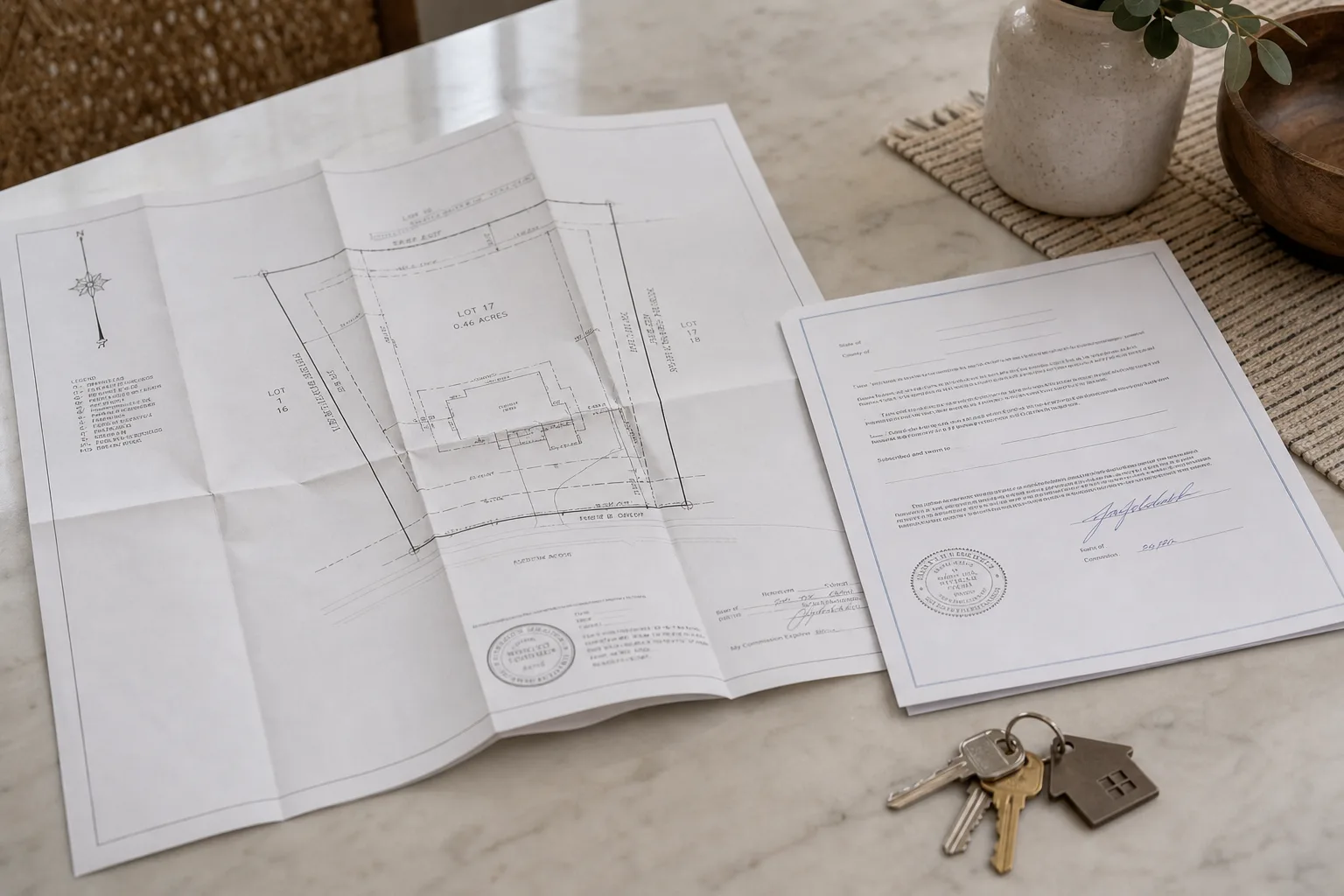
The survey line on a settlement statement is small enough that most buyers approve it without asking what it buys. A few hundred dollars, a drawing that arrives as a PDF, a glance at the shape of the lot, and into the closing folder it goes. Then four years later a fence comes down, or a refinance stalls, or a buyer's title company flags something nobody mentioned the first time, and the survey turns out to have been the document that decided all of it. The reason that happens is simple once you see it: the survey was never written for you. It was written for a party you probably never spoke to.
The reader of the survey is the title underwriter
Every owner's title policy starts out with a standard exception covering anything an accurate survey would have revealed. Encroachments, overlaps, a shed sitting across a setback, a neighbor's driveway that has crept two feet onto your side. Under that standard exception, those things are the buyer's problem and not the insurer's. The survey exists to persuade the underwriter to delete or amend that exception, which converts a list of unknowns into covered risk. The surveyor is a licensed professional who answers to a state board, but the audience for the finished product is the title company's examiner sitting in an office you will never visit. Your lender is the second reader. You are the third, and in practice the one who looks at it least.
That ordering explains behavior that otherwise seems arbitrary. It is why a survey that satisfied you completely can be rejected: the examiner wanted improvements shown that the surveyor was not asked to locate. It is why the fee for deleting the area and boundary exception is quoted as a share of the title premium rather than a flat charge, and why it is listed separately on the Closing Disclosure, the standardized form the Consumer Financial Protection Bureau is responsible for. And it is why a survey you commissioned yourself, outside the transaction, may still need the underwriter's blessing before it counts for anything.
Three ways to satisfy the same requirement
In Texas, you are really choosing among three paths, and they are not equivalent.
| Option | What it costs | What it leaves open |
|---|---|---|
| New survey ordered for this closing | Highest cash outlay, plus scheduling time in the option period | Very little; improvements as they exist today are plotted and dated |
| Existing survey plus a seller's T-47 affidavit | Modest; the affidavit is a notarized statement, not a field visit | Anything built, moved, or paved since the old survey date, and whether the underwriter accepts it at all |
| No survey | Nothing | The standard survey exception stays in the policy, so boundary and improvement problems are uninsured |
The middle option is the one people misunderstand. A T-47 is a residential real property affidavit in which the seller swears, under oath, that nothing material has changed since the old survey was made. No new fence, no pool, no slab poured for a workshop, no driveway widened. If that is true, the underwriter will often accept the older drawing and the examination moves on. If it is not true, the seller has signed a sworn statement that can be held against them later, and the title company has been handed a defective basis for coverage. This is the part of the process a seller should not improvise. Finding the old survey in a closing folder, calling the surveyor's office for a reissued copy, pulling permit records on the addition: all of that you can do yourself in an afternoon. Deciding whether a 2009 drawing still describes the lot is not a judgment call to make alone.
Where the consequences actually show up
The costs of skipping the survey almost never arrive at closing. They arrive at the next transaction. A buyer three years out orders their own survey, learns the back fence sits inside the line, and asks for a price reduction that is larger than the survey would ever have cost. An insurer declines to write a policy on a detached structure that turns out to straddle an easement. A homeowner applies for a permit on an addition and discovers the setback math never worked. In each case the problem was created by a prior owner and inherited silently, because nobody had asked the underwriter to look.
Companies that market under the banner of we buy houses in san antonio tx handle this differently, and it is worth understanding why: when a cash purchaser accepts the standard survey exception and closes without a new drawing, they are absorbing the boundary risk themselves rather than asking an insurer to price it, which is part of what lets those closings run short.
What to decide, and when
Make the call during the option period, not the week of closing. Ask the title company directly whether an existing survey will be accepted, and get the answer before you spend money. Ask the surveyor whether improvements will be located, not just corners. If you are the seller, assemble the old survey and an honest list of everything built since, then let your attorney or the title officer tell you whether a T-47 is supportable.
Treat the survey as the document that tells your insurer what it is agreeing to cover, and the rest of the choices order themselves.
About the author
Corinne writes for readers doing some of the work themselves.