Got a Ring in December? Why the Appraisal on It Starts Aging Immediately
A first piece of jewelry worth insuring puts four different specialists between you and coverage, and the calendar decides how long each of them takes.
| Author | Wesley Tarbox |
|---|---|
| Section | Financial |
| Published | |
| Length | 932 words · 4 min |
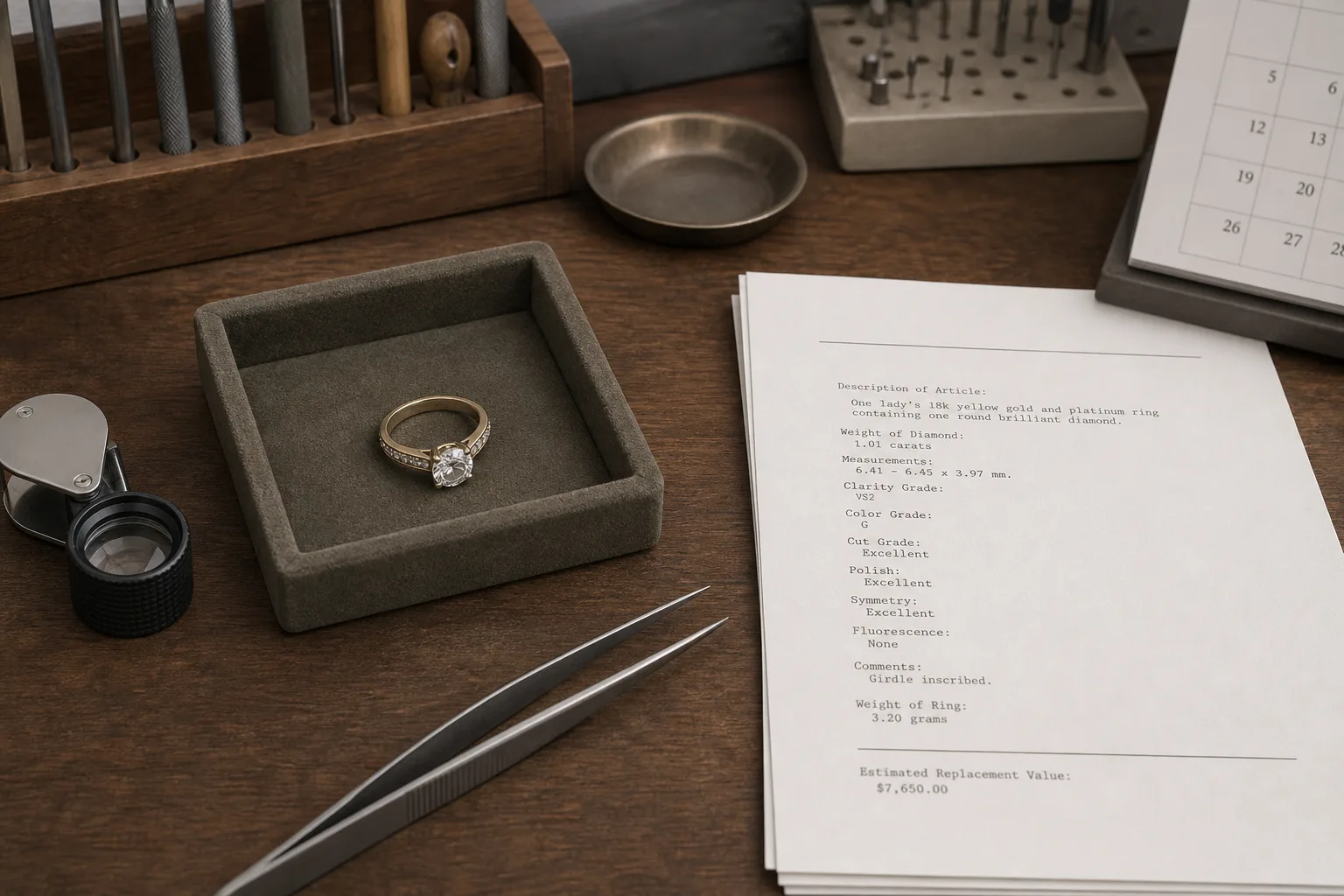
The item usually arrives in a compressed stretch of weeks. Late November through February is when engagement rings are given, when inherited pieces get handed across a table at a holiday meal, and when a watch that sat in a drawer for a decade suddenly belongs to someone new. For most people this is the first object they have owned that does not simply fall under the contents limit on a homeowners or renters policy. The instinct is to call the insurance company. That is the right instinct, but it is the second call, not the first, and the order matters more in this season than in any other.
Four people stand between you and a scheduled item, and they do not do each other's jobs
Coverage for a valuable piece almost always ends up as what insurers call a scheduled item or a personal articles policy: the piece is listed individually, with its own dollar figure, usually with no deductible and broader coverage than the general contents section of your policy. Getting there involves four separate people, and a first-timer's confusion usually comes from assuming that two of them are the same person.
The appraiser writes a document describing the piece and assigning it a value. Independence matters here. An appraisal from the store that sold you the item is not worthless, but some insurers weigh it differently than one from an appraiser with no stake in the sale. The credential to look for is a gemologist qualification paired with appraisal training, and the appraiser should be able to say plainly which of several values they are reporting: retail replacement, fair market, or liquidation. Those are different numbers for the same object, sometimes dramatically so, and insurance wants retail replacement.
The agent or broker takes that document and turns it into a schedule. They know which carriers want a formal appraisal above a certain threshold and which will accept a detailed sales receipt. The underwriter, who you will never meet, is the one who actually accepts the risk and sometimes asks for a photograph, a second opinion, or a statement about where the item is kept. And the bench jeweler, the person who sizes, tightens prongs and resets stones, is the one whose repair receipts quietly document the piece's condition over time. Keep those receipts. They matter later.
The bench is backed up for exactly as long as you are shopping
Appraisers and bench jewelers run on the same calendar you do. From roughly Thanksgiving through Valentine's Day, the same people who write appraisals are doing rush sizings, repairs and last-minute retail work. Turnaround that takes a week in September can take three or four weeks in January, and appointments for in-person appraisal, which is the only kind that carries weight, fill first. The practical consequence for someone insuring a piece for the first time is a gap: you have a valuable object and no coverage while you wait.
Most carriers will bind coverage on an interim basis using a receipt or a bill of sale, with the appraisal to follow within a set window. Ask for that explicitly. It converts a month of exposure into a phone call. Then book the appraisal for late winter or early spring, when the bench has cleared, rather than fighting for a slot in the same weeks everyone else is.
Why the document expires even though the ring has not changed
An appraisal is a snapshot of a market, not a measurement of an object. What it records is what it would cost, on a particular day, to replace that piece at retail. Metal prices move. Stone grading and supply shift, and lab-grown stones have changed the pricing floor under certain categories considerably. Designer and vintage pieces respond to demand in ways that have nothing to do with material content. None of this touches the ring in your drawer, but all of it touches the number.
Carriers typically want an updated appraisal every few years, and the interval varies by company and by value band. The reason this is not bureaucratic busywork becomes clear at claim time. If your piece is scheduled at a figure set six years ago and replacement now costs meaningfully more, the check reflects the schedule, not the market. The gap is yours. Some policies include an inflation adjustment on scheduled items, which helps but rarely tracks a volatile category precisely. The Federal Trade Commission oversees how jewelry is described and advertised in the United States, which is part of why the vocabulary on an appraisal (treatment disclosures, origin claims, grading terminology) is worth reading rather than skimming. Those descriptors are what a replacement will be matched against.
A workable order of operations for a first piece
- Photograph the item from several angles the day it comes into your hands, including any inscription or serial number.
- Call your agent with the receipt and ask what they can bind today and what documentation they need within what window.
- Book an independent appraisal for the first clear week after the seasonal rush, and ask for retail replacement value specifically.
- Put a reminder on the calendar for the reappraisal interval your carrier names, and check it against your renewal date so the two arrive together.
- File every bench repair receipt with the appraisal. Condition history supports value.
Set the reappraisal reminder for a slow month. Spring and early fall are when the same appraiser who could not see you in December has an open afternoon, and the same review that felt urgent under holiday pressure becomes a short errand on a quiet Tuesday.
About the author
Wesley writes about timing, and why the same job costs differently in March.