Insuring a Ring or a Watch? What the Rate Is Built From, and Why the Appraisal Has a Shelf Life
Scheduled jewelry premiums are quoted per $100 of value, and the appraisal behind that value stops being usable sooner than most owners expect.
| Author | Junko Halloran |
|---|---|
| Section | Financial |
| Published | |
| Length | 985 words · 4 min |
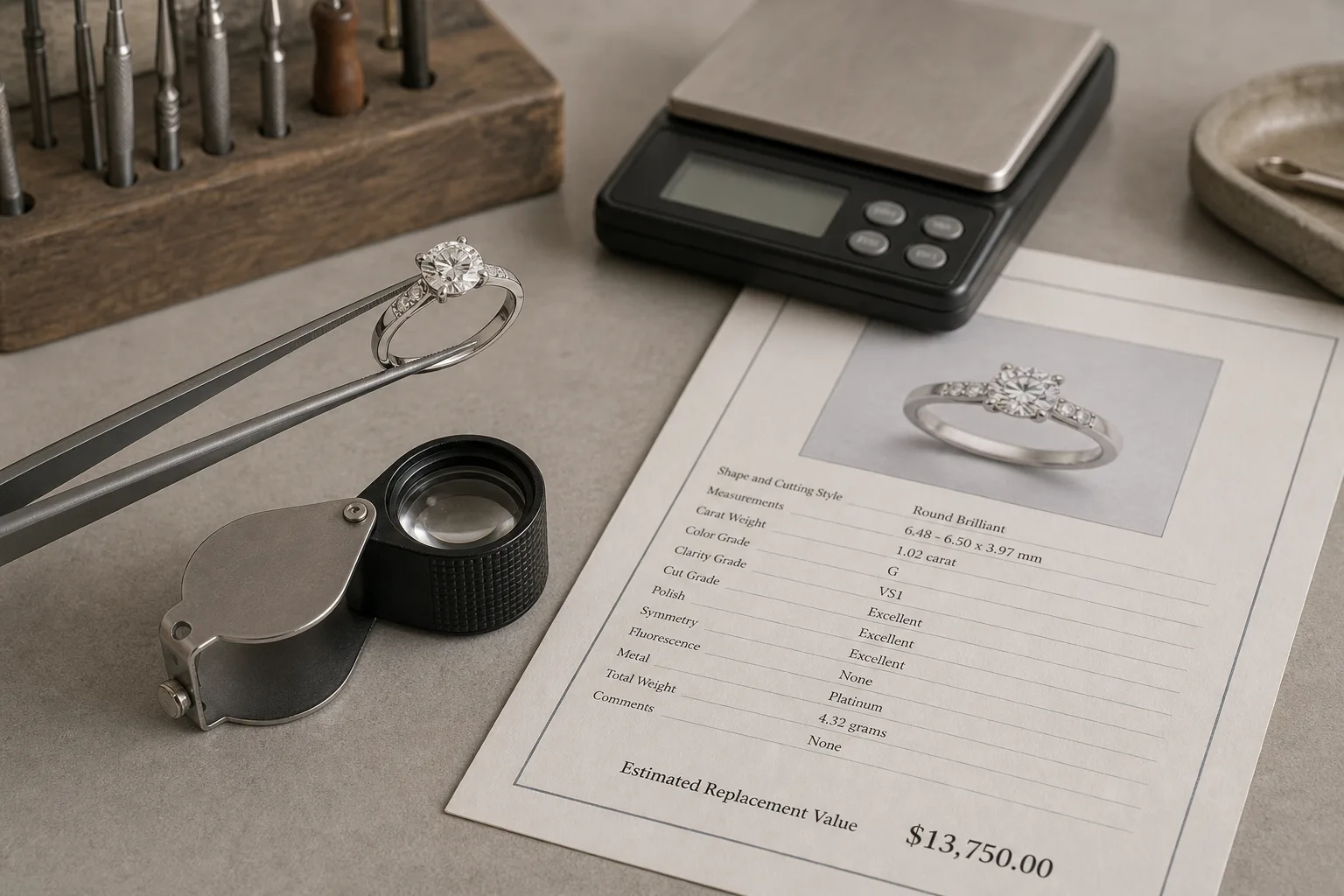
A homeowners policy will usually pay something toward a lost ring, but the something is capped by a special limit buried in the personal property section, and on many policies that cap is low enough that a single good stone exceeds it. The fix is to schedule the item: list it individually, with a stated value, on either the homeowners policy or a standalone valuables policy from a carrier that specializes in them. That step is straightforward. What surprises people is the pricing mechanism, and the fact that the appraisal they paid for a few years ago is no longer acceptable to the underwriter who once accepted it.
What scheduling actually buys, and how a large carrier prices it
Scheduled personal property is quoted as a rate per $100 of insured value. That is the unit. A larger carrier's underwriting desk does not think in monthly premiums; it applies a rate table to the value you declare, then adjusts for the specifics of the item and where it lives. You will be quoted something like a figure per $100, and the arithmetic from there is simple. If a carrier quotes you $1.40 per $100 on an $8,000 ring, the annual premium is 80 units of $100, times $1.40, or $112. If the rate is $2.10, the same ring costs $168. Ask for the rate rather than the total, because the rate is the number you can compare across quotes and the number that tells you how much a value increase will cost you later.
In exchange, the coverage is broader than what the homeowners policy gives an unscheduled item. Most scheduled valuables coverage is written on an all-risk basis, which includes mysterious disappearance: the stone that is simply gone from the setting one evening, with no theft and no explanation. Many are written with no deductible. Many are agreed value, meaning the carrier pays the scheduled amount in a total loss rather than arguing about market value after the fact. Those three features, taken together, are the reason a specialty valuables policy from a national insurer often costs less per $100 than adding the same item to a homeowners policy at a general rate.
What drives the rate up or down
Location is the largest single factor in most rate tables, and it operates at the ZIP code level rather than the state level. Two addresses twenty minutes apart can price differently. Item type matters next: a diamond ring worn daily, a watch worn daily, loose stones, and a piece kept in a bank vault are all treated as separate exposures, and they are not close to each other in price. Carriers commonly offer a vault credit, sometimes a substantial one, for items held in a safe deposit box with a restriction that coverage outside the vault requires notice. If you own an inherited collection you never wear, that credit is the difference between an annoying premium and a trivial one.
The smaller inputs still move the number. A safe at home with a recognized burglary rating, a monitored alarm, whether the item travels internationally, and prior claims all appear in underwriting. So does aggregate value. Once a schedule passes a certain total, a larger provider will typically move the account to a dedicated collections form with its own limits, its own appraisal requirements, and often a requirement for a loss-prevention survey of the house.
Why the appraisal stops being usable
An appraisal does not expire the way milk does. It expires in the sense that it states a value as of a specific date, for a specific purpose, and both of those go stale. A replacement cost appraisal answers one question: what would it cost, today, at retail, to replace this item with one of like kind and quality. Metal prices move. Stone prices move, and not uniformly across sizes, colors and cuts. Labor and bench time move. A document written four years ago answers the question as of four years ago, which is not the question a claim asks.
That is why larger carriers attach an update cycle to scheduled items, commonly every few years, and why they may decline an appraisal that is older than that or one written by the same store that sold the piece. It is also why the type of value stated matters. An estate or fair market value figure, prepared for a probate filing or a charitable deduction, is the wrong basis for insurance and will be rejected or read down. The report should say plainly what it is for. Consumer-facing description standards for gemstones and metals sit with the Federal Trade Commission, which is responsible for the rules governing how those materials are described in commerce, and a competent appraisal will use that vocabulary rather than store shorthand.
What the appraisal itself costs
Appraisers who hold credentials from a recognized appraisal organization charge by the hour or by the item, and they are not supposed to charge a percentage of the value they arrive at, because that gives them a financial interest in the answer. A fee quoted as a percentage of value is the clearest signal to keep calling. Ask three things before you book: the hourly or per-item fee, the expected number of hours for your specific pieces, and whether the fee includes gemological testing such as diamond grading or gold assay. Testing is usually the line item that grows. If you are updating an existing schedule rather than starting fresh, ask whether a value update letter is available, since that is typically priced well below a full new report.
Build the update into the same calendar slot each time. A short note in your records with the appraisal date, the appraiser's name, the stated basis of value, and the scheduled amount on the policy turns the next cycle into a phone call and a fee, rather than a scramble after something goes missing.
About the author
Junko covers what work costs and why two quotes for the same job differ.