Same price, two very different rings. What to ask before the all-aboard call
Two rings can carry the same tag and hold very different value. Here is what actually sets the price, and the questions that settle it before you pay.
| Author | Junko Halloran |
|---|---|
| Section | Financial |
| Published | |
| Length | 1,215 words · 5 min |
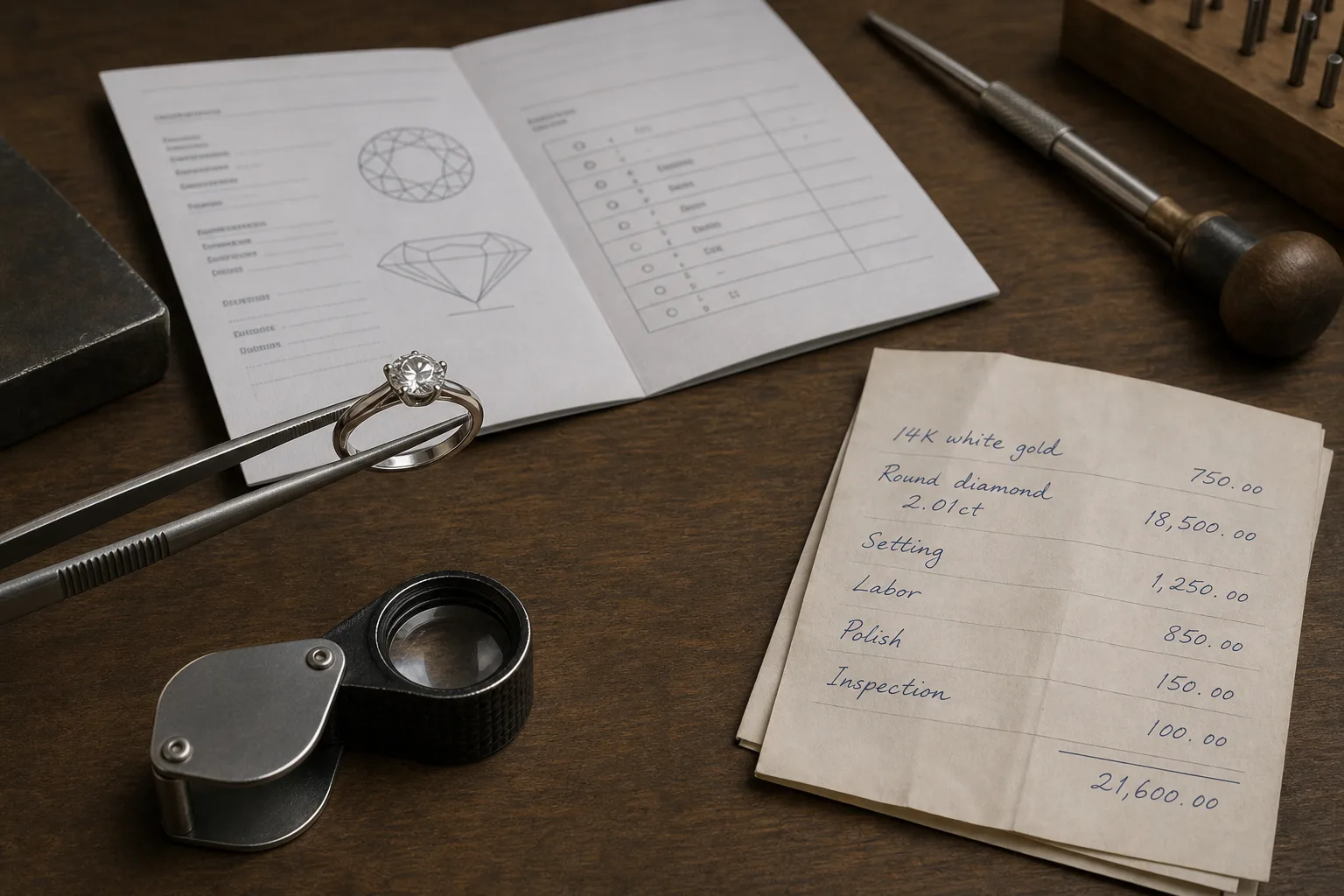
The assumption almost every buyer walks in with is that price tracks appearance. Bigger stone, brighter metal, heavier in the hand, higher number on the tag. It is a reasonable guess, and it is wrong often enough to cost real money. Two rings sitting in the same case at the same asking price can contain very different amounts of value, and the difference is rarely visible from eighteen inches away under display lighting. What separates them is a short list of things that are written down somewhere: metal fineness, stone weight and grade, whether a stone was treated and how, who set it and how long that took, and whether any of it is documented by someone with no stake in the sale.
What the tag is actually paying for
Take two hypothetical rings, both marked $4,200. The arithmetic below is illustrative, not a market quote, because the price of a specific stone in a specific week is not something anyone can tell you from a distance.
Ring A: a mined stone of about a carat, middling color and clarity, a report from a lab whose grading runs loose, set in 14k white gold over a cast head, finished in a factory. Most of the $4,200 sits in the stone, and the stone's grade is the part being taken on faith.
Ring B: a smaller stone with a tighter grade from a lab with a stricter reputation, set by hand in platinum, with a hand-fabricated basket and hand-cut millgrain. Less of the money is in the stone and more of it is in metal weight and labor. Platinum is denser and harder to work than gold, so the same design in platinum costs more in raw material and more in bench hours.
Neither ring is the better buy in the abstract. But if you resell Ring A in eight years, the buyer will price the stone against a current grading report and ignore the setting almost entirely. If you resell Ring B, the same thing happens, which is why the labor you paid for is worth having only if you actually wanted it. That is the single most useful reframing available to a customer: some of the price buys value that survives resale, and some of it buys craftsmanship you enjoy wearing. Both are legitimate. Knowing the split before you pay is what keeps the purchase from feeling like a mistake later.
The paperwork does more work than the loupe
Two documents get confused constantly, and they do opposite jobs.
A grading report describes a stone. Carat weight, cut, color, clarity, measurements, any treatment detected, and often a plotted diagram of inclusions. It carries no dollar figure, because a lab is not in the business of pricing. Reports from different labs are not interchangeable; the same stone can come back a grade or two apart depending on who graded it, which means the lab's name is part of what you are buying.
An appraisal attaches a dollar figure, and the figure it attaches is almost always retail replacement value for insurance purposes. It is not what you could sell the item for, and a document reading well above what you just paid is not evidence of a bargain. It is evidence that the appraiser was asked to estimate replacement cost.
Treatment disclosure is where quiet money hides. Heated sapphires, fracture-filled rubies, clarity-enhanced diamonds, and lab-grown stones are all sold legitimately every day, and all of them belong on the receipt in plain words. The Federal Trade Commission is the agency responsible for how jewelry is described to consumers in the United States, including when a treatment or a synthetic origin has to be stated rather than implied. If a stone's origin or treatment is not written on the sales slip, ask for it to be written on the sales slip.
Buying under a clock, from the customer's side
Most purchases of st thomas jewelry happen inside a window of two or three hours between a ship docking and the all-aboard call, and that window, not the item, is usually what decides how the decision goes. The pressure is structural rather than anybody's fault. You are comparing three storefronts on foot, in heat, without your notes, and the person who can answer your hardest question may be on the other side of the shop.
Two practical consequences. First, the customs exemption for goods bought in the U.S. Virgin Islands is more generous than the allowance for most foreign ports, and the current figures and the rules on family pooling are published by the agency that administers them. Look them up before you travel, not at the pier. Second, an itemized receipt is worth more than a folded one. You want the metal fineness, stone weights, treatment language, any lab report number, the store's legal name, and the date, all on one document, because that piece of paper is what your insurer, your appraiser, and any future buyer will read.
Pay by credit card, not wire or cash, and keep the card statement with the receipt. Card networks give you a dispute window that a cash purchase simply does not have, and the fee difference is trivial against the protection.
Six questions to ask before the card comes out
- What is the metal, and what fineness? Platinum, 18k, 14k. Ask to see the stamp.
- Who graded this stone, and can I see the report? Then check that the report number matches any laser inscription, and that the measurements on the report match the stone in front of you.
- Has anything been treated or enhanced, and will that be written on the receipt? Ask for the word, not a nod.
- What is the return policy in writing, and how many days do I have from purchase or from arriving home? Also who pays return shipping, and whether there is a restocking charge.
- Who services this if a prong wears or it needs sizing? A store can authorize a local jeweler to do warranty work, but only if that is arranged in advance.
- Can I have an itemized appraisal for insurance, and does it cost extra? Many stores provide one; the point of asking is to learn whether the figure is theirs or an independent appraiser's.
None of these six requires jewelry knowledge. They require only that you keep asking until the answer is specific.
When you get home
Jewelry sits under a low theft sublimit in most standard homeowners policies, which means a single significant piece is usually underinsured the moment it comes through the door. The fix is a scheduled personal property endorsement, sometimes called a rider: the item is listed individually, insured for a stated amount, and typically covered for loss as well as theft. Your insurer will want the appraisal and clear photographs. Handle it in the first week, while the receipt is still on the counter and not in a drawer with the boarding passes.
Then have the setting checked once a year by a bench jeweler. Ten minutes with a loupe and a pair of pliers catches a worn prong long before it lets go, and a tightened prong costs a fraction of replacing a stone. That is the least glamorous line in the whole budget, and the one with the best return.
About the author
Junko covers what work costs and why two quotes for the same job differ.