A Roof Claim Paid Short by Code Upgrades, and the Regulator Who Approved the Wording
A hail claim covered the shingles but not the code upgrades the permit required. The exclusion behind that gap was filed, reviewed, and approved years before the storm.
| Author | Corinne Adeyemi |
|---|---|
| Section | Financial |
| Published | |
| Length | 1,132 words · 5 min |
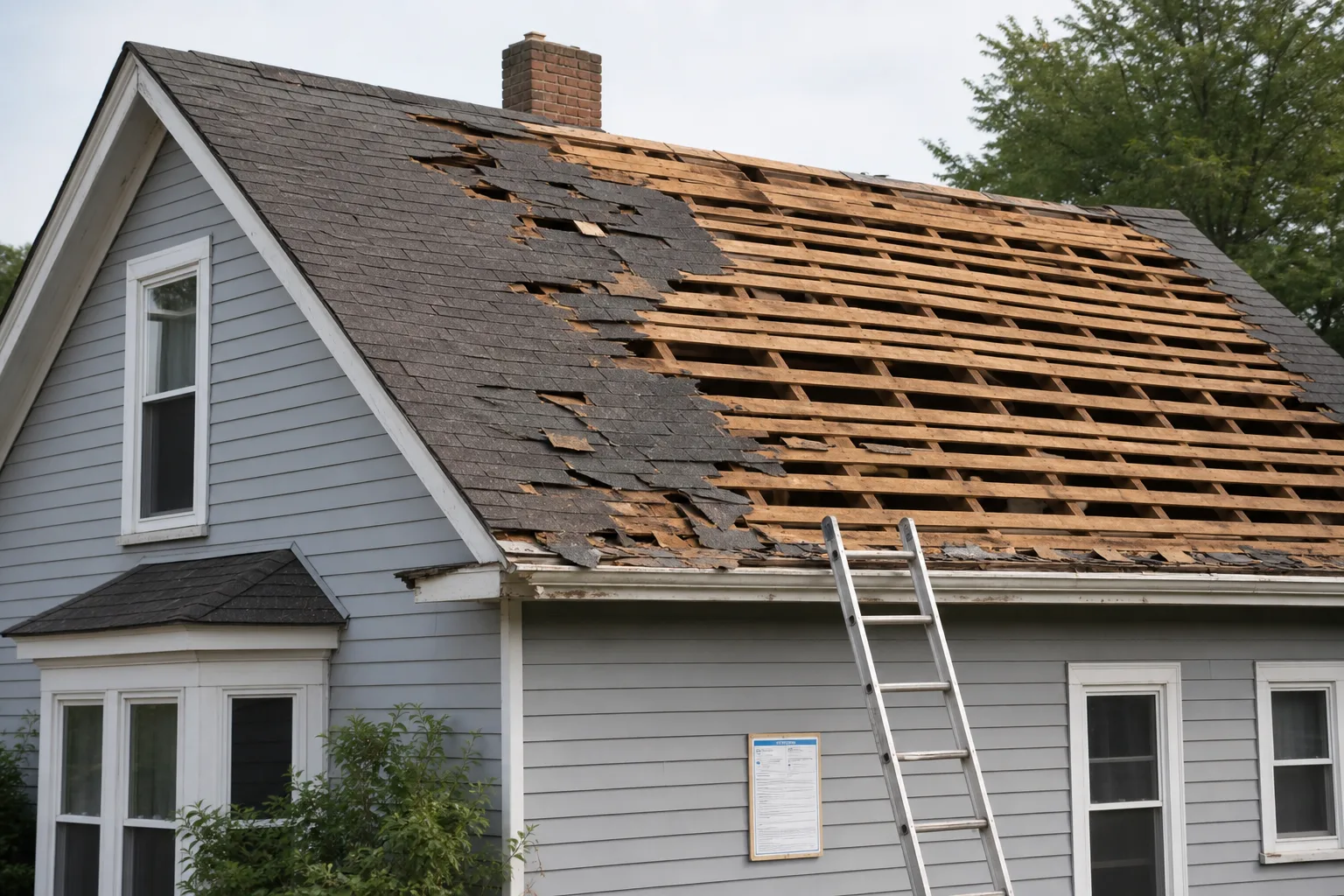
A hailstorm takes out a twenty-two-year-old asphalt roof on a two-story house. The adjuster inspects, agrees the roof is a total loss, and writes an estimate to tear off one layer of shingles and install a comparable replacement. Then the roofer pulls a permit, and the building department attaches conditions: full deck replacement where the sheathing is spaced boards, an ice barrier at the eaves, and drip edge on every rake. None of that was on the roof before. All of it is required now. The gap between the adjuster's number and the invoice is several thousand dollars, and the insurer declines to close it, citing a clause the homeowner had never read.
The clause is the ordinance or law exclusion. It appears in nearly every unendorsed homeowners policy sold in this country, and it says, in substance, that the insurer will not pay the increased cost of construction imposed by any law or ordinance regulating the repair or demolition of a building. It is not an error. It is not the adjuster being difficult. It is a piece of wording that was drafted, filed with a state agency, reviewed, and approved for use long before the storm, and understanding who did that reviewing is the fastest route to understanding what the clause is doing there in the first place.
The party nobody in the room represents
Most people picture an insurance transaction as two parties: the household and the carrier. There is a third, and it never appears at the kitchen table. Before a carrier can sell a homeowners policy in a state, it generally has to file the policy form with that state's department of insurance, which oversees the forms, rates, and market conduct of insurers licensed there. Many states require affirmative approval before use. Others allow a form to take effect after a waiting period unless the regulator objects. Either way, the sentence that shortchanged the roof claim passed under the eyes of a public agency that had the authority to reject it and did not.
That matters for two practical reasons. First, the wording is usually not negotiable at the point of sale. An agent cannot strike a line from an approved form, which is why arguing with an agent about the exclusion's fairness goes nowhere. Second, the filing is a record. Form numbers, editions, and the endorsements available to attach to that form are administrative facts, and in most states a policyholder can request them or find them through the department's public filing search. When you know the form number printed on your declarations page, you can read the exact document the regulator approved rather than a summary of it.
Why the exclusion exists at all
An exclusion is not primarily a way to avoid paying. It is a way to define the size of the promise so the promise can be priced. Building codes change on their own schedule, vary by jurisdiction, and can be amended between the day a policy is written and the day a loss occurs. A carrier that agreed to fund every future code upgrade on every insured structure would be underwriting the decisions of thousands of separate building departments. The premium would have to reflect that open-ended obligation, and every household would pay for it whether or not their local code had teeth.
So the base form carves the obligation out, and the carve-out is sold back as a priced option. That option is ordinance or law coverage, offered as an endorsement, typically as a percentage of the dwelling limit. It is one of the least expensive endorsements on a homeowners policy relative to what it can pay, and it is the reason two neighbors with visually identical policies can get very different answers after the same hailstorm. The homeowner in this case had a clean policy with no such endorsement. The neighbor two doors down had it at ten percent of the dwelling limit, added years earlier at an agent's suggestion, and the code upgrades on that roof were funded without argument.
The protections that do apply to the wording
Filed and approved does not mean untouchable. Several rules constrain how an exclusion can be written and used. Most states require policy language to be legible and, increasingly, readable at a defined plain-language standard. Exclusions generally have to be set out conspicuously rather than buried inside a coverage grant. Courts across the country construe genuine ambiguity in an insurance contract against the party that drafted it, on the reasoning that the policyholder had no hand in the drafting. And an insurer that denies part of a claim is usually required to identify the specific provision it relies on, in writing, rather than gesturing at the policy generally.
Those protections are real but narrow. The ordinance or law exclusion is old, heavily litigated, and clearly worded, so an ambiguity argument against it rarely goes anywhere. What is often arguable is scope: whether a particular expense is truly a code-driven upgrade or simply part of restoring the roof to its pre-loss condition. Replacing rotten sheathing the hail exposed is not the same expense as replacing sound spaced boards the code no longer permits, even though both show up on the same invoice.
What to do yourself, and where to stop
You can do the reading. Find the form number and edition date on your declarations page. Pull the endorsement schedule and check whether an ordinance or law endorsement is listed, at what percentage, and whether it applies to the dwelling only or to other structures too. Call your building department and ask what a full roof replacement on a house of your age triggers in your jurisdiction. Then ask your agent, in writing, for the annual cost to add or increase that endorsement, and get the answer at two levels so you can see the shape of the pricing.
Where to stop is the denial letter itself. If a carrier has cited the exclusion and you believe part of the disputed cost is restoration rather than upgrade, that is a line-item dispute over an estimate, and the people who win it are licensed public adjusters and attorneys who read these estimates for a living. Bring them the permit conditions, the roofer's itemized invoice, the adjuster's estimate, and the form number. That packet is most of their work, and assembling it is entirely within your reach.
The homeowner in this case paid the code upgrades out of pocket and added ordinance or law coverage at the next renewal for a figure that would not cover a single sheet of sheathing at replacement time. The clause is still in the policy. It is doing exactly what it was filed to do, and now the household knows what sits on the other side of it.
About the author
Corinne writes for readers doing some of the work themselves.