Your Inspection Report Flagged Everything. Four Ways to Respond, and What Each Costs
Home inspection reports got longer for reasons that have nothing to do with your house. Here is how to sort a long findings list into four responses with different price tags.
| Author | Junko Halloran |
|---|---|
| Section | House & Home |
| Published | |
| Length | 1,163 words · 5 min |
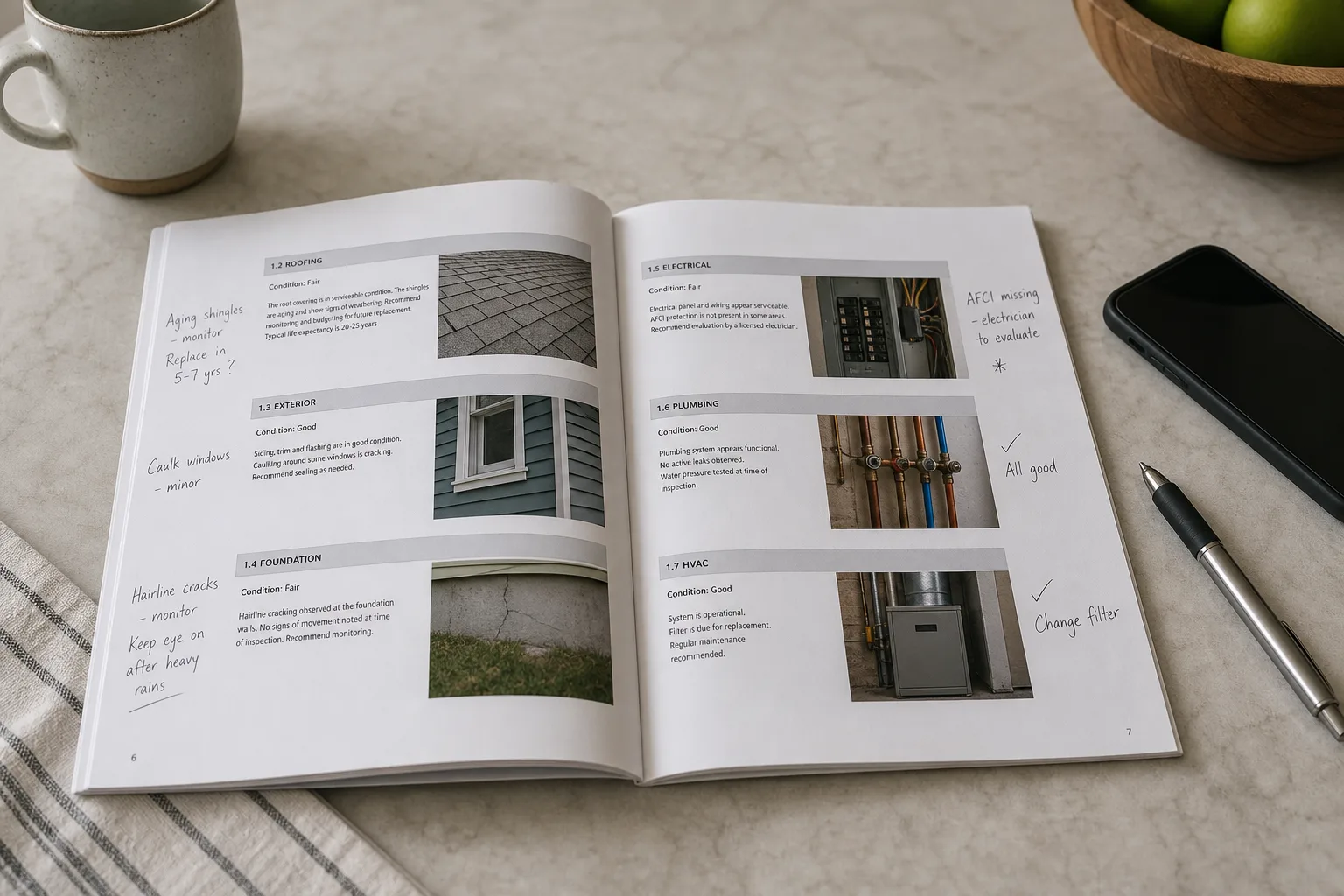
A home inspection report that runs sixty pages and flags forty items is not a report on a bad house. It is a report written under a standard of practice that rewards completeness and penalizes silence, delivered as a PDF that costs nothing to lengthen. Understanding why the document looks the way it does is the first step in deciding which of its findings deserve your money, which deserve a phone call, and which deserve a note in a folder and nothing else.
Why the report is long, and why that is not about your house
Home inspection as a paid consumer service is younger than most of the houses it examines. Through the middle of the twentieth century, a buyer's protection was largely the walkthrough, a contractor friend, and whatever the seller volunteered. Trade associations formed in the 1970s and began publishing a standard of practice: a list of systems an inspector must examine and a list of things an inspector is not responsible for. States followed with licensing schemes, and licensing brought the thing that shaped the modern report more than anything else. Liability.
An inspector who omits a cracked cleanout cap has a problem. An inspector who lists it, photographs it, and recommends evaluation by a licensed plumber does not. Meanwhile the reporting software moved from a carbon-copy checklist to a template that inserts a photo, a severity tag, and a boilerplate recommendation with two clicks. Length became free. So the report you are holding is a complete inventory of observable conditions with a recommendation attached to each, and it is deliberately not a repair plan or a budget. Those are separate documents, and nobody has written them for you yet.
This matters because the emotional weight of a finding in the report bears almost no relationship to its cost. "Evidence of prior moisture intrusion at basement slab, recommend evaluation by qualified contractor" reads worse than "GFCI protection not present at kitchen receptacles," and the second one is the one with a firm price attached.
The four responses, and what separates them
Every finding on the list can be routed to one of four places. The skill is in the routing, not in the reading.
| Response | What you spend | What it buys | Best fit |
|---|---|---|---|
| Log and monitor | Nothing but a dated photo | A baseline you can compare against next spring | Static cracks, cosmetic wear, aging equipment still running |
| Fix it yourself or with a handyman | Parts, or a half-day labor minimum | The item leaves the list permanently | Items with a known part and no diagnosis needed |
| Pay for a specialist evaluation | A diagnostic or inspection fee | A number, in writing, from someone who would do the work | Anything where the range of possible cost is wide |
| Renegotiate or walk | Deal friction, possibly the deal | Price adjustment or exit | Findings with a large, documented estimate |
Notice that three of the four are cheap and one is expensive, and that the expensive one requires input from the third. You cannot ask for a credit against a number you do not have. The most common error is not overreacting to a finding; it is jumping from a scary sentence straight to renegotiation with no estimate behind it, which produces an argument instead of an adjustment.
A worked example, with the numbers left where they belong
Take a single-family house, fifty years old, and a report with three findings that all sound serious: a diagonal crack at a foundation corner, staining on the subfloor under a second-floor bathroom, and a furnace the inspector notes is at the end of its typical service life.
The crack goes to a specialist evaluation. A structural engineer charges a flat fee to visit and write a letter, and that fee is knowable before you book: call three, write down what each says. The letter comes back with one of two conclusions, and they are not close in cost. If the crack is shrinkage and stable, the letter itself is the remedy, and the finding is closed for the price of the visit. If the letter calls for underpinning or a drainage correction, you now have grounds for an estimate and grounds for a conversation about price.
The bathroom staining goes to a plumber's diagnostic call, priced by the hour or as a flat trip charge. This is the case where paying for the evaluation almost always pays for itself, because "active supply leak behind tile" and "old dried stain from a failed wax ring replaced in 2014" are the same photograph.
The furnace goes in the log. An appliance at the end of its published service life is not a defect; it is an age. Suppose replacement runs R dollars whenever it happens. Deferring for three heating seasons does not reduce R, but it does mean you pay R later with money you have set aside, rather than now with money you needed for closing. If the heat exchanger is cracked, that is a different finding and belongs in the specialist column instead. The distinction is worth a technician's visit to settle.
The arithmetic that decides how far to go on any single item is the same every time: the cost of finding out, against the width of the range you are guessing across. Spending a few hundred dollars to resolve a finding that might cost anywhere between nothing and five figures is obviously worth it. Spending the same amount to resolve a finding that tops out at a two-hour service call is not, and the honest answer is that you will not know which is which until you have made three phone calls.
The findings that skip the sorting
A short list bypasses triage entirely, and it exists because a separate body of law and testing grew up alongside home inspection rather than inside it. Radon testing, lead-based paint disclosure, and asbestos handling are governed by federal rules, and the Environmental Protection Agency is the agency responsible for the radon action guidance and the disclosure framework that real estate transactions follow. Your inspector may note a suspect material and will almost certainly decline to identify it, which is not evasion. Identification requires sampling and a lab.
Alongside those sit the life-safety items: missing GFCI protection in wet locations, a gas water heater with no draft, a double-tapped breaker, no smoke alarm on a sleeping level. These are cheap, they are defined, and they come with prices a licensed trade can quote over the phone. Do them regardless of whether you buy, sell, or stay. They are the part of the report where acting immediately is also the frugal choice.
Print the findings list, add three columns, and write the response, the person to call, and the date next to each line. Most households find that the forty items collapse into five or six that need a phone call and a handful that need money, which is a very different document from the one the inspector handed over.
About the author
Junko covers what work costs and why two quotes for the same job differ.