What Does a Clogged Dryer Vent Actually Cost a Household Over Four Years?
The dryer took two cycles instead of one. That was the only symptom, it was easy to live with, and it was the house saying something for four years.
| Author | Corinne Adeyemi |
|---|---|
| Section | House & Home |
| Published | |
| Length | 1,214 words · 5 min |
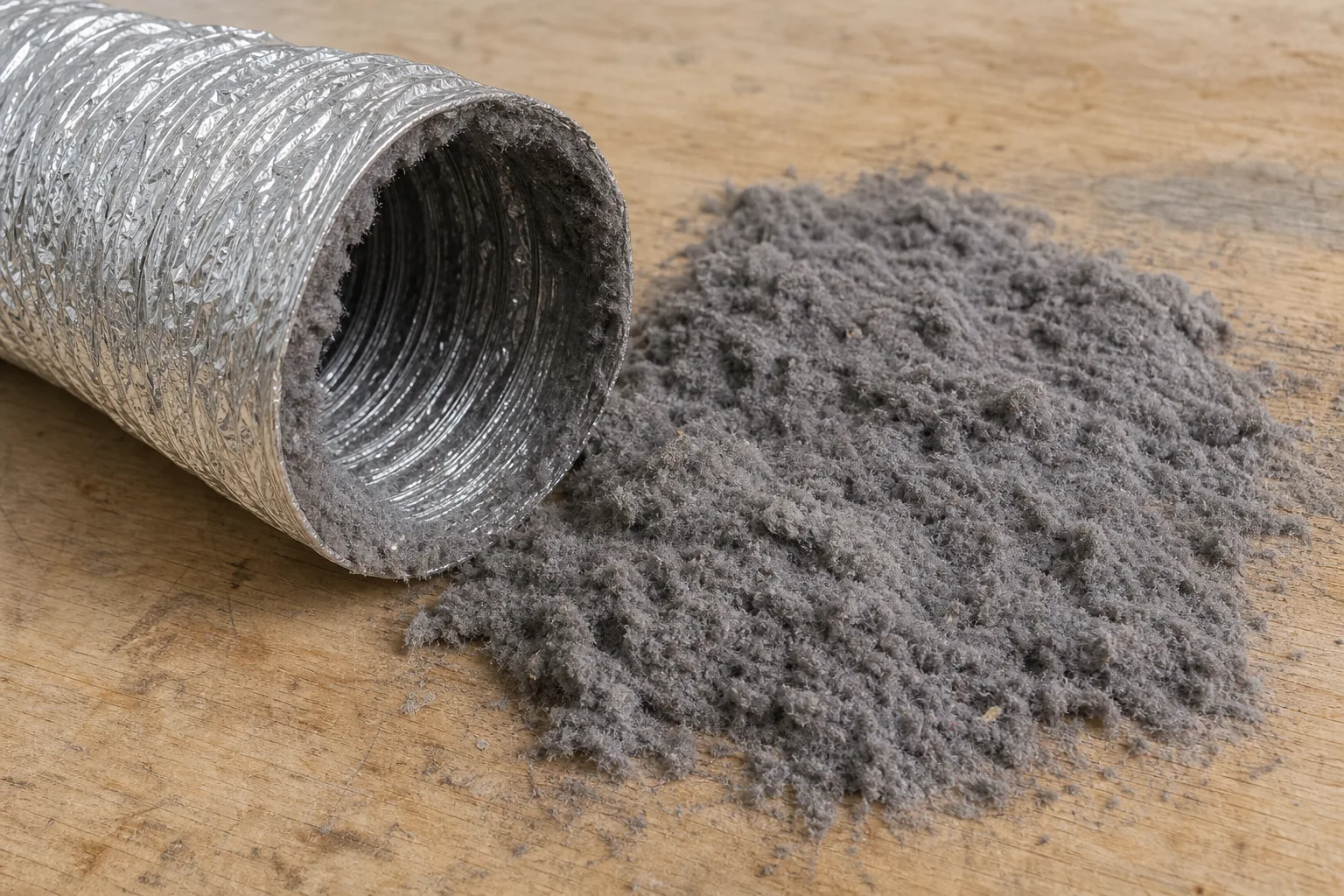
A family moved into a fifteen-year-old house in the spring and noticed within a month that towels came out of the dryer damp. Running a second cycle solved it, the second cycle only took forty minutes, and nobody thought about it again for four years. What follows is the ordinary shape of that problem, because the sequence repeats in thousands of houses with only the details changed. Every stage of it was visible, none of it was urgent, and the total spent by the end came to several times what a ten-minute inspection in the first month would have cost.
The First Year, When the Only Symptom Was a Second Cycle
The duct in this house ran from the laundry room in the middle of the floor plan, up through a wall, and out through a hood on the side of the roof, a distance of roughly twenty-five feet with three elbows in it. That is a long run by any standard, and long runs are where lint settles. Flexible foil duct had been used for the last section behind the machine, crushed into the gap between the dryer and the wall so the appliance would sit flush. Airflow was restricted from the day the house was built, and the only evidence available to the family was that a load of towels needed eighty minutes rather than forty.
They adapted, as almost everybody does. Loads got smaller, the dryer got started earlier in the evening, and the second cycle became part of how laundry worked in that house. Nothing about that year felt like a problem to solve. It felt like an appliance that was a little tired, which is precisely why the condition is so reliably ignored.
The Second Year, When the Room Got Warm and the Machine Got Hot
By the following winter the laundry room was noticeably warmer than the hallway during a cycle, and the top of the dryer was too hot to rest a hand on comfortably. Both are direct consequences of the same restriction: air that cannot leave carries heat and moisture back into the room, and the appliance runs its heating element far longer than it was designed to. Clothes dryers sit among the appliances whose energy consumption is governed by standards set through the Department of Energy, and the plain implication of that for a household is worth stating: a dryer that needs two cycles is drawing roughly twice the energy for the same laundry, every load, all year.
The second year also brought the first small repair, though not to the dryer. A painter working through the house noticed that the drywall behind the machine felt soft, cut out a patch the size of a hand, replaced it and repainted the wall. Nobody asked why a wall in the middle of a house was damp, and the answer was sitting behind it in a duct nobody had opened. That patch is the moment in the account where the problem was closest to being caught by accident, and it passed without anybody writing it down.
The Third Year, When the Repair Fixed Nothing
In the third summer the dryer stopped heating entirely and a technician replaced a failed thermal fuse, which is the part designed to cut power when the appliance overheats. That call cost a service fee plus parts, and the machine worked again for about five months before the same fuse blew a second time. A thermal fuse does not fail because it is defective. It fails because it did its job, and a fuse that has blown twice in one year is a message about airflow rather than about the part. The second technician said so directly and recommended having the duct cleaned, which the family put on a list.
The Fourth Year, When the Ceiling Told Them
The following February a brown ring appeared on the ceiling of the room below the laundry, roughly a foot across, and that finally produced a phone call. What the duct cleaner found was a run packed with compressed lint along most of its length, a crushed section behind the machine, and a roof hood whose flapper had been held permanently open by debris, letting rain enter the duct. Moisture that could not escape had been condensing inside the wall cavity for years, and the stain was the point at which it reached a surface somebody could see. The remediation involved opening the ceiling, drying the cavity, replacing insulation, replacing the duct run in rigid metal, and repairing the drywall.
Nobody in this account behaved unreasonably. Running a second cycle was sensible, replacing a blown fuse was the correct repair for the symptom presented, and patching soft drywall is what a painter is there to do. Each decision was defensible on the day it was made, and every one of them was made without the piece of information that would have connected it to the others. That is what a slow failure looks like from inside the house it is happening to.
What the Ten-Minute Check Would Have Been
Pull the dryer out far enough to see the connection behind it, which in most laundry rooms takes two minutes. Look for flexible foil or plastic duct, which should be replaced with rigid or semi-rigid metal, and look for a crushed section where the appliance was pushed back against the wall. Then go outside during a cycle and put a hand at the vent hood. Strong warm airflow means the run is clear; a weak trickle means it is not, and a hood whose flapper does not move at all means it is fully blocked. That is the entire diagnostic, it requires no tools, and it takes about ten minutes.
The maintenance that follows is equally modest. Clean the lint screen every load, vacuum the housing the screen sits in a few times a year, and have the full run cleaned professionally on a schedule that suits its length, which for a twenty-five-foot run with elbows means roughly annually. A short straight run to an exterior wall can go considerably longer between cleanings.
Where the Compounding Actually Happened, and Why It Is Fixable
Trace the money in this account and very little of it was spent on the vent. It went on four years of doubled drying energy, a thermal fuse replaced twice with two service calls attached, wear on a machine that spent its life overheating, and finally a ceiling repair with drying and insulation behind it. The vent cleaning itself, done at any point in those four years, was the smallest number in the story by a wide margin, and it would have removed the cause of every other line.
That is the encouraging part rather than the bleak one. The whole chain runs from a single restriction with a single cheap remedy, and the symptom that starts it, laundry needing a second cycle, is one that every household in the country would notice within a month of it beginning. A damp towel is not a small annoyance to be tolerated. It is the earliest and cheapest warning the house is capable of giving, and acting on it is the difference between ten minutes behind the machine and a weekend with a ceiling open.
About the author
Corinne writes for readers doing some of the work themselves.