Two Fogged Panels in Year Seven, and the Installer Is Gone. What Still Pays
When a storefront's insulated glass fails years after the installer dissolves, the manufacturer's unit warranty usually survives. Here is how to find it and use it.
| Author | Wesley Tarbox |
|---|---|
| Section | House & Home |
| Published | |
| Length | 1,078 words · 5 min |
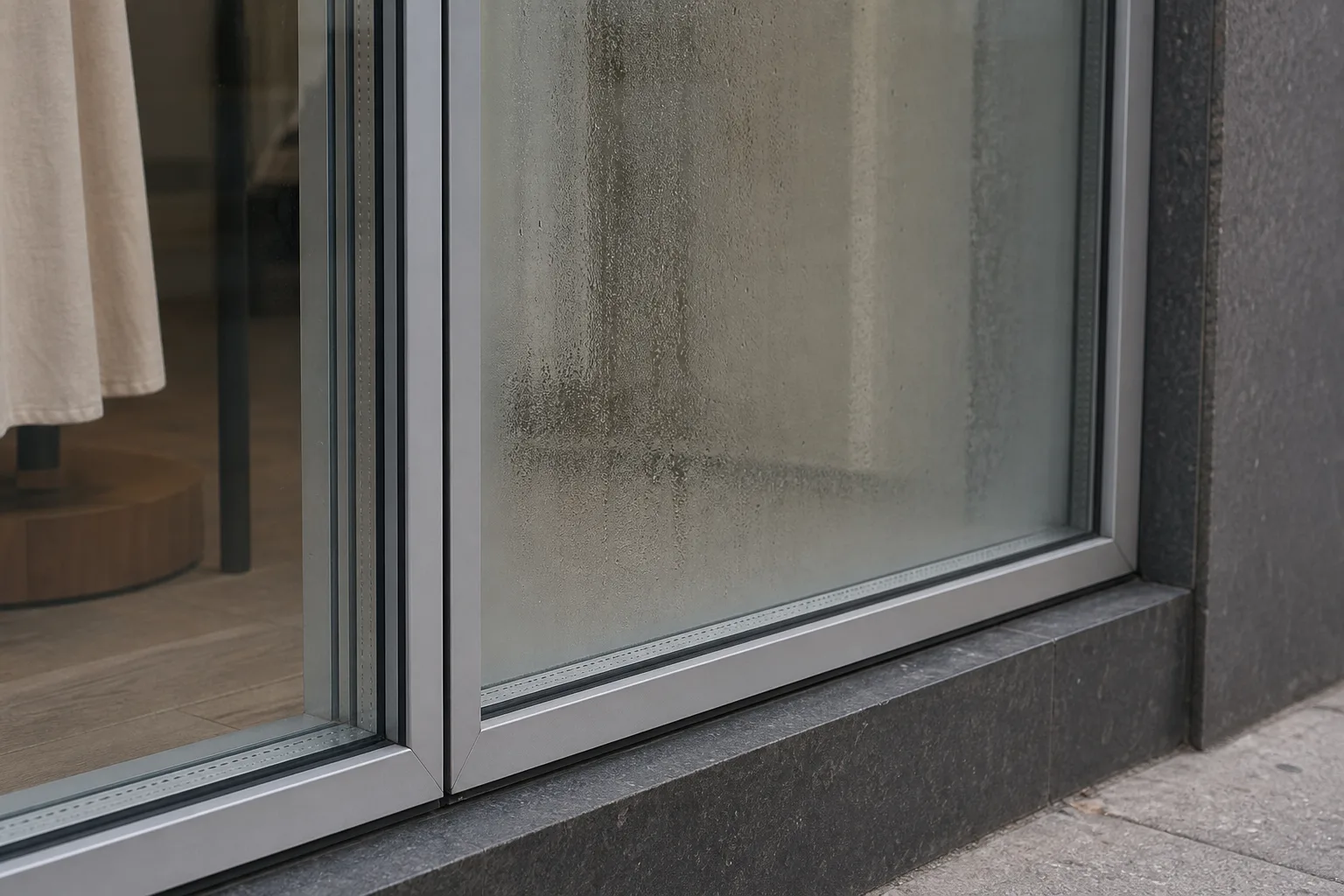
The call almost always comes in April or October. Not because glass fails on a schedule, but because that is when a building swings thirty degrees between dawn and mid-afternoon, and the haze inside a sealed unit finally becomes visible from the sidewalk. A tenant looks up, sees two panels in a twelve-panel storefront that no longer match the other ten, and starts looking for the company that installed them in 2018. The phone number rings to a disconnect notice. The entity shows as administratively dissolved with the Secretary of State. Nothing about that means the guarantee is gone.
Why the guarantee was split in two in the first place
An insulated glass unit, or IGU, is two or three panes held apart by a spacer and sealed at the perimeter, with the cavity filled by dry air or argon. When the industry moved toward these assemblies at commercial scale in the middle of the last century, the failure mode nobody had priced in was the seal itself. Once the perimeter seal loses integrity, moisture-laden air migrates into the cavity, the desiccant in the spacer saturates, and condensation appears between the panes where no one can wipe it away. The glass is not broken. It is not leaking into the building. It simply looks wrong, and its thermal performance quietly drops.
Seal failure is a manufacturing question, not an installation question, so the guarantee structure that settled into place separates the two. The fabricator who built the unit warrants the seal, typically for a fixed term running from the date of fabrication. The company that set the unit into the frame warrants its own labor: the glazing, the setting blocks, the gaskets, the sealant joints, the flashing details. Those two promises have different owners, different clocks, and very different survival odds. Standardized accelerated weathering tests gave fabricators a defensible basis for a long unit warranty, which is why a ten, fifteen or twenty year term on the sealed unit became ordinary while installer labor coverage is usually one or two years. The Federal Trade Commission oversees how written warranties are presented to buyers, and part of what that scrutiny produced is the plain separation you now see on the paperwork: the unit warranty names the fabricator, not the installer, as the party who owes you a replacement.
The narrow case: two hazed panels, one dissolved installer
Take the twelve-panel storefront. Two units on the south elevation are hazed. The general contractor who managed the 2018 buildout has moved on, the glazing subcontractor is dissolved, and the tenant's file contains one invoice with a line item that reads "storefront glazing, per plan." That invoice is close to worthless for warranty purposes because it names nobody who made anything.
What matters is the identity of the glass itself. Sealed units carry that identity in three places. First, most fabricators stamp or laser-etch a code into the spacer bar, visible if you look closely at the perimeter through the glass, often at a corner. Second, low-emissivity coated glass and tempered glass carry a permanent bug or logo etched in a corner of the lite, which identifies the primary glass maker and the tempering plant. Third, the shop drawings and glass order for the original job, if anyone kept them, name the fabricator outright. Any one of those three gets you to a company that is still in business and still honoring a warranty it wrote seven years ago, because fabricators are capital-heavy regional plants that outlast the small installation firms that buy from them.
What the fabricator pays and what it does not
Read the term carefully, because this is where expectations get set. A unit warranty on sealed glass almost always covers the replacement unit itself, freight to a distribution point, and nothing else. Removal of the failed unit, transport to the site, lifting equipment, new gaskets and sealant, traffic control if the panel faces a sidewalk, and after-hours labor if the tenant cannot close during business hours are all yours. On a ground-floor storefront panel that gap might be modest. On a fourth-floor curtain wall unit needing a lift and a lane closure, the labor is the entire cost of the job and the free glass is a rounding error.
That is the point at which you are hiring, not claiming. Fabricators will not send a crew, and they will usually decline to recommend one, so the replacement work goes out to commercial glass installers who handle warranty deglazing as ordinary volume and know how to receive a unit shipped against someone else's claim number. Ask specifically whether the firm will take the fabricator's measurements or insist on field-measuring the opening before the unit is built, because a unit ordered off old shop drawings and delivered a quarter inch out of tolerance costs you the whole lead time twice.
Where the calendar changes the number
Lead time on a made-to-order insulated unit runs weeks, and those weeks stretch in late spring and again in early fall, when commercial glazing demand peaks and fabricators are running full shifts against new construction. Filing a claim in January against a haze you noticed in October is often cheaper and faster than filing in May, because the plant is not backed up and installers have open days. Sealant and glazing tape also want moderate temperatures to cure properly, which argues for the shoulder weeks rather than a hard freeze or an August afternoon on a west elevation.
So the practical order is: identify the fabricator in the quiet months, open the claim before the season turns, and have the installer field-measure while the claim is in review. That sequence turns a twelve-week problem into a four-week one.
The file that makes this easy in year seven
On any new glazing work, ask for four things at closeout and store them where a future tenant can find them: the fabricator's name and the glass order confirmation, the written unit warranty with its start date, the shop drawings with opening sizes, and photographs of the spacer stamp on at least one installed unit. That packet costs nothing at handover and is the difference between a paid replacement and a full-price one later.
The installer who set your glass was one link in a chain, and the chain was built so that the loss of that link does not cost you the guarantee. Find the plant that made the unit, and the promise is still standing.
About the author
Wesley writes about timing, and why the same job costs differently in March.