Told You Have Forty-Eight Hours Before Mold? What the Clock Is Actually Counting
The famous 48-hour mold window is the least useful thing about the first two days after a water loss. Here is what the clock is really tracking, and what changed in how the work is billed.
| Author | Junko Halloran |
|---|---|
| Section | House & Home |
| Published | |
| Length | 1,349 words · 6 min |
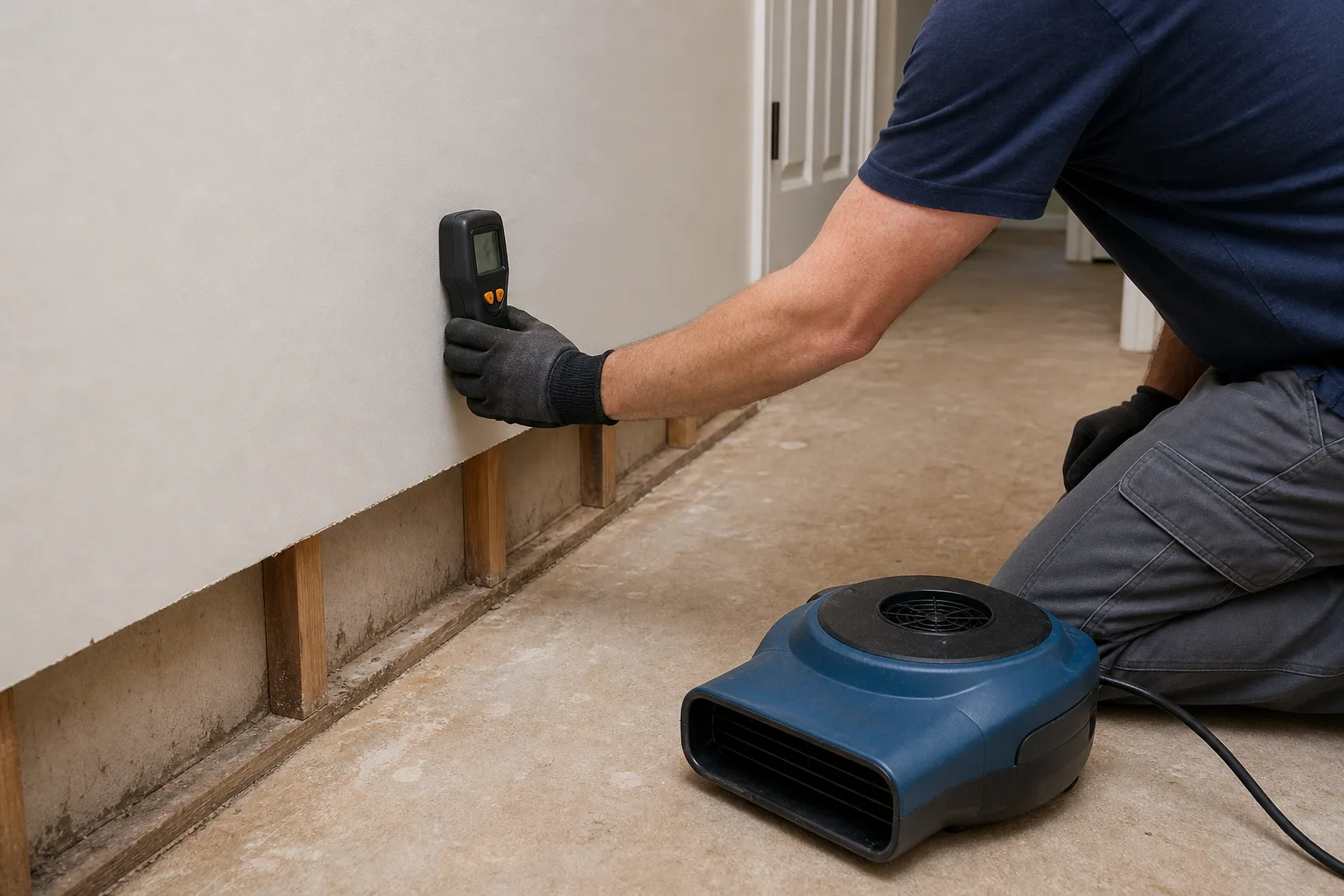
Almost everyone who has had a supply line fail has heard the same sentence from a technician standing in the hallway: you have about forty-eight hours before mold starts. It is repeated so often that homeowners treat it as the governing fact of the whole event, and they make decisions accordingly. They agree to demolition they did not need. They sign an authorization they have not read because the clock is running. They let the phrase do the work that a moisture reading should be doing.
The forty-eight hour figure is not wrong so much as it is the wrong variable to watch. Mold growth depends on temperature, on the material that got wet, and on how long that material stays above a moisture content where growth is possible. A soaked piece of unfinished pine in a warm, closed room behaves very differently from a damp concrete slab in a basement at sixty degrees. What the clock is really counting is something more specific, and it has direct consequences for what you are billed.
The clock is counting water category, not calendar hours
Restoration work classifies water by how contaminated it is. Clean water from a supply line, a water heater, or a melting ice maker is the least contaminated category. Water that has picked up contaminants on its way, such as discharge from a dishwasher or a washing machine, or water that has sat in contact with building materials and soil, sits in the middle category. Sewage and flood water from outside the building is the worst.
The category is not fixed. Clean water that sits in carpet cushion, wicks up drywall, and warms to room temperature stops being clean water. It degrades. That is the actual countdown, and it matters because the category determines the method. Clean water in a room found quickly can often be dried in place: equipment runs, the materials give up their moisture, and the drywall, the baseboard, and sometimes the carpet stay where they are. Once the same water is reclassified, porous materials that absorbed it are generally removed rather than dried, and removal is where the invoice changes shape. Drying is equipment and time. Removal is demolition, disposal, and then a rebuild that has to be estimated separately and scheduled around a drying schedule that has not finished yet.
So the useful question in hour one is not how many hours until mold. It is what got wet, how deep did it go, and is the water still clean. The Environmental Protection Agency is the federal body responsible for guidance on indoor mold and moisture, and the consistent thread in that area is the same one the restoration standard uses: control the moisture quickly and the biological problem does not get a chance to start.
What changed: the job is now documented as it happens
Ten or fifteen years ago a mitigation crew could arrive, make a judgment call, cut out four feet of drywall, run fans for three days, and send an invoice. The proof that the work was necessary was largely the technician's word.
That is no longer how the money moves. Insurers now expect a moisture log: initial readings on each affected material, daily readings at the same points, and a documented end point where the material reaches a dry standard taken from an unaffected area of the same house. They expect photographs at arrival, photographs of equipment placement, and a sketch or measurement of the affected area. Several things pushed this change at once. Estimating software made line-item pricing standard on both sides, so an adjuster reviews a mitigation invoice against the same database the contractor billed from. Meters that log readings to a phone made daily documentation cheap to produce. And a run of disputes over long equipment rentals gave carriers a reason to ask why a dehumidifier was still on site on day six.
The practical effect is favorable to a homeowner who understands it. If the readings are taken and recorded from the first visit, the case for the work is built into the file, and the mitigation invoice tends to move through review without a fight. If nobody took a reading on day one, there is no baseline, and the argument about whether three days of equipment were reasonable becomes a matter of opinion. Ask, in the first hour, whether readings are being logged and whether you can have a copy. A crew doing this properly will hand it over without hesitation.
The second change: in-place drying replaced automatic demolition
The other shift is in the equipment itself. Low-grain refrigerant dehumidifiers pull moisture from air at lower humidity levels than older units could, which makes it realistic to dry a wall cavity or a hardwood floor rather than remove it. Injection systems push dry air behind baseboard into stud bays through small holes. Floor mat systems pull moisture up through hardwood.
This is why a crew that arrives quickly may propose drilling a row of small holes behind the baseboard instead of cutting out the bottom of the wall. It costs less in total because the rebuild is a row of patched holes hidden by reinstalled trim rather than new drywall, tape, texture, and paint on every affected wall. It also takes longer in equipment days, and it only works while the water is still clean and the materials have not been saturated for days. That is the real deadline.
A worked example, and the parts of it that can be known
Take a half bath and the adjoining hallway, roughly 220 square feet of affected floor, where a toilet supply line let go while the house was occupied and was shut off within an hour. Clean water. Tile in the bath, carpet and pad in the hallway, drywall wet to about eight inches up on three walls.
The mitigation scope for that job is predictable in structure even though the dollars are not. You would expect: an emergency service call, extraction of standing water, carpet lifted and the pad removed and discarded, an antimicrobial application priced per square foot, some number of air movers (typically one per affected room plus one for each additional wall run) and one dehumidifier sized to the cubic volume, all billed per unit per day, plus a daily monitoring visit, plus equipment setup and takedown labor.
What that totals depends on the per-unit-per-day rate in your region, which varies enough that quoting a national figure would be misleading. It is knowable, though, and you should ask for it before the equipment is placed. The three numbers that decide the bill are the count of air movers, the count of dehumidifiers, and the number of days each runs. Get those three in writing on day one and the invoice on day five holds no surprises.
What you sign in the first hour
The document put in front of you at the door is usually a work authorization for emergency services. It is not the same as an insurance claim and it does not cap your exposure at the deductible. Read for two things: whether it authorizes only mitigation or also the rebuild, and whether it includes an assignment of benefits, which transfers your right to collect from the insurer directly to the contractor.
Assignment of benefits has been the subject of state legislative attention in recent years, with several states restricting or reshaping how these agreements work in property claims after disputes over billing. Rules differ by state and they have moved. If the form contains one, you are entitled to ask that it be struck and to authorize mitigation only, which keeps the invoice review between you and your carrier. Call the claim in before or while the crew works so the adjuster has the loss on file with the same day-one photographs the crew is taking.
The forty-eight hours are real. They are just not a countdown to mold. They are the window in which clean water stays clean, materials stay dryable, and the readings that justify every later line item still exist to be taken.
About the author
Junko covers what work costs and why two quotes for the same job differ.