Cold and Damp at the Same Time? Why a House Feels Clammy With the Cooling On
An air conditioner removes humidity as a side effect of cooling. When those two jobs come apart, a house ends up cold and damp simultaneously.
| Author | Corinne Adeyemi |
|---|---|
| Section | House & Home |
| Published | |
| Length | 802 words · 3 min |
Ask a service technician what the most common complaint of a humid July actually is and it is rarely a house that will not get cool. It is a house that gets cool and still feels wrong: sticky air, doors that stick in their frames, a basement that smells faintly of a cellar, condensation on a window in the morning. The thermostat says the system is working and in one sense it is. Cooling and dehumidifying are two jobs performed by the same machine, and when they come apart the house ends up cold and damp at once, which is an uncomfortable and entirely fixable condition.
The Oversized System Problem, Which Is the Usual Cause
An air conditioner removes moisture by running long enough for water to condense on a cold coil and drain away, which means run time is what dries a house. A system larger than the house needs satisfies the thermostat quickly and shuts off, so it runs in short bursts that drop the temperature without ever removing much water. That is why an oversized unit produces exactly the symptom people describe: fast cooling, clammy air. Equipment is frequently oversized because bigger feels safer at the point of sale, and the correction after the fact is not usually replacement but adjustment, including running the fan at a lower speed, which keeps the coil colder and pulls out more water per hour of operation.
Where the Moisture Is Coming From
A cooling system is fighting a supply, and the supply is worth identifying before anybody buys equipment to fight it harder. Ordinary living produces a surprising amount: cooking, showering, laundry, and simply breathing. Bathroom and kitchen fans that vent into an attic rather than outside are putting all of that back into the building. A crawlspace or basement floor with bare earth releases moisture continuously and a plastic vapor barrier laid over it costs very little. Damp entering through a foundation wall, gutters discharging at the wall, or a slow leak under a sink all add to the same total, and any of them will defeat a correctly sized system.
The Outside Air Question, Which Runs Both Ways
Opening windows on a July evening feels like drying a house out and is usually the opposite, since outdoor air in a humid climate carries more water than the conditioned air inside, and every hour of open window is an hour of that water arriving. Basements are the clearest case: a cool basement with the windows open in August collects condensation on every cool surface. The same logic applies to ventilating a crawlspace, which older guidance encouraged and which in humid regions has largely been reversed in favor of sealing and conditioning the space instead.
When a Dehumidifier Is the Right Answer, and Where It Goes
Where the cooling system is correctly sized and the moisture sources have been addressed, a dedicated dehumidifier is the appropriate tool rather than an admission of defeat. A portable unit handles a basement or a single problem room well provided it drains somewhere permanent rather than into a bucket somebody has to empty. A whole-house unit tied into the ductwork addresses the entire building and can run independently of cooling, which is what makes it useful in the shoulder seasons when the air is damp and nobody needs the temperature lowered. Both work. Only one of them helps a house where the whole floor plan is uncomfortable.
Measure Before Buying Anything, and What Is Actually at Stake
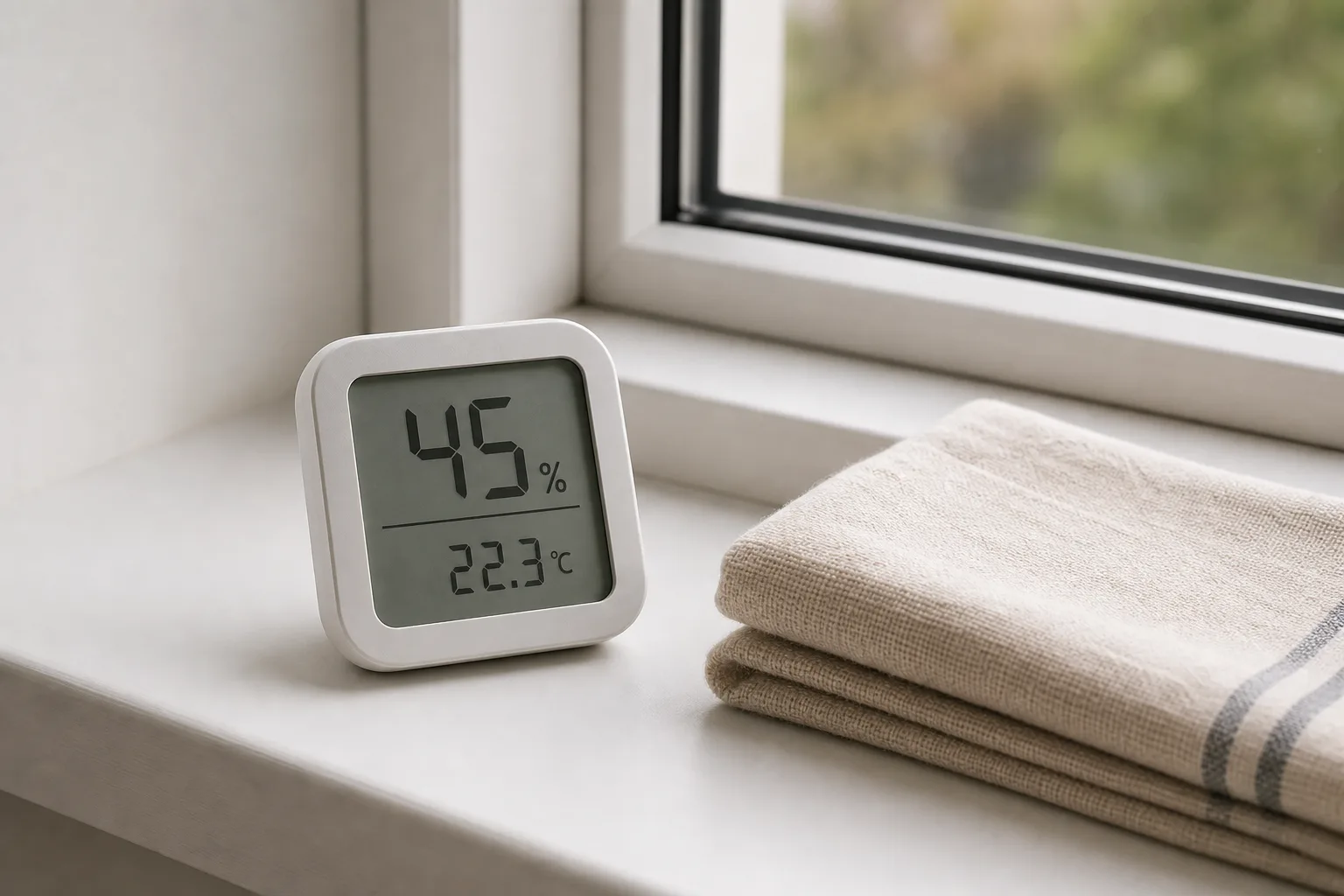
An inexpensive hygrometer settles most of this before any money is spent. Put one in the living space and one in the basement, read them over a week, and the picture usually explains itself. Indoor relative humidity in the range of the mid-forties to around fifty percent is the comfortable band, and readings well above it confirm the problem while readings inside it point elsewhere, most often to air moving across skin or a thermostat placed somewhere unrepresentative. Guidance published through the Environmental Protection Agency on indoor air treats controlling humidity as the primary way to prevent mold growth indoors, which is the reason this matters beyond how a room feels.
That is the part worth holding onto. A clammy July is unpleasant, and the same conditions that make a house uncomfortable are the ones that let mold establish itself in a closet, warp a wood floor at the seams, and make a finished basement smell like an unfinished one. All of it is measurable with a twenty-dollar instrument and most of it is correctable with a fan ducted properly, a sheet of plastic over a dirt floor, and a system allowed to run a little longer. The house that felt cold and damp in the first week of July is generally the same house feeling right by August.
About the author
Corinne writes for readers doing some of the work themselves.