A Windshield Chip in February, and Whether the Call Costs You at Renewal
How loss history databases turned a small glass claim into a permanent record, and what to establish before you give an insurer your policy number.
| Author | Wesley Tarbox |
|---|---|
| Section | Financial |
| Published | |
| Length | 1,300 words · 6 min |
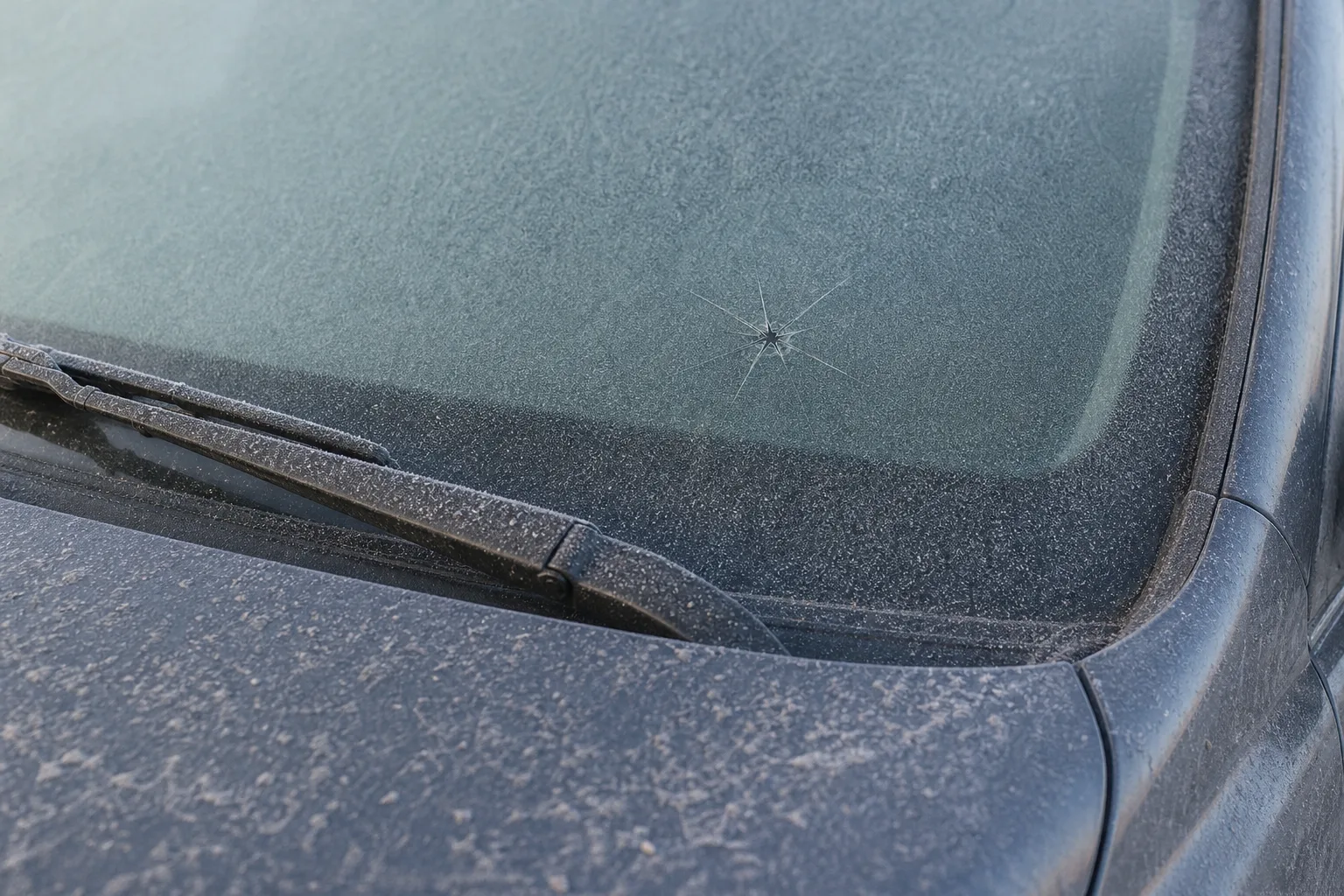
Road crews start spreading sand and grit the week the first hard freeze arrives, and for the next three months every vehicle on a treated road is driving through a low-grade shot blast. The chip usually arrives without ceremony. A tick on the glass somewhere near the passenger side, invisible until the light hits it, and then a short crack that grows a quarter inch every time the defroster fights a cold morning. At that point you have a decision that costs either nothing or a few hundred dollars, depending on your coverage, and a second decision underneath it that is harder to price: whether to involve the insurance company at all, and what the company will remember about it when your policy comes up for renewal.
That second question did not used to exist in any serious form. Understanding why it exists now is most of what you need to make the call correctly.
How a chip became a permanent record
For most of the twentieth century, what an insurer knew about your claims history was what its own files held and what you wrote on an application. If you moved carriers, the new company started close to blank. A local agent's judgment filled the gap. That system had obvious problems, chiefly that it rewarded people who shopped around after a bad year, and the industry solved it the way most industries solved information problems in the 1980s and 1990s: by pooling the data.
The result is a pair of shared loss history databases that nearly every personal auto and homeowners carrier contributes to and queries. They are consumer reports in the legal sense, which means the Federal Trade Commission oversees the federal fair credit reporting framework they sit inside, and which means you have the right to request your own file and dispute what is in it. Each entry records the date of loss, the type of loss, the amount paid, and the policy it attached to. The period insurers typically look at runs a few years back, not forever, though the file itself stretches further.
Two consequences follow, and they are the entire reason this topic requires care. First, the record travels with you. Switching carriers in March does not leave a February glass claim behind. Second, the record is created by the report, not by the payment. A file can exist showing a loss and a payment of zero. Underwriting systems that sort policyholders into rating tiers are reading structured data, and a zero-dollar entry still occupies a row.
What actually gets written down when you call
There is a meaningful difference between an inquiry and a claim, and the difference is not always obvious from your side of the phone call. An inquiry is a question: what would happen if, is this covered, what is my glass deductible. A claim is a reported loss with a claim number attached. In practice, many service representatives are trained to open a file as soon as a specific vehicle and a specific date of damage enter the conversation, because that is how their systems are built and because an opened file protects the company from a late-notice argument later.
So the useful habit, before you give a policy number, is to ask three things in order and to ask them in the abstract.
- Does my policy include glass coverage, and does it carry a separate deductible or a waived deductible for repair rather than replacement?
- If I report a glass loss, is it recorded as a comprehensive claim, and does this company surcharge or re-tier on comprehensive losses?
- Are we currently having a conversation that creates a claim number, or not?
The third question is the one people skip. Ask it plainly. If the answer is that a file is already open, ask what it will show if no money is paid, and whether a claim closed without payment is reported to the shared databases. Carriers differ on this, and the representative may need to check. Let them check.
The carve-outs that exist specifically for glass
Glass has been treated as a special case for decades, for a practical reason: a chip repaired in week one costs a fraction of a windshield replaced in week four, and a cracked windshield is a safety problem that gets worse on its own. Insurers worked out early that a deductible discourages the cheap fix and guarantees the expensive one. Several states went further and wrote the arithmetic into law. Florida, Kentucky and South Carolina have long required carriers to cover windshield replacement without applying the comprehensive deductible for drivers who carry comprehensive coverage. Many other states do not mandate it, but a large share of carriers offer full glass coverage as an endorsement that costs a modest amount per term and waives the deductible for repair.
Separately, a number of states restrict how insurers may rate on losses the driver did not cause. Comprehensive claims, which cover damage that is not a collision, often sit inside those restrictions, and some states specifically bar surcharging for glass-only losses. This is state insurance law, not a company policy, so the answer where you live is knowable. Your state's department of insurance publishes consumer guidance on rating practices and will answer the question by phone.
What those protections generally do not touch is tier placement and discounts. A claims-free discount is a discount, not a surcharge, and losing one raises your premium just as effectively. That distinction is the single most common surprise at renewal.
Why the calendar changes the answer
Most personal auto policies run in six-month terms, which means your rate is recalculated twice a year rather than once. A loss reported in February lands squarely inside the experience period for the term that renews in spring and for several terms after that. A chip that appears in late winter also arrives at the worst moment for repair capacity: glass shops see their heaviest volume as the grit season ends and the thaw begins, and mobile appointment windows stretch from days to a week or more in that stretch.
This argues for speed on the repair and deliberation on the claim. A resin repair performed within a few days, while the break is still clean and dry, holds better than one performed after a month of road salt and water intrusion. Many shops will quote a cash price for a chip repair that is low enough to make the insurance question academic. Get that number first. If it is less than your deductible, or close to it, the decision resolves itself and nothing enters the shared record at all.
If the crack has already run and you are looking at a full replacement, the calculation changes, and this is where full glass coverage earns its keep. A driver who added the endorsement in the fall is making a zero-deductible claim that their state may prohibit the carrier from surcharging, which is close to the clean outcome the coverage was designed to produce.
Setting yourself up before the next freeze
The move that pays is made in October, not February. Pull your declarations page and find the comprehensive deductible and whether a glass endorsement is listed. Ask your agent what a glass-only loss does to your tier and to your claims-free discount at that specific company. Request your own loss history file once a year so you know what a new carrier would see if you shopped. None of this takes an afternoon, and all of it is easier to do when nothing is cracked and nobody is waiting on an answer.
Then, when the tick on the glass arrives on some cold morning in the middle of grit season, the only question left is how fast you can get the resin in.
About the author
Wesley writes about timing, and why the same job costs differently in March.